°C
°C
 4
Min
4
Min
BUCHAREST, Romania (AP) – Romania’s pro-European coalition collapsed Tuesday after lawmakers voted against Prime Minister Ilie Bolojan, less than a year after he was sworn in, triggering fresh turmoil in the European country.
Romania’s pro-European coalition collapses after prime minister fails a no-confidence vote
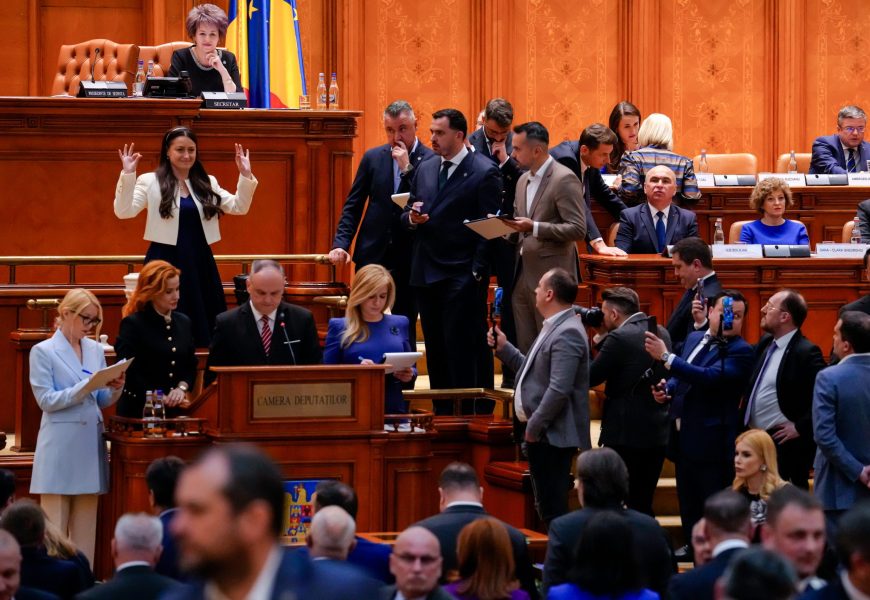

BUCHAREST, Romania (AP) - Romania's pro-European coalition collapsed Tuesday after lawmakers voted against Prime Minister Ilie Bolojan, less than a year after he was sworn in, triggering fresh turmoil in the European country.
The no-confidence vote was a blow to Bolojan, who came to power with the aim of ending one of Romania's worst political crises in its post-communist history.
The Social Democratic Party, or PSD, and the nationalist opposition Alliance for the Unity of Romanians party, or AUR, jointly submitted the motion to Parliament on April 28. PSD withdrew from the coalition last month. On Tuesday, 281 lawmakers voted in favor and four voted against.
Lawmakers from Bolojan's National Liberal Party, or PNL, and coalition partners, Save Romania Union party and the small ethnic Hungarian UDMR party, abstained.
Romanian President Nicusor Dan called for calm on Tuesday, saying that while it is "not a happy moment ... it is a democratic decision by Parliament," and that negotiations and informal consultations to form a new government are underway.
"We will have a new government within a reasonable time," Dan said. "I exclude the scenario of early elections. And I emphasize: at the end of these procedures, we will have a pro-Western government - we will calmly get through this."
Romania has faced a long period of instability after the annulment of a presidential election in December 2024. The country has also grappled with one of the highest budget deficits in the European Union, rampant inflation, and a technical recession. In June, when the coalition was voted in, it pledged to reduce the budget deficit, marking it a top priority.
The PSD had often found itself at loggerheads with Bolojan over austerity measures, including tax hikes, public-sector wage and pension freezes, and cuts to state spending and public administration jobs.
Last week, the party accused Bolojan of "failing to implement any genuine reform" in his 10 months leading the government, and said Romania needs a leader who is "capable of collaboration." Bolojan said that he took tough but necessary fiscal measures that effectively "regained the trust of the markets in the Romanian government."
Bolojan also called the no-confidence motion "cynical and artificial" and said before the vote that it "seems to be written by people who were not in government every day and did not participate in all the decisions."
"It is cynical, because it does not take into account the context in which we find ourselves," he said. "I assumed the position of prime minister, being aware that it comes with enormous pressure and that I would not receive applause from the citizens. But I chose to do what was urgent and necessary for our country."
The PSD party's president, Sorin Grindeanu, said Bolojan should appoint an interim prime minister until one is voted into office by lawmakers. He also said he expected Romanian President Nicusor Dan to consult PSD.
"I would like us to quickly find a solution ... together with the other parties and move forward," Grindeanu said. "All options are open."
The secretary-general of Bolojan's party, Dan Motreanu, posted on social media, saying PSD and AUR "have a duty to take over the government, to come up with a prime minister candidate and a clear program," accusing the two parties of "playing political theater."
"You cannot overthrow a government and then run away from accountability," Motreanu wrote, adding that "any signal of political chaos" negatively affects the country's economy and people.
The PSD would be needed to form a pro-European parliamentary majority. The party has previously ruled out forming a government with AUR, whose leader, George Simion, said Tuesday that voters had "supported and wanted water, food, energy," but had "received taxes, war and poverty."
Cristian Andrei, a Bucharest-based political consultant, said the crisis will likely lead to a stalemate, since "no one has a majority, or a coalition, and it will take the president ... weeks to find such a majority and name a new prime minister, prolonging the indecision."
"At this moment, there are two tentative options for a new Cabinet, both difficult to achieve; either a reshuffled coalition, without Bolojan, in the same formation ... or a minority Cabinet, rather led by PSD and satellites from populist parties, like AUR, or other small groups," he said. "A PSD-AUR official Cabinet is not a possibility today because the president will not endorse it."
The prime ministerial position was set to be rotated in 2027 from Bolojan to a PSD premier as part of a power-sharing agreement. A general election is scheduled for 2028.
More Top Stories