°C
°C
 3
Min
3
Min
STOCKHOLM (AP) – Alva Palosaari Sundman scoured the racks of secondhand clothes in Stockholm for hours in search of the right pair of pre-owned jeans.
Sweden’s secondhand clothing swaps offer a trendy way to cut environmental waste
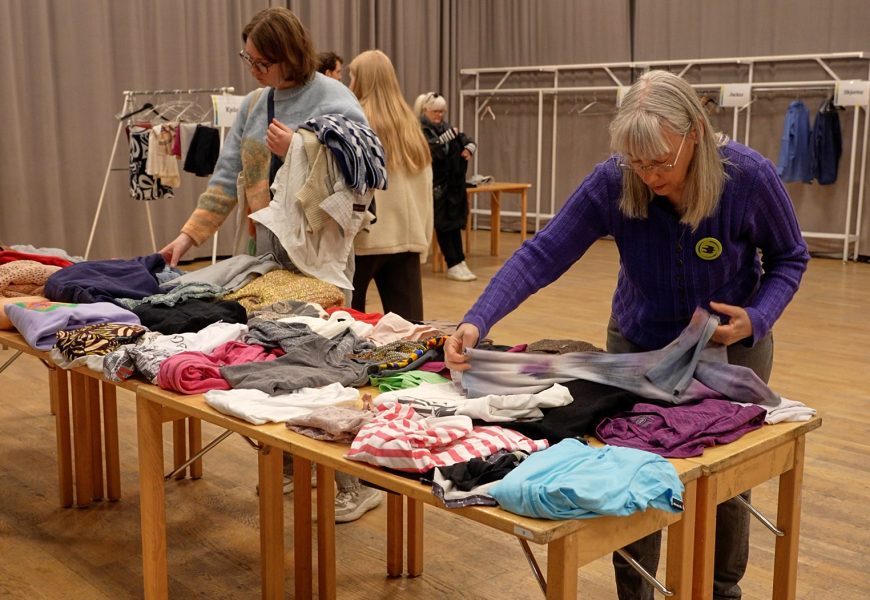

STOCKHOLM (AP) - Alva Palosaari Sundman scoured the racks of secondhand clothes in Stockholm for hours in search of the right pair of pre-owned jeans.
The 24-year-old art student was among hundreds of people attending an annual clothing swap on Sunday at a community center in Sweden's capital. They exchanged their own clothes to "shop" for others. Similar events drew thousands across the country to reduce the environmental cost of clothing production.
Palosaari Sundman said she enjoyed seeing others pick out the clothes she'd brought.
"It's like, 'Oh, OK, it gets a new life with this person,'" she said. "It just feels a bit more humane."
The UN Environment Programme cites fast fashion as major player in environmental damage, producing up to 10% of the world's carbon emissions. Discarded clothes gorge landfills that scar landscapes in developing countries, and the plastic fibers used to make cheap fabrics pollute oceans.
To produce a pair of jeans, for example, roughly 2,000 gallons (7,571 liters) of water is required, UNEP has said.
Sweden's clothing swap initiative began in 2010 and has grown. Last year, some 140,000 people participated in 140 swap events and took home more than 44,000 pre-owned items.
Sweden is often seen as environmentally advanced, but the reality is more nuanced. Clothing consumption contributes to roughly 3% of a Swede's total emissions, according to Mistra Future Fashion, a research institute.
Swedes last year were banned from throwing away clothes in the regular trash in a European Union bid to boost recycling. But the measure backfired when municipalities' collection sites were overwhelmed, leading to stockpiles of unused textiles, and the government reversed part of the rule in October.
The swap events are organized by the Swedish Society for Nature Conservation. Its chair, Beatrice Rindevall, said each Swede throws away around 9-10 kilograms (20-22 pounds) of clothes.
Swedes on average buy around 25 new items of clothing per year, according to the society, and 90% of items in wardrobes are never used.
"We have to be more careful and we have to think about our consumption," said Cecilia de Lacerda, one of the society's volunteers in Stockholm.
At the swap events, tailors helped shoppers repair clothes to extend their life span.
"A lot of people don't have sewing machines anymore, or they don't quite know how they should fix that buttonhole that broke," said Meg Goldmann, another volunteer.
For high school student Alice Dundeberg, 19, secondhand clothes allow her to have a unique style.
"You don't find multiple types of the same shoes, pants or sweater," she said. "No one has the same clothes as the others."
More Top Stories