°C
°C
 5
Min
5
Min
Russia’s traditional parade marking the defeat of Nazi Germany in World War II will take place next week without tanks, missiles and other military equipment, the Russian Defense Ministry said in a statement. It will be the first time in nearly two decades that no military equipment will rumble through Moscow’s Red Square on May 9.
Russia to hold a Victory Day parade without military equipment for the 1st time in nearly 2 decades
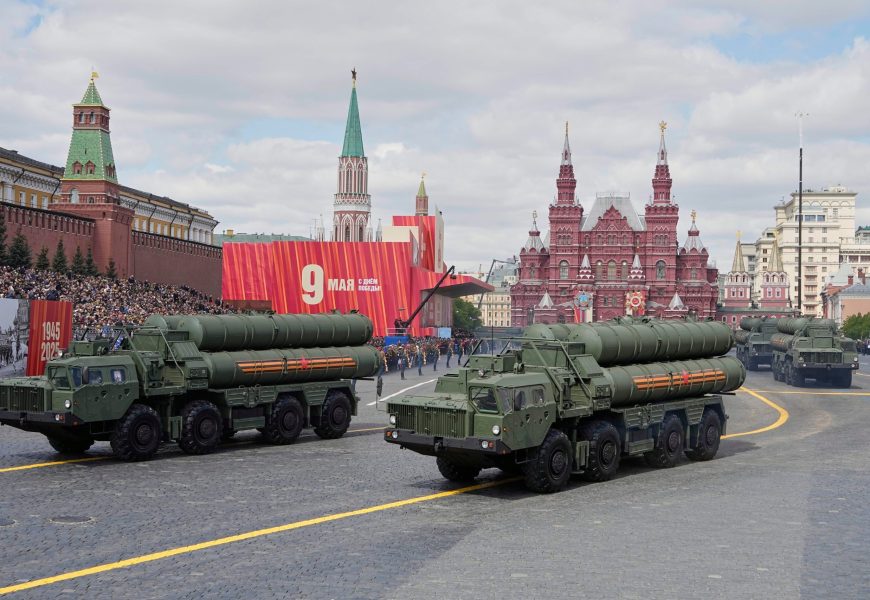

Russia's traditional parade marking the defeat of Nazi Germany in World War II will take place next week without tanks, missiles and other military equipment, the Russian Defense Ministry said in a statement.
It will be the first time in nearly two decades - and in Russia's 4-year-old war in Ukraine - that no military equipment will rumble through Moscow's Red Square on May 9, the day Russia celebrates its most important secular holiday. The Kremlin has used it to showcase its military might and global clout, and it is a source of patriotic pride.
Victory Day parades on Red Square have involved military equipment and various weaponry every year since 2008. Smaller parades are held elsewhere across the country, including in cities like St. Petersburg.
The ministry cited the "current operational situation" as a reason for excluding military equipment, as well as cadets, from this year's parade on the 81st anniversary of the victory. Ukraine has launched drone attacks deep inside Russia to counter Moscow's more than 4-year-old invasion.
While the ministry did not elaborate, Kremlin spokesman Dmitry Peskov on Wednesday blamed Ukraine, accusing it of "terrorist activity," in an apparent reference to the drone strikes. In recent months, attacks have reached locations deep inside Russia, like the Baltic port of Ust-Luga to the north of Moscow, the Samara region near the border with Kazakhstan, and the Perm region in the Ural mountains.
"All measures are being taken to minimize the danger," he told reporters.
The parade will feature "servicemen from higher military educational institutions of all kinds and certain service branches of the Russian Armed Forces" and a traditional military aircraft flyover, the ministry said.
Russian President Vladimir Putin told U.S. President Donald Trump in a phone call later Wednesday that he was ready to declare a ceasefire with Ukraine for the Victory Day holiday, according to presidential adviser Yuri Ushakov.
Ushakov said the Trump had supported the idea as the holiday marked "our common victory over fascism" in World War II.
World War II remains a rare point of consensus in the nation's divisive history under Communist rule, and the Kremlin has leveraged that sentiment to encourage national pride and underline Russia's position as a global power.
The Soviet Union lost 27 million people in what it calls the Great Patriotic War in 1941-45, an enormous sacrifice that left a deep scar in the national psyche.
President Vladimir Putin, who has ruled Russia for over 25 years, has turned Victory Day into a key pillar of his tenure and has tried to use it to justify the war in Ukraine.
"Traditionally, the parade of tanks, missile systems and other military hardware across Red Square has been central to these celebrations, providing powerful optics and reinforcing Russia's image as the heir to Soviet victory in World War II," said Natia Seskuria, associate fellow with the Royal United Services Institute.
"Removing this important element weakens the propaganda value of the event, particularly for domestic audiences, as it reduces one of the most visible symbols of Russian power and military prestige," she told The Associated Press.
Security concerns are the most likely explanation, Seskuria said.
But there also could be practical military considerations, "including the need to preserve equipment, avoid highlighting battlefield losses, and reduce the exposure of valuable military assets," she said,
"This decision signals a degree of vulnerability rather than strength, because even last year, Russia demonstrated a range of new tanks and drones in front of invited world leaders," Seskuria added.
Last year's parade on the 80th anniversary was the largest since Russia sent troops into Ukraine, and drew the most global leaders to Moscow in a decade, including high-profile guests like Chinese President Xi Jinping, Brazilian President Luiz Inácio Lula da Silva and Slovakia's Prime Minister Robert Fico.
Fico will attend this year, too, along with other foreign dignitaries, Putin aide Yuri Ushakov said Wednesday.
It featured over 11,500 troops and more than 180 military vehicles, including tanks, armored infantry vehicles and artillery used on the battlefield in Ukraine, as well as huge Yars nuclear-tipped intercontinental ballistic missiles as well as drones carried on military trucks. Fighter jets flew over Red Square, too.
Putin had declared a unilateral 72-hour ceasefire starting May 7, 2025, and authorities blocked cellphone internet in Moscow for several days to avert Ukrainian drone attacks.
In 2023, the parade was scaled down, with fewer troops and military equipment on display and no flyover.
In the Soviet era, the first Red Square parade marking the defeat of Nazi Germany took place on June 24, 1945. Then it was held on May 9 several times after that, with the last Soviet-era parade taking place in 1990.
After the USSR collapsed, the parades resumed in 1995. That year, troops and veterans marched through Red Square, and a separate parade of military equipment took place at the sprawling Poklonnaya Gora World War II memorial. After that, parades were held every year. In 2020, amid the COVID-19 pandemic, authorities moved the parade to a later date, and it was held on June 24.
More Top Stories