°C
°C
 4
Min
4
Min
Large chunks of ice rammed into homes along Michigan’s Black Lake in the northeastern Lower Peninsula as constant spring rainfall and winter melt left many homes flooded and threatened to overflow stressed dam systems.
Heavy rain and snowmelt are hurtling large chunks of ice into northeastern Michigan homes
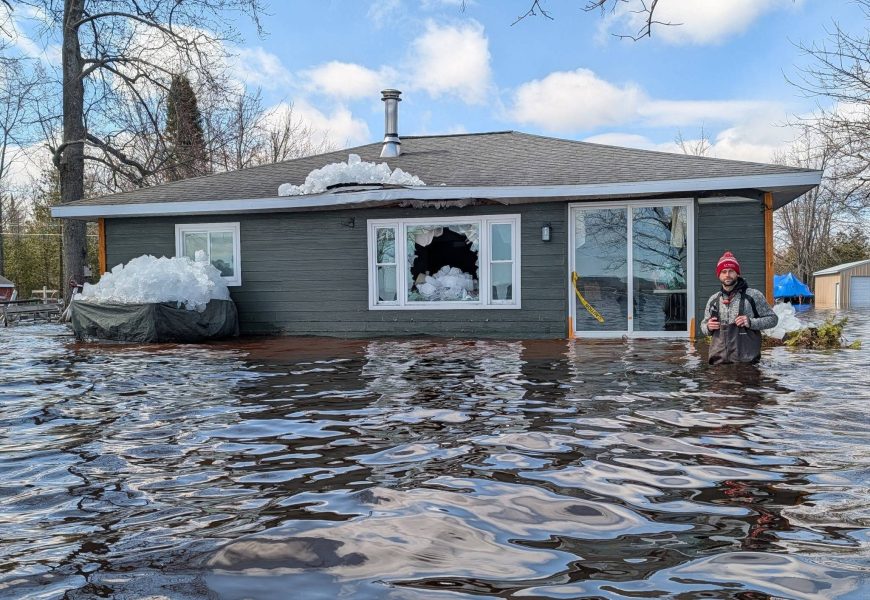

Large chunks of ice rammed into homes along Michigan's Black Lake in the northeastern Lower Peninsula as constant spring rainfall and winter melt left many homes flooded and threatened to overflow stressed dam systems.
Photos and video posted to social media Wednesday showed ice sitting inside living rooms after it busted through windows and doors. Homes, garages and sheds could also be seen surrounded by several feet of muddy, brown river and lake water.
Spring rains and winter snowmelt have swelled rivers and lakes, forcing torrents of water through Cheboygan County communities on its way to Lake Huron.
"Black Lake, Black River, Cheboygan River, Burt Lake, Mullett Lake, the Sturgeon River - and nearly every waterway in the county - have overflowed beyond their banks, swallowing docks, roads, yards, and in far too many cases, homes," the Cheboygan County sheriff's office told residents last week on its Facebook page. "What should be familiar shorelines are now unrecognizable expanses of water."
Homes along Black Lake's west side were evacuated over the weekend, according to the sheriff's office.
"These are ice sheets. They're massive," said Christopher Narsesian, who took photos and video of the damage. "They're mini glaciers, if you will. They just run down everything in their path. Nothing can stop that kind of weight."
State and county officials are working to keep debris and ice from clogging the Cheboygan Lock and Dam Complex to allow water to flow on to Lake Huron.
If water levels were normal, lake ice would just break up in place as it melts, according to Patrick Bak, a meteorologist with the National Weather Service in Gaylord, Michigan.
The ice on Black Lake, more than likely, was pushed ashore by the wind, he added.
"The fact that the water was so high, the ice ... had more room to travel," Bak said.
Ice chunks were also moving through nearby Mullett Lake. Both lakes feed into the Cheboygan River, with water flowing through the Cheboygan Dam.
"We've managed a little bit of ice issues on Mullett Lake," said Patrick Ertel, a spokesman for the Michigan Department of Natural Resources Incident Management Team.
Last week, crews added pumps, and power was restored to an old hydroelectric station to increase water flow through the dam. Cranes also were used to remove gates that hold back water.
A large chunk of ice snapped the safety cable at the Cheboygan Lock and Dam Complex on April 9, forcing the natural resources department to close access points upstream and downstream of the dam.
"We can't have large chunks of ice flowing down blocking up the gates," Ertel said. "Two marine vessels are kind of breaking up the chunks ... on the Cheboygan River. The more water we can safely pass at the Cheboygan Dam, the faster we can bring relief to Mullet Lake. It's going as fast as it can. It is purely driven by gravity."
The smaller Alverno Dam is between Black Lake and the Cheboygan River.
"Ice from Black Lake is not going to make it down to the Cheboygan River. It will be held up," Ertel said.
Gov. Gretchen Whitmer has declared a state of emergency in Cheboygan and more than 30 other Michigan counties due to flooding and other severe weather this month.
Narsesian lives near Cheboygan and grew up along Black Lake.
Slabs of ice, which he described as a "several-mile-wide sheet," continue to float in the lake. He said the ice is "smashing into homes and taking them out, just leveling them." He said some ice was pushed as high as rooftops.
"We've never seen it that high," Narsesian said. "Typically, the ice would just come over the break walls in front of houses, like a couple of feet. People's homes don't typically flood. The ice just melts."
Water is receding, but Narsesian said levels are still high and the ice still is out there.
"As long as the wind doesn't pick up and move that around again, we should be OK," he said. "If that ice does come back, it's going to do more damage."
It's the aftermath that concerns him most for the community where it's "all friends and family" and "everybody knows everyone," Narsesian said.
"Most people don't have any help - coverage," he added. " Flood insurance was never necessary. No one's ever seen this here. It's a lot."
More Top Stories