°C
°C
 5
Min
5
Min
WASHINGTON (AP) – President Donald Trump’s vow to shrink America’s military deployment in Germany has put a new spotlight on the U.S. role in Europe.
What to know about the US military presence in Europe as Trump seeks drawdown of thousands of troops
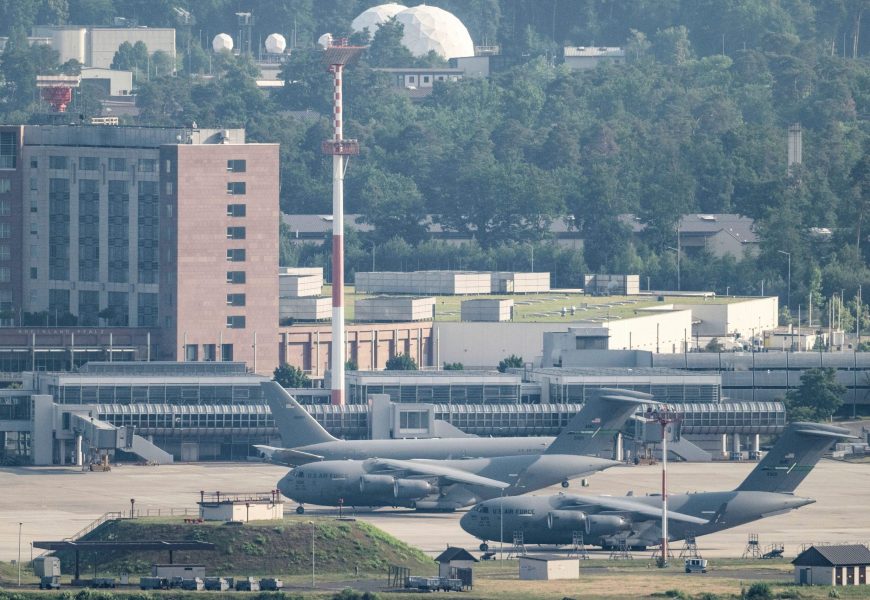

WASHINGTON (AP) - President Donald Trump's vow to shrink America's military deployment in Germany has put a new spotlight on the U.S. role in Europe.
There are usually 80,000 to 100,000 troops on the continent, with more than 36,000 in Germany. The Pentagon announced Friday that it would remove 5,000 troops from Germany, and Trump said the next day that he would go "a lot further" than that.
The U.S. military presence is a legacy of World War II, when Americans helped stabilize and rebuild Europe, and the Cold War, when the troops served as a bulwark against Soviet expansion. More recently, the deployment has played a key role supporting operations in the Arctic, Africa and the Middle East including the current conflict with Iran.
But Trump has broken with years of bipartisan consensus, criticizing European allies in NATO and following through on threats to reduce the U.S. commitment to the continent's security. The recent announcement comes after escalating tensions with German Chancellor Friedrich Merz, who last week said the U.S. was being "humiliated" by Iran and accusing Washington of lacking a clear strategy.
Here's a look at America's current deployment in Europe and how it could change.
The U.S. European Command, created in 1947 and known as EUCOM, is one of 11 combat commands within the Defense Department, and covers some 50 countries and territories.
In addition to more than 36,000 troops in Germany, Italy hosts more than 12,000 and there's another 10,000 in the United Kingdom, according to Pentagon numbers from December.
The Pentagon has offered few details about which troops or operations would be affected in the drawdown announced Friday.
The U.S. increased its European deployment after Russia launched its full-scale war on Ukraine four years ago. NATO allies like Germany have expected for over a year that these troops would be the first to leave.
Aside from its role as a deterrent to Russia, the U.S. military presence in Europe helps Washington project power across the globe.
U.S. Gen. Alexus Grynkewich, who is the commander in Europe of both U.S. and NATO forces, reinforced the benefits of a strong footprint on the continent to the Senate Armed Services Committee in March.
"It is having capabilities in Europe, munitions in Europe that allow us to help U.S. Africa Command to target terrorists in Africa, or to help U.S. Central Command as they execute Operation Epic Fury," he told lawmakers, referring to the Iran war. "The distances are shorter, it's less expensive and it's much easier to project power."
Germany hosts the headquarters of the U.S. European and Africa commands, Ramstein Air Base and a medical center in Landstuhl, where casualties from the wars in Afghanistan and Iraq were treated. U.S. nuclear weapons are also stationed in the country.
The U.S. has approximately 100 nuclear bombs deployed to bases in Europe that would be delivered by aircraft, according to a March estimate from the Federation of American Scientists. The group's report said the bombs are at bases in Belgium, Germany, Italy, the Netherlands and Turkey, while it's possible they're also at a base in the United Kingdom.
Even before Trump's comment Saturday to reporters, Republican leaders of both armed services committees in Congress expressed concern about the Pentagon plan, warning a premature drawdown in Europe would send "the wrong signal to Vladimir Putin" as the Russian president continues his war in Ukraine.
Sen. Roger Wicker of Mississippi and Rep. Mike Rogers of Alabama said troops should be shifted to bases in Eastern Europe rather than withdrawn.
The lawmakers also said allies have made "substantial investments to host U.S. troops."
Wicker and Rogers said the Pentagon, following its announcement Friday, has also decided to cancel the planned deployment to Germany of one of the U.S. Army's long-range fires battalions, which operate ground-launched missile systems.
As part of its National Defense Strategy announced in January - a sweeping document laying out a vision on everything from deterring China to defending against cyberattacks to disrupting Iran's nuclear ambitions - the administration said Europe must do more for its own defense.
While "we are and will remain engaged in Europe, we must - and will - prioritize defending the U.S. Homeland and deterring China," it said.
Among other things, the document noted that Europe's economic power, while shrinking in relative terms globally, remains significant, and said that Germany's economy alone "dwarfs that of Russia."
"Fortunately, our NATO allies are substantially more powerful than Russia - it is not even close," it said, noting a recent commitment among NATO allies to raise national defense spending to 5% of GDP in total, a push led by Trump.
Germany has moved to modernize its long-neglected military, or Bundeswehr, since Russia's invasion of Ukraine in 2022. That year, it set up a 100 billion euro ($117 billion) special fund to boost Bundeswehr, much of which has been committed to procuring new equipment.
Late last year, Merz's government announced plans to raise the number of military personnel to 260,000, up from about 180,000. In 2001, when Germany still had conscription, the headcount was 300,000 - more than a third of them conscripts.
Berlin says it will also need around 200,000 reservists, more than double the current figure.
Defense Minister Boris Pistorius, in comments to German news agency dpa after the Pentagon's drawdown plan was announced Friday, acknowledged that Europe must take more responsibility for its own security - and said the Bundeswehr is growing, military equipment is being procured more quickly, and infrastructure is being developed.
___
Keaten reported from Geneva.
More Top Stories