°C
°C
 5
Min
5
Min
BEIRUT (AP) – Fierce fighting rocked the strategic southern Lebanese town of Bint Jbeil on Monday, as Israeli troops appeared to encircle the area while Hezbollah militants launched rockets and artillery in an effort to push them back.
Israel and Hezbollah clash in strategic Lebanese village ahead of official talks
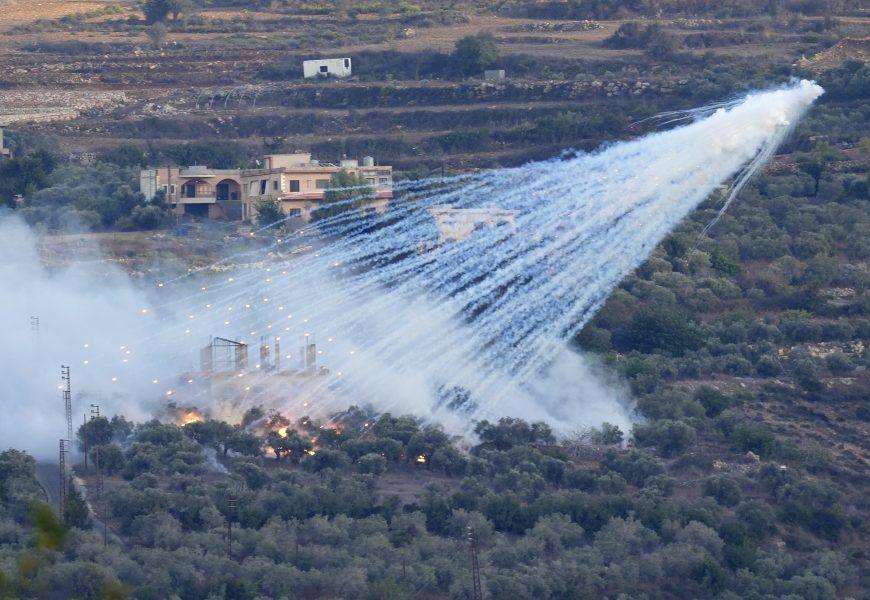

BEIRUT (AP) - Fierce fighting rocked the strategic southern Lebanese town of Bint Jbeil on Monday, as Israeli troops appeared to encircle the area while Hezbollah militants launched rockets and artillery in an effort to push them back.
The clashes in the hilly town that overlooks the U.N.-mandated Blue Line dividing the two countries just over 2 miles (3.2 kilometers) away have intensified over the past week, after Iran and the United States agreed to a temporary truce. On Tuesday, Lebanon and Israel's ambassadors to the U.S. are set to meet in Washington for an in-person meeting in a bid to kick off a landmark series of direct negotiations.
Israel has scaled back its attacks in Lebanon, especially in Beirut, after a series of deadly strikes without warning hit the heart of the capital in some of its busiest residential and commercial areas, killing over 350 people.
At the same time, Israel appears to have stepped up strikes and ground invasion in southern Lebanon, where it intends to create a security zone along the Litani River, almost 20 miles (32 kilometers) from the border. Bint Jbeil is among dozens of towns and villages south of the river that Israel called to evacuate early on in the war. The latest round of fighting was sparked by Hezbollah firing rockets into northern Israel on March 2, in solidarity with Iran.
At least 2,055 people have been killed in Israeli strikes in Lebanon, the Health Ministry said, among them 252 women, 165 children, and 87 medical workers, while 6,588 were wounded.
Lebanon's state-run National News Agency has reported Israeli ground forces making their way into the town with most of the exit roads cut off. Local media reported dozens of Hezbollah gunmen were largely encircled.
The Israeli military said its troops surrounded Hezbollah infrastructure and started ground operations in Bint Jbeil and surrounding areas, killing over 100 Hezbollah fighters. Hezbollah did not immediately announce any fatalities among its ranks, and Israel did not comment on its military casualties.
Hezbollah on Sunday claimed at least five attacks on Israeli troops in the town and outskirts with rockets, artillery and drones. According to the group's statements, Israeli troops were positioned near a school, a hospital and juncture that surrounds the heart of Bint Jbeil. That day, Israel said its troops attacked Hezbollah forces surveilling from the Bint Jbeil Government Hospital and found a cache of machine guns and rockets.
When Israel occupied southern Lebanon until its withdrawal in 2000, it had relied on Bint Jbeil and other elevated locations for strategic vantage points. A major turning point was Hezbollah retaking the hilly town, and the victory speech by then-Secretary General Hassan Nasrallah in a stadium there. The Israeli military on Monday shared a satellite photo showing the stadium apparently destroyed in a strike.
Israeli Prime Minister Benjamin Netanyahu said during a Cabinet meeting Monday that the military was expanding beyond the five hilltops it controlled in southern Lebanon since the ceasefire with Hezbollah in 2024, toward a "solid, deeper security zone." He said it was in order to protect northern Israel.
Elsewhere, a Lebanese Red Cross volunteer killed in an Israeli strike Sunday while on a mission in the southern village of Beit Yahoun was laid to rest in Choueifat, just south of Beirut.
Hassan Badawi, 31, and a colleague were going to a house that was struck by Israel a short drive from where they were stationed, his colleagues said at the funeral. Their trip was coordinated with the U.N. peacekeeping force in southern Lebanon, which liaises with the Israeli army, and they received the go-ahead, according to his colleagues. They drove in ambulances clearly marked with the Red Cross emblem, flashed their emergency lights and wore helmets and flak jackets, they said.
"That is the only protection we have," said Ahmad Assi, 29, another friend of Badawi and fellow paramedic.
Badawi often relayed the horrors he witnessed to friends and family while on duty. "He said they were bombing everywhere, that he felt stuck, like he had to stay because there were too many wounded people that needed his help," said Mohammed Cheito, one of Badawi's friends from Lebanese University, where they studied engineering together a decade ago.
On Monday, an Israeli strike near the entrance to Red Cross offices in the coastal city of Tyre killed a wounded person who was being transported, damaging several Red Cross vehicles. A person familiar with the matter said the strike targeted a man on a motorcycle transporting the wounded. It's unclear who either people were. The person spoke on condition of anonymity they weren't authorized to disclose the information.
The International Committee of the Red Cross urged for the protection of humanitarian and medical workers in a statement on Monday.
"Saving lives must never cost a life," said Agnès Dhur, head of the ICRC delegation in Lebanon. "They must be allowed to reach and help the wounded and return unharmed."
The Israeli military did not immediately respond to The Associated Press when asked for comment.
___
Associated Press writer Isabel DeBre in Choueifat, Lebanon and Melanie Lidman in Tel Aviv contributed to this report.
More Top Stories