°C
°C
 4
Min
4
Min
ROME (AP) – Top-ranked Aryna Sabalenka believes tennis players should organize a boycott if they don’t start receiving a bigger share of tournament revenues at the Grand Slams – and the likes of Coco Gauff, Elena Rybakina and Jasmine Paolini are prepared to protest, too.
No. 1 Sabalenka calls for boycott if players don’t get bigger cut of Grand Slam revenues
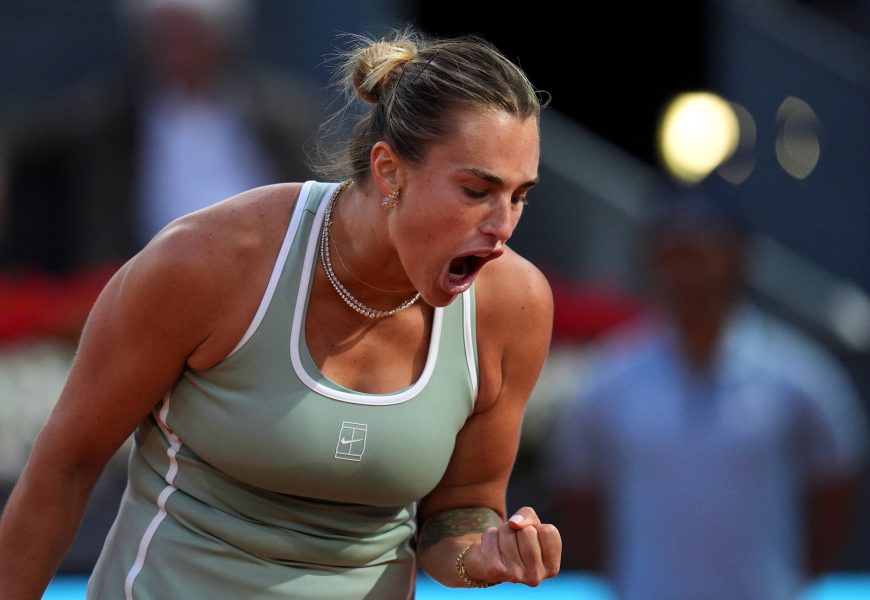

ROME (AP) - Top-ranked Aryna Sabalenka believes tennis players should organize a boycott if they don't start receiving a bigger share of tournament revenues at the Grand Slams - and the likes of Coco Gauff, Elena Rybakina and Jasmine Paolini are prepared to protest, too.
Sabalenka and fellow No. 1 Jannik Sinner were among leading players - most of them ranked in the top 10 - who issued a statement on Monday expressing "deep disappointment" over the French Open prize money.
"Without us there wouldn't be a tournament and there wouldn't be that entertainment. I feel like definitely we deserve to be paid more percentage," Sabalenka, a four-time Grand Slam champion, said on Tuesday at the Italian Open.
"I think at some point we will boycott it. I feel like that's going to be the only way to fight for our rights," Sabalenka added on her 28th birthday.
The players are also seeking better representation, health options and pensions from the four Grand Slam tournaments: Australian Open, French Open, Wimbledon and U.S. Open.
French Open organizers announced last month they were increasing overall prize money by about 10% for an overall pot of 61.7 million euros ($72.1 million), with the total amount up 5.3 million euros from last year. But the players' statement said "the underlying figures tell a very different story," claiming they will receive a smaller share of tournament revenues.
The players claim their share of Roland Garros revenue has declined from 15.5% in 2024 to 14.9% projected in 2026.
Gauff, the defending French Open champion, cited a landmark new WNBA collective bargaining agreement reached in March as an example of the benefit of working together.
"From the things I've seen with other sports, usually to make massive progress and things like this, it takes a union," Gauff said. "We have to become unionized in some way. ... We definitely can move more as a collective."
Regarding a boycott, Gauff said, "If everyone were to move as one and collaborate, yeah, I can 100% see that." But she added she hasn't heard of any discussions about a walkout.
"I definitely think there's a consensus around that this needs to be addressed for all players of all levels, especially the lower-ranked players, too," Gauff added. "I want to leave the sport better than I found it. If I can say I played my part when I retire, that's something I can be proud of."
Rybakina, a two-time Grand Slam champion who won the Australian Open this year, would follow the other players.
"If the majority say we are boycotting, we are not playing, then of course I'm up for it," Rybakina said. "It's not only on the Grand Slams and it's not only about raising the prize money. A lot of people are not aware that there is taxes which are big. You even make more prize money, but you giving it all to the taxes."
Paolini, the Italian who reached the final of the French Open and Wimbledon in 2024, also believed in a boycott option.
"If we're all in agreement and I think we are - the men and the women are united right now - it's something we could do," Paolini said.
Paolini added that the WTA and ATP Tours - which organize all of the other tournaments - have done more than the Grand Slams to provide players with benefits, such as maternity leave, and retirement plans.
"There's a lot of things that the Slams are not doing," Paolini said, "that the WTA and I think the ATP are doing."
Iga Swiatek, a four-time French Open champion, said "the most important thing is to have proper communication and discussions with the governing bodies so we have some space to talk and maybe negotiate.
"Hopefully before Roland Garros there's going to be opportunity to have these type of meetings and we'll see how they go," Swiatek added. "But boycotting the tournament, it's a bit extreme kind of situation."
The players' statement said Roland Garros generated 395 million euros in revenue in 2025, a 14% year-on-year increase, yet prize money rose by just 5.4%, reducing players' share of revenue to 14.3%.
"With estimated revenues of over 400 million euros for this year's tournament, prize money as a percentage of revenue will likely still be less than 15%, far short of the 22% that players have requested to bring the Grand Slams into line with the ATP and WTA Combined 1000 events," the players said.
French Open organizers did not respond to a request for comment after the players issued their statement.
The Australian Open this year increased the players' compensation by 16%, and the U.S. Open prize money last year went up by 20%.
The French Open starts on May 24 and the singles champions will each receive 2.8 million euros and the runners-up 1.4 million euros. Semifinalists earn 750,000 euros and first round losers get 87,000 euros.
More Top Stories