Estimated reading time 7 minutes 7 Min

The Latest: Democrats describe hostile relationship with Trump’s Washington

Some Democratic mayors and governors say they are experiencing an increasingly hostile relationship with President Donald Trump, driven by his immigration policies.  Trump deployed National Guard troops to some U.S. cities last year over the objection of local leaders. Federal officers remain in Minneapolis despite local opposition, highlighting the growing divide.


February 7, 2026
7 February 2026

Some Democratic mayors and governors say they are experiencing an increasingly hostile relationship with President Donald Trump, driven by his immigration policies.

Trump deployed National Guard troops to some U.S. cities last year over the objection of local leaders. Federal officers remain in Minneapolis despite local opposition, highlighting the growing divide.

The tensions have upended longtime Republican arguments that the federal government should leave local governance to the states under the 10th Amendment to the U.S. Constitution.

"There's no question that the Trump administration has repeatedly violated the Constitution and how it deals with states," Kentucky Gov. Andy Beshear, a Democrat, said in an interview.

For his part, Trump has expressed frustration at reflexive resistance from Democratic mayors and governors, insisting this week that he doesn't want to force federal law enforcement on communities.

Tensions worsened after federal agents killed two U.S. citizens in Minneapolis last month.

The latest:

The Trump administration is asking a federal judge to allow it to end temporary legal protections for roughly 350,000 Haitians in the U.S. while it appeals her ruling blocking the termination.

In a court filing on Thursday, the Department of Justice asked U.S. District Judge Ana Reyes to pause her decision. Reyes ruled Monday that a lawsuit challenging the termination was likely to prevail on its merits.

The Trump administration wants Reyes to issue a decision by Monday. If she denies the request, it could ask an appeals court to pause her ruling. Attorneys for the plaintiffs objected to that timeline in a court filing, arguing there was no emergency that requires the sudden termination of Haiti's TPS status.

The administration has separately appealed Reyes' ruling blocking the termination of Temporary Protected Status for Haiti, which was set to expire on Tuesday.

The presence of Director of National Intelligence Tulsi Gabbard does "absolutely not" taint last week's FBI search of an election office in Georgia.

The office has been central to right-wing conspiracy theories over Trump's 2020 election loss. It came a week after Trump predicted prosecutions over a contest he has baselessly insisted was tainted by widespread fraud.

Bondi stressed on Friday that the search was helmed by FBI Deputy Director Andrew Bailey, adding, "Georgia is a very important issue to us."

Gabbard has said that she present at the search because Trump wanted her there. Trump this week said Gabbard had gone to Georgia "at Pam's insistence," referencing the attorney general.

Attorney General Pam Bondi says federal authorities are assisting Arizona officials investigating the disappearance of Savannah Guthrie's mother.

Bondi was referring to 84-year-old Nancy Guthrie, the mother of the "Today" show host.

Bondi called for prayers for the family and said she's known Savannah Guthrie for more than 30 years.

She declined to say more about what federal officials are doing to assist.

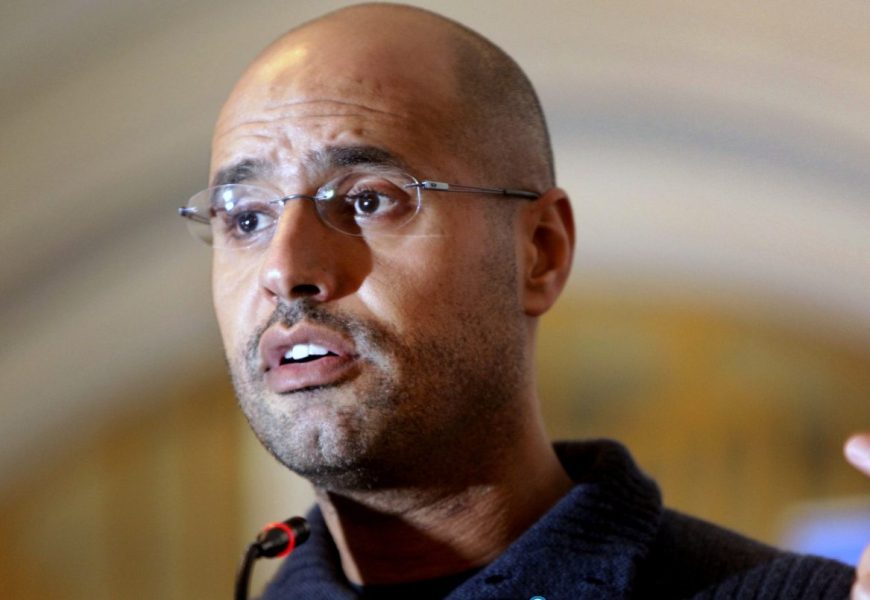
A "key participant" in the 2012 attack on a U.S. compound in Benghazi, Libya, that killed four Americans is in custody, Attorney General Pam Bondi said Friday..

The 2012 attacks on the U.S. compound killed Americans including Ambassador Chris Stevens and immediately emerged as a divisive political issue.

Republicans challenged President Barack Obama and Secretary of State Hillary Clinton on security at the facility, the military response to the violence and the Democratic administration's changing narrative about who was responsible and why.

A final report by a Republican-led congressional panel faulted the Obama administration for security deficiencies and a slow response to the attacks.

The report, however, found no wrongdoing by Clinton.

U.S. Navy Adm. Brad Cooper, the head of the American military's Central Command, attended the meeting - something that did not happen in previous rounds and likely served as a signal to Tehran that Washington may still strike Iran if negotiations fail.

With the aircraft carrier USS Abraham Lincoln and other warships in the region, along with more fighter jets, the U.S. now likely has the military firepower to launch an attack if it wanted.

But whether attacks could be enough to force Iran to change its ways - or potentially topple its government - remains far from a sure thing.

Meanwhile, Gulf Arab nations fear an attack could spark a regional war dragging them in as well. That threat is real - already, U.S. forces shot down an Iranian drone near the Lincoln and Iran attempted to stop a U.S.-flagged ship in the Strait of Hormuz.

Trump used his social media account to share a video about election conspiracy theories that includes a racist depiction of former President Barack Obama and his wife, Michelle Obama.

The Republican president's Thursday night post immediately drew backlash for its treatment of the nation's first Black president and first lady.

It was part of a flurry of social media activity that amplified Trump's false claims that the 2020 election was stolen from him, despite courts around the country finding no evidence of fraud that could have affected the outcome.

White House press secretary Karoline Leavitt rejected criticism of the post that depicted the Obamas, who are Democrats.

An Obama spokesperson did not immediately respond to a request for comment Friday.

At the video's 60-second mark is a quick scene of two primates, with the Obamas' smiling faces imposed on them.

Iran and the United States held indirect talks in Oman over Tehran's nuclear program on Friday, months after America bombed Iran's uranium enrichment sites and just weeks following nationwide protests that convulsed the Islamic Republic.

Iran's Foreign Minister Abbas Araghchi described the talks as "a very good start" even as the parties met Oman's top diplomat at different times at a palace on the outskirts of the country's capital, Muscat.

Both Araghchi and the Omanis described the talks themselves as focused on merely trying to find a way to hold future negotiations - seemingly returning to the start of discussions about the Iranian nuclear program that unfolded over months a year ago, before Israel launched its 12-day war on Iran in June.

The U.S. side, represented by U.S. envoy Steve Witkoff and Jared Kushner, President Donald Trump's son-in-law, had no immediate comment on the talks.

Trump claims his tariffs have revived the U.S. economy, calling it an "American economic miracle."

He argues that tariffs have boosted growth and reduced inflation. However, the facts tell a different story.

The U.S. economy was already growing before his second term. During the first three quarters of the year, Trump's tariffs - or the threat of them - delivered mixed results for the American economy. Inflation figures are skewed by data disruptions, and tariffs have actually increased core goods prices.

Trump also claims foreign producers bear most tariff costs, but studies show U.S. consumers and firms are affected.

Oman has mediated indirect talks between Iran and the United States over the Islamic Republic's nuclear program, seeking to de-escalate tensions between the nations after Washington bombed Iranian nuclear sites and Tehran launched a bloody crackdown on nationwide protests.

Oman issued a public statement acknowledging the talks after Associated Press journalists watched Iranian and American officials separately visit a palace on the outskirts of Muscat to speak to the sultanate's foreign minister, Badr al-Busaidi.

It wasn't immediately clear Friday if that was the end of the talks for the day.

The U.S. bombed Iranian nuclear sites during that war, likely destroying many of the centrifuges that spun uranium to near weapons-grade purity. Israel's attacks devastated Iran's air defenses and targeted its ballistic missile arsenal as well.
U.S. officials like Secretary of State Marco Rubio believe Iran's theocracy is now at its weakest point since its 1979 Islamic Revolution after nationwide protests last month represented the greatest challenge to 86-year-old Supreme Leader Ayatollah Ali Khamenei's rule. Khamenei's forces responded with a crackdown that killed thousands and reportedly saw tens of thousands arrested - and spurred new military threats by Trump to target the country.

More Top Stories