°C
°C
 12
Min
12
Min
Pope Leo XIV offered a silent prayer at the site of the 2020 Beirut port explosion as he wrapped up his first foreign trip to Turkey and Lebanon on Tuesday.
The Latest: Pope Leo ends first foreign trip with silent prayer at Beirut blast site, Mass at port

Pope Leo XIV offered a silent prayer at the site of the 2020 Beirut port explosion as he wrapped up his first foreign trip to Turkey and Lebanon on Tuesday.
He also met with relatives of some of the 218 victims of the blast on Aug. 4, 2020. The explosion tore through Beirut and did billions of dollars in damage after hundreds of tons of ammonium nitrate detonated in a warehouse.
No official has been convicted in a judicial investigation that has been repeatedly obstructed, angering Lebanese for whom the blast was just the latest crisis after decades of corruption and financial crimes. When he arrived in Lebanon on Sunday, Leo urged the country's political leaders to pursue the truth as a means of peace and reconciliation in the country.
Leo sought to bring a message of peace to Lebanon as it copes with years of economic and political crises.
The American pope opened his final day with a visit to the De La Croix hospital, which specializes in care for people with psychological problems, and will close with a Mass along the Beirut waterfront before returning to Rome.
On Monday, he presided over a gathering of Lebanon's Christian and Muslim spiritual leaders, celebrating the country's interfaith coexistence as a potent message of peace in the conflict-plagued region.
Here is the latest:
Pope Leo XIV on Tuesday shared for the first time what he was thinking when the votes started going his way during the conclave that elected him, saying he resigned himself to the inevitable and put the rest in God's hands.
"I took a deep breath. I said 'Here we go Lord. You're in charge and you lead the way,'" Leo told reporters during a wide-ranging airborne news conference coming home from his inaugural trip to Turkey and Lebanon.
His responses, after seeming timid with the media early in his pontificate, showed he is much more comfortable now, is paying close attention to what is being reported about him, and that he has a good sense of humor about it.
Leo was asked what he was thinking when he saw a huge crowd of people at one of his events in Lebanon, where it seemed as if the size had taken him by surprise. Leo suggested that wasn't necessarily the case.
"My face is very expressive but I'm oftentimes amused by how the journalists interpret my face," he said. "It's interesting. Sometimes I get really great ideas from all of you because you think you can read my mind or my face."
"You're not always correct," he added, to laughs.
Pope Leo XVI has called for the United States to pursue dialogue and even economic pressure on Venezuela to achieve its goals, rather than threats of military action.
Leo, history's first American pope, told reporters aboard the papal plane returning from Lebanon that the Venezuelan bishops conference and the Vatican Embassy in Caracas were trying to calm the situation and look out for the plight of ordinary Venezuelans.
"The voices coming from the United States change, with a certain frequency at times," he said. "On the one hand it seems there was telephone conversation between the two presidents, on the other there's this danger, this possibility of an activity, an operation including invading the territory of Venezuela."
He stressed that he didn't have further information. "Again I believe it's better to look for ways of dialogue, perhaps pressure - including economic pressure - but looking for other ways to change, if that's what the United States wants to do."
Leo says he hopes to make his second trip as pope to Africa, visiting several countries but especially Algeria because of its important role in Christian-Muslim relations.
Leo, an Augustinian missionary, recalled that Algeria is also important in the life of St. Augustine, the fifth-century theologian that inspired his religious order and is his most-cited church father.
Leo also said he hoped to visit three countries in Latin America in either 2026 or 2027: Argentina, Uruguay and Peru, where he lived for two decades as a missionary. Argentina especially has been waiting for a papal visit after Pope Francis never went home after his 2013 election.
Leo was returning from his first trip as pope, to Turkey and Lebanon.
In his farewell speech at the Beirut airport at the conclusion of the first foreign trip of his pontificate Tuesday, Pope Leo XIV referenced the ongoing conflict in southern Lebanon, including "Biblical places," and sent a message of support to people of the south.
Christians in the south had been disappointed his visit did not include their areas, which were battered by last year's war between Israel and Hezbollah and are still the target of regular Israeli airstrikes.
"I greet all the regions of Lebanon that I was unable to visit: Tripoli and the north, the Beqaa and the south of the country, which is currently experiencing a state of conflict and uncertainty," Leo said, referencing the cities of Sidon and Tyre, which are mentioned in the New Testament, as "biblical places."
"May the attacks and hostilities cease," he said. "We must recognize that armed struggle brings no benefit. While weapons are lethal, negotiation, mediation and dialogue are constructive."
Lebanese President Joseph Aoun urged the pope to keep Lebanon in his prayers.
The Lebanese are "a faithful people who deserve life - who are worthy of it," he said. "As we bid you farewell, we do not only part with an honored guest, but with a father who brought us comfort, and reminded us that the world has not forgotten Lebanon."
Concluding a public Mass on Beirut's waterfront, Pope Leo XIV made another call for peace.
"The Middle East needs new approaches in order to reject the mindset of revenge and violence, to overcome political, social and religious divisions, and to open new chapters in the name of reconciliation and peace," he said. "The path of mutual hostility and destruction in the horror of war has been traveled too long with the deplorable results that are before everyone's eyes."
He urged Christians in the region to have courage and faith.
"Dear Christians of the Levant, when the results of your efforts for peace are slow in coming, I invite you to lift your gaze to the Lord who is coming," Leo said.
The Mass drew an estimated 150,000 people, capping off Leo's three-day visit to Lebanon before a return flight to Rome from the Beirut airport.
Pope Leo XIV has called for Lebanon to be a "home of justice and fraternity" and a "prophetic sign of peace" in the region.
Leo made the appeal during Mass along the Beirut waterfront on the final day of his visit.
In his homily, Leo acknowledged the many crises that have scarred Lebanon, citing the 2020 Beirut port blast, economic crises and "the violence and conflicts that have reawakened ancient fears."
He said it is natural to feel "paralyzed by powerlessness in the face of evil and oppressed by so many difficult situations."
But the pope urged Lebanon's people to not be resigned and to find ways to remain hopeful and grateful. He insisted, though, that justice was part of the equation.
"Let us cast off the armor of our ethnic and political divisions, open our religious confessions to mutual encounter and reawaken in our hearts the dream of a united Lebanon," he said. "A Lebanon where peace and justice reign, where all recognize each other as brothers and sisters."
"Lebanon, stand up," he said. "Be a home of justice and fraternity! Be a prophetic sign of peace for the whole of the Levant!"
Tens of thousands of worshippers packed into an open area on the Beirut waterfront where Pope Leo XIV is set to deliver a public mass before heading back to Rome.
The crowd included Lebanon's President Joseph Aoun and other government leaders, as well as people from all walks of life.
"I think the pope's visit will give the Lebanese people hope, hope that there will be peace, because we have been waiting for peace for 50 years," said Gabriel Raji, who was among the attendees.
Lebanon fought a brutal 15-year civil war that began 50 years ago in 1975. Since then, it has faced several other conflicts including wars between Israel and the Lebanese militant group Hezbollah. The most recent nominally ended with a U.S.-brokered ceasefire in November 2024. Since then, Israel has continued to launch near-daily airstrikes that it says aim to stop Hezbollah from rebuilding.
On Tuesday, Lebanon's state-run National News Agency reported more Israeli strikes on the southern village of Aitaroun.
Pope Leo XIV prayed at the site of a deadly 2020 Beirut port explosion that has become a symbol of Lebanon's dysfunction, impunity and scars.
Relatives of some of the 218 people killed by the blast held up photos of their loved ones as Leo arrived. They stood silently by the shell of the last standing grain silo destroyed by the blast and the piles of burned cars torched in its wake.
Leo stood in silent prayer among the wreckage.
The Aug. 4, 2020, explosion tore through Beirut and did billions of dollars in damage after hundreds of tons of ammonium nitrate detonated in a warehouse.
Five years on, these families are still seeking justice. No official has been convicted in a judicial investigation that has been repeatedly obstructed, angering Lebanese for whom the blast was just the latest evidence of impunity after decades of corruption and financial crimes.
Pope Leo XIV has encouraged the Lebanese people to remember the most vulnerable among them.
Leo made an emotional visit Tuesday to the De La Croix hospital, which cares primarily for people with psychological problems.
The mother superior of the congregation that runs the hospital, Mother Marie Makhlouf, was overcome as she welcomed the pope. She told him that her hospital cares for the "forgotten souls, burdened by their loneliness."
In his remarks to the patients and staff, Leo said the facility stands as a reminder to all of humanity.
"We cannot forget those who are most fragile. We cannot conceive of a society that races ahead at full speed clinging to the false myths of wellbeing, while at the same time ignoring so many situations of poverty and vulnerability," he said.
Leo is on the final day of his visit to Lebanon, his first foreign trip as pope.
Pope Leo XIV has arrived at one of the Middle East's oldest psychiatric hospitals, the De La Croix hospital in Beirut's northern suburb of Jal el-Dib, where he will meet with patients as well as nuns who work at the facility.
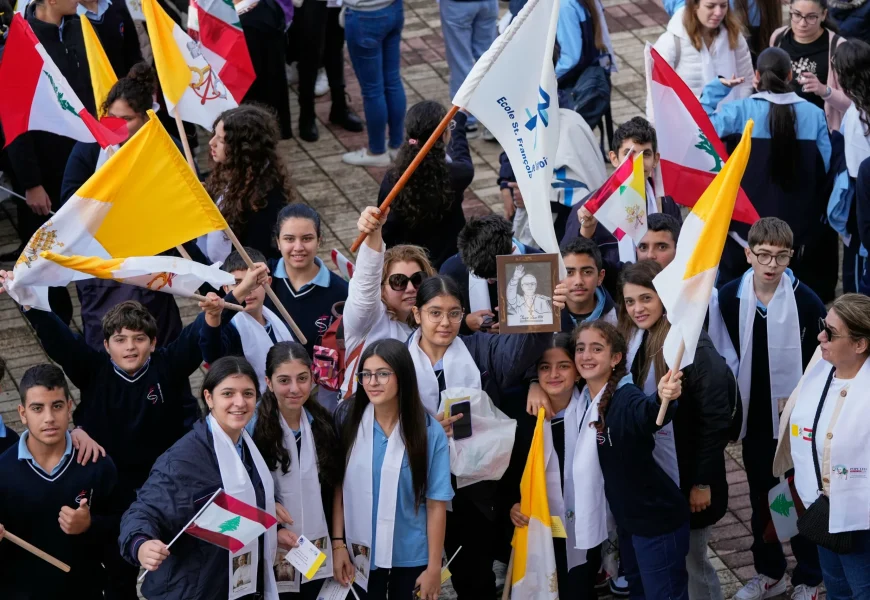
The road leading there was lined by thousands of women, men and children who waved Lebanese and Vatican flags. The pope was then received upon arrival by officials at the hospital, where about 175 nuns work.
The hospital visit is the pope's first activity Tuesday, which is his third and last day in Lebanon.
The hospital has a capacity of 1,200 patients and currently has about 700 patients mostly being treated for mental health illness and epilepsy and some for drug addiction.
A hall inside was packed with hundreds of patients and scores of nuns
"There was a rainbow over the monastery of the cross today. This is a sign of grace and blessing. We will not say anything more than God's word," said Jihan Khoriaty, a nun who works at the the De La Croix hospital. "The word of nature today was the biggest good sign."
Ahead of his large public mass in the Lebanese capital's seaside waterfront on Tuesday, Pope Leo XIV will hold a silent prayer nearby at the site of the deadly Beirut port explosion with some families of the 218 victims.
The blast on Aug. 4, 2020, was fueled by hundreds of tons of ammonium nitrate stored in the port and flattened several neighborhoods.
Leo's late predecessor, Pope Francis, openly advocated for the families.
Mireille Khoury, who lost her 15-year-old son Elias, is one of the family members who will join the prayer.
"I will not say that this anger will fully just disappear," Khoury told The Associated Press before Leo's visit. "But I think it will give some sort of relaxation of this anger that is in my heart until justice is served."
An ongoing probe that has implicated a long list of politicians, judicial and security officials continues to face obstructions as families push for international support including from the Vatican.
Lebanon will never heal from its wounds without justice and the port blast probe could set a precedent, Khoury said.
"Justice is the basis of building any country," she said. "Our children were killed in their homes. They were killed because someone kept (ammonium) nitrate in the main port of the city near a residential area."
Among those waiting to greet Pope Leo at the De La Croix hospital are throngs of children dressed as Swiss Guards in colorful gold, red and blue ceremonial uniforms.
Seamstresses worked for three months to make the outfits for the children, Sister Teresa Azar said.
The crowd also includes cardinals in their red cassocks and a boy dressed as the pope in white.
Pope Leo XIV will offer a silent prayer at the site of the 2020 Beirut port explosion.
Leo also was expected to meet with relatives of some of the 218 victims of the blast, which tore through Beirut and did billions of dollars in damage after hundreds of tons of ammonium nitrate detonated in a warehouse.
Five years on, no official has been convicted in a judicial investigation that has been repeatedly obstructed, angering Lebanese for whom the blast was just the latest crisis after decades of corruption and financial crimes.
More Top Stories