°C
°C
 15
Min
15
Min
The U.S. seized two sanctioned oil tankers linked to Venezuela in back-to-back actions in the North Atlantic and the Caribbean, officials said Wednesday. U.S. European Command announced the seizure of the merchant vessel Bella 1 for “violations of U.S. sanctions.” A Coast Guard cutter had pursued the tanker into the waters between Scotland and Iceland.
The Latest: US says it’s seized 2 more sanctioned oil tankers linked to Venezuela

The U.S. seized two sanctioned oil tankers linked to Venezuela in back-to-back actions in the North Atlantic and the Caribbean, officials said Wednesday.
U.S. European Command announced the seizure of the merchant vessel Bella 1 for "violations of U.S. sanctions." A Coast Guard cutter had pursued the tanker into the waters between Scotland and Iceland after it tried to avoid being ensnared by the U.S. blockade on sanctioned oil vessels around Venezuela.
Then, Secretary of Homeland Security Kristi Noem revealed that U.S. forces also took control of the tanker Sophia in the Caribbean. In a social media post, she said both ships were "either last docked in Venezuela or en route to it."
The Bella 1 was reflagged as Russian and renamed the Marinera after turning toward Europe. The U.S. military handed control of it to law enforcement officials after seizing it, said a U.S. official, who spoke to The Associated Press on Wednesday on the condition of anonymity to discuss sensitive military operations. The ship was sanctioned by the U.S. in 2024 for allegedly smuggling cargo for a company linked to Lebanese militant group Hezbollah, which is backed by Iran.
The Latest:
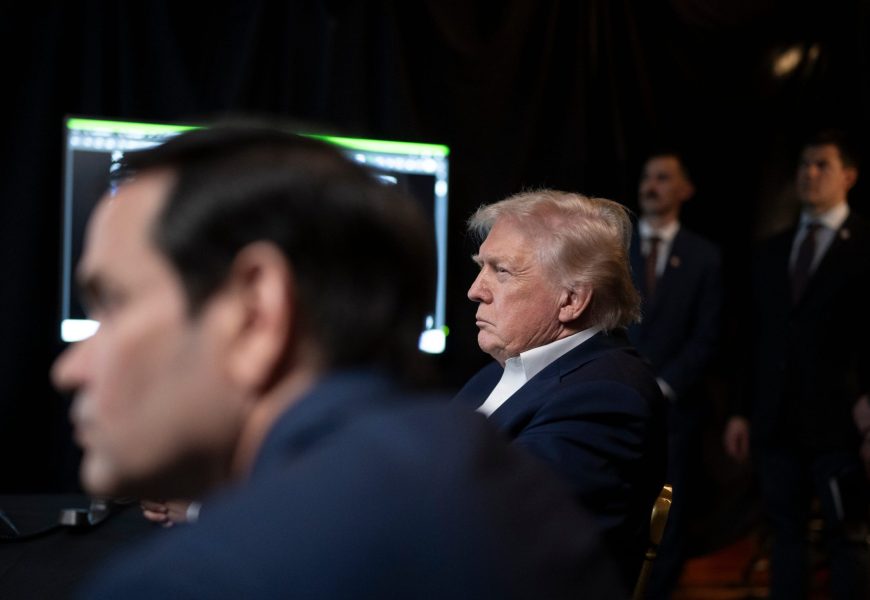
Secretary of State Marco Rubio and several Republican senators said that the potential purchase of Greenland was discussed Wednesday during a classified briefing primarily focused on Venezuela, though many stopped short of supporting military action to acquire the territory - an option the White House has said is not off the table.
"I think Greenland would be a huge asset to America," Sen. Roger Marshall said as he left the briefing. "It could be very critical to our national security going forward. I hope that we can work out a deal."
GOP Sen. John Hoeven agreed, saying Greenland "has strategic importance," but he added that some of the discussion about taking the territory by force has been "misconstrued."
"One of the things about President Trump, you may have noticed, is he keeps our adversaries off balance by making sure they don't know what we're going to do," Hoeven said.
Other Republican senators have openly opposed acquiring Greenland, whether by purchase or by force. Sen. Lisa Murkowski said she hates "the rhetoric around either acquiring Greenland by purchase or by force."
"I think that it is very, very unsettling," she said.
The press secretary said the crew of a merchant vessel seized earlier Wednesday would be "brought to the United States for such prosecution if necessary," citing the presence of a "judicial seizure order" in place.
U.S. European Command earlier Wednesday announced the seizure of the Bella 1 for "violations of U.S. sanctions." A Coast Guard cutter had pursued the tanker into the waters between Scotland and Iceland after it tried to avoid being ensnared by the U.S. blockade on sanctioned oil vessels around Venezuela.
According to an outline of the policies published Wednesday by the Energy Department, the Trump administration is "selectively" removing sanctions to enable the shipping and sale of Venezuelan oil to global markets.
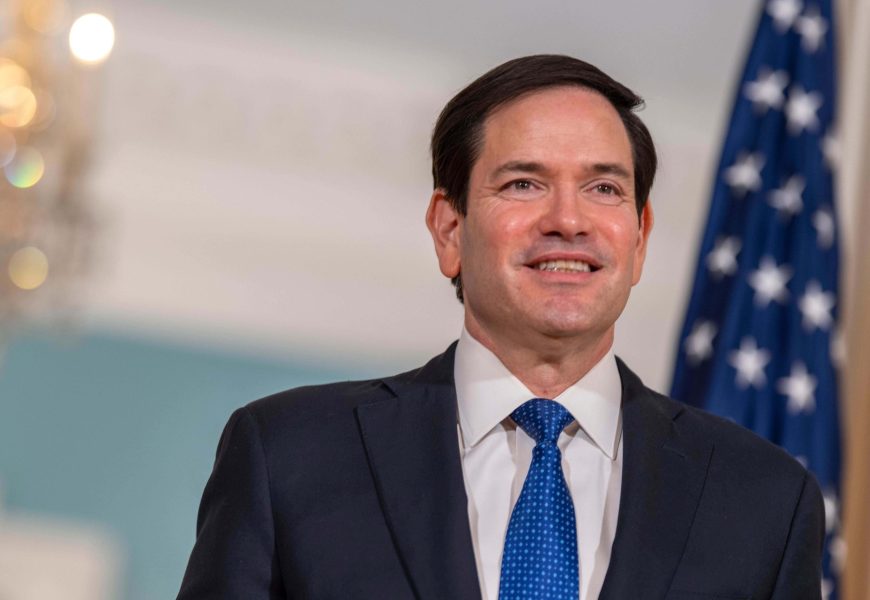
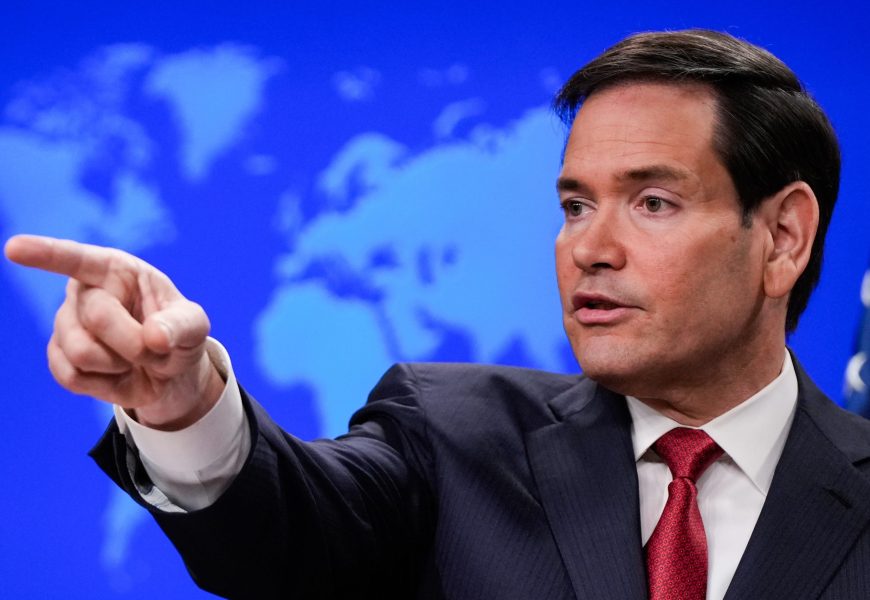
Secretary of State Marco Rubio told reporters Wednesday that he'll meet with officials in Denmark next week regarding President Donald Trump's desire to acquire Greenland.
Greenland is a self-governing territory of Denmark, a longtime U.S. ally that has rejected Trump's overtures. Greenland's own government also opposes U.S. designs on the island, saying the people of Greenland will decide their own future.
Rubio said Trump has always intended to buy Greenland. Rubio declined to talk possible military intervention, but said the U.S. always retains the option when it comes to defending its national security interests.
Asked if Trump or Venezuela's leader, Delcy Rodríguez, is running Venezuela, press secretary Karoline Leavitt said, "We obviously have maximum leverage over the interim authorities in Venezuela right now."
During her briefing with reporters, Leavitt said, "The Trump administration - led by Secretary Rubio, the vice president and the president's entire national security team - is in close correspondence with the interim authorities in Venezuela."
She added that those "interim authorities agreed to release" seized oil to the U.S.
Secretary of State Marco Rubio told reporters Wednesday morning that President Donald Trump's intention was always to buy Greenland
"That's always been the president's intent from the very beginning," Rubio said. "He said it very early on. I mean this is not new. He talked about it in his first term. And he's not the first U.S. president that has examined or looked at how we could acquire Greenland."
He added: "Not only did Truman want to do it, but President Trump has been talking about this since his first term."
Rubio did not directly answer a question about whether the Trump administration is willing to risk the NATO alliance by potentially moving ahead with a military option regarding Greenland. Rubio said every president retains the option to address national security threats to the United States through military means.
Defense Secretary Pete Hegseth tells reporters that the "leverage" of seizing sanctioned or stateless oil tankers out of Venezuela will continue.
"Our military is prepared to continue this," Hegseth said. "The president when he speaks, he means it. He's not messing around. We are an administration of action to advance our interests, and that is on full display."
The comments came after Hegseth and Secretary of State Marco Rubio briefed lawmakers about the U.S.'s recent military action in Venezuela.
Secretary of State Marco Rubio told a select group of lawmakers that it was the Trump administration's intention to eventually purchase Greenland, rather than through military force.
The remarks were made in a classified briefing Monday evening on Capitol Hill, according to a person with knowledge of his comments who was granted anonymity because it was a private discussion.
Rubio was again at the Capitol on Wednesday to brief the entire Senate and House, where questions from lawmakers centered not just on the administration's operation to capture Maduro but also Trump's future intentions for Greenland, a semiautonomous territory of NATO ally Denmark.
Calling alcohol a "social lubricant," Dr. Mehmet Oz, administrator of the Centers for Medicare and Medicaid Services, was asked about the removal of specific daily drink amounts from the guidelines.
"There's probably nothing healthier than having fun with friends in a safe way," Oz said, adding that, "in the best case scenario, I don't think that you should drink alcohol."
"There is alcohol on these dietary guidelines, but the implication is don't have it for breakfast," he said.
The new guidelines removed specific recommendations about daily alcohol limits, instead saying broadly that adults should "consume less alcohol for better overall health."
In the first White House news conference since Maduro's arrest, Leavitt touted a number of achievements she said the Trump administration had marked during its first year in office,
Leavitt plugged what she characterized as economic benefit to Americans by following "incredible deals that the president cut" on prescription drug prices.
For the rollout of new dietary guidelines, Leavitt was joined in the briefing room by administration officials including Health and Human Services Secretary Robert F. Kennedy Jr. and Agriculture Secretary Brooke Rollins.
Leavitt said the new guidelines would pertain to all federally funded food services, including for the military and the Special Supplemental Nutrition Program for Women, Infants and Children, also known as WIC.
Americans should eat more whole foods and protein, fewer highly processed foods and less added sugar, according to the latest edition of federal nutrition advice released Wednesday by the Trump administration.
Health Secretary Robert F. Kennedy Jr. and Agriculture Secretary Brooke Rollins issued the 2025-2030 U.S. Dietary Guidelines for Americans, which offer updated recommendations for a healthy diet and provide the foundation for federal nutrition programs and policies. They come as Kennedy has for months stressed overhauling the U.S. food supply as part of his Make America Healthy Again agenda.
"Our message is clear: Eat real food," Kennedy told reporters at a White House briefing.
"One of the current hawks of the US President speaks without hesitation about an international order based on military force and power, which reminds us of the worst years of plunder through war," Bruno Rodríguez wrote on X.
"They are ready to violate any of the standards and principles of International Law established after centuries of barbarism," he added. "They do so from a position of privileges, jeopardizing the lives of thousands of low-income American youths who would be enlisted in the armed forces and sent to fight anywhere in this planet, thus wasting billions of dollars in wars and military operations, contrary to the electoral promises that took them to the government and betraying their electoral bases."
Noem identified the second tanker seized by the U.S. as the Motor Tanker Sophia. A ship named M Sophia is on the U.S. sanctions list for moving illicit cargos of oil from Russia. The ship is currently "running dark," not having transmitted location data since July. Tankers involved in smuggling often turn off their transponders or broadcast inaccurate data to hide their true locations.
Samir Madani, the co-founder of TankerTrackers.com, said his organization had used satellite imagery and surface-level photos to document that at least 16 tankers had left the Venezuelan coast since Saturday, after the U.S. captured Maduro. The M Sophia is one of those ships, Madani said, citing a recent photo showing the tanker located in the waters near Jose Terminal, Venezuela's main oil export hub.
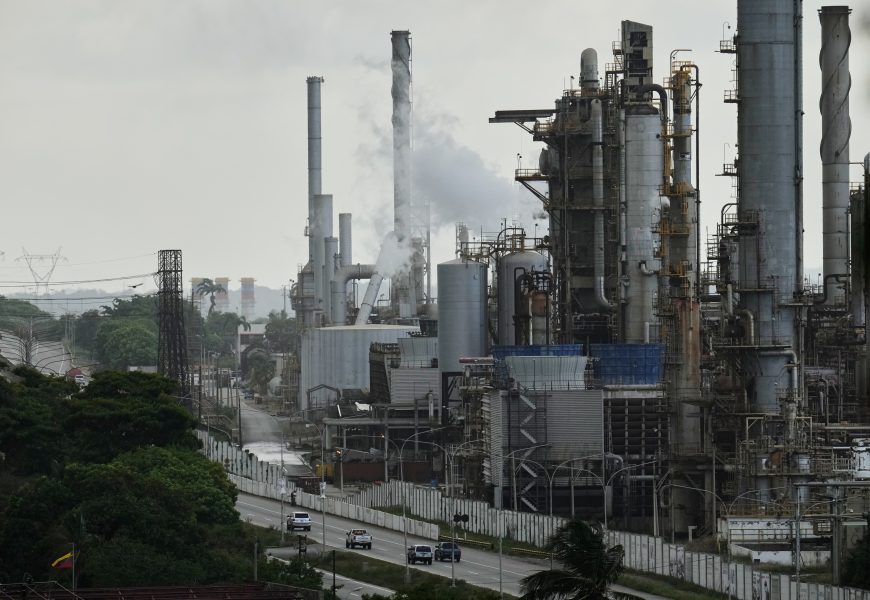
The Trump administration is "selectively" removing sanctions to enable the shipping and sale of Venezuelan oil to markets worldwide, according to an outline of the policies published Wednesday by the Energy Department.
The oil sales are slated to begin immediately with the sale of 30 million to 50 million barrels from the South American country, and "will continue indefinitely," the outline says.
Proceeds will settle in U.S. controlled accounts at "globally recognized banks" and then be disbursed to the U.S. and Venezuelan populations at the "discretion" of the Trump administration, it says.
The Russian Foreign Ministry said it's "closely following" reports about U.S. forces boarding the Marinera tanker and that it has information about Russian nationals among the crew.
"Taking into account the incoming information about Russian citizens among the crew, we demand that the American side ensure humane and dignified treatment of them, strictly respect their rights and interests, and not hinder their speedy return to their homeland," the ministry said in a statement carried by Russia's state news agencies Tass and RIA Novosti.
Separately, senior Russian lawmaker Andrei Klishas on Wednesday decried the U.S. action against the tanker as "blatant piracy" in an online statement.
"I talked to Maria Machado yesterday," Republican Rick Scott told reporters on Capitol Hill. "I think what they're trying to do is make sure there is a transition that doesn't end up in, bloodshed. And so I think we'll get to, a free and fair elections. But in the meantime, (Venezuela's interim president) Delcy Rodriguez is either going to cooperate or she's going to end up in prison or something else."
As for seizing oil tankers, Scott said he's all for it: "Presidents and presidents and presidents have allowed our own backdoor to be taken over by Russians and Chinese and North Koreans, and there is Hezbollah in Iran. And finally, we have a president that gives a damn. So he's going to use the power he's got."
The British military's "enabling support" included surveillance aircraft, a support ship and the use of U.K. bases, and was "in full compliance with international law," the U.K. defense ministry said.
Defense Secretary John Healey said the seizure of the Bella 1 - reflagged as Russian and renamed the Marinera - was part of global efforts to crack down on sanctions-busting.
"This ship, with a nefarious history, is part of a Russian-Iranian axis of sanctions evasion which is fueling terrorism, conflict, and misery from the Middle East to Ukraine," he said. "The U.K. will continue to step up our action against shadow fleet activity to protect our national security, our economy, and global stability - making Britain secure at home and strong abroad."
A separate poll from the Pew Research Center conducted in March found that 54% of Americans were opposed to the U.S. taking over Greenland. Only about one-quarter were in favor, and a similar share did not have an opinion.
Relatively few people thought Trump was serious about pushing for a takeover of Greenland at that point, according to the Pew poll. Only 23% said it was "extremely" or "very" likely that he would pursue taking over the territory. About 3 in 10 said it was "somewhat" likely, and one-third said "not too likely" or "not at all likely."
Despite Trump's assertions that the U.S. needs Greenland for national security, polling conducted last year suggests that taking over the Danish territory would not be popular among Americans.
About 7 in 10 U.S. adults said they would oppose the U.S. taking control of Greenland, despite Trump's insistence that it's necessary, according to a Marquette/SRSS poll from May. Republicans were split on whether the U.S. should take control of the Arctic island when told that Trump believed it was necessary: Roughly half were in favor and about half were opposed.
NATO leaders have criticized Trump's pursuit of Greenland - with Denmark warning a takeover of its territory could spell the end of the NATO alliance.
In a defensive social media post, Trump suggested NATO "won't be there for us" if needed. He did not note that the only time in history that NATO invoked its collective defense clause was to support the U.S., after the Sept. 11, 2001 attacks.
Trump in his post complained that Norway, a NATO member, failed to award him the Nobel prize, and claimed that China and Russia would have "ZERO FEAR OF NATO" without the U.S.
But Trump said, "We will always be there for NATO, even if they won't be there for us."
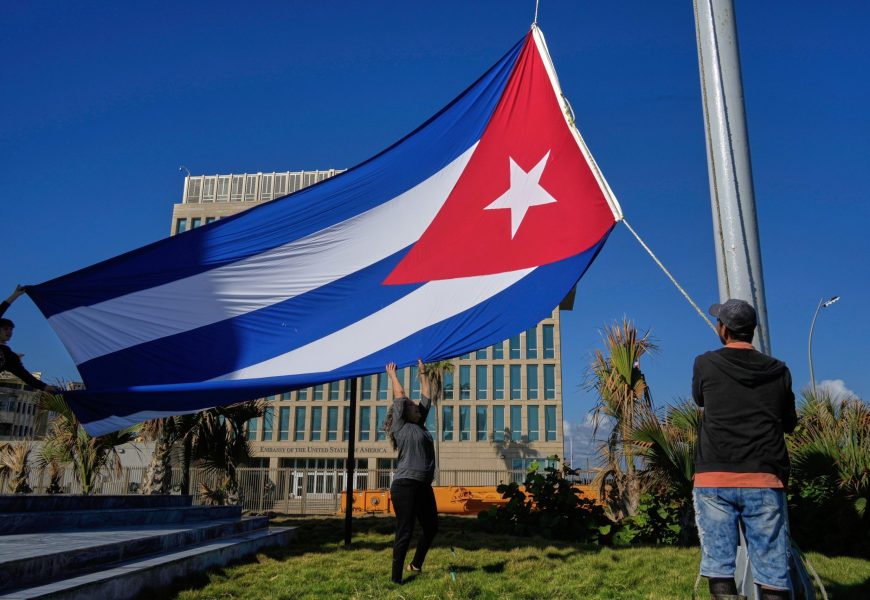
"Mexico has become an important supplier" of oil to Cuba in the wake of the U.S. attack on Venezuela, Sheinbaum said Wednesday, but she noted that "no more oil is being sent than has been sent historically; there is no particular shipment."
After widespread protests in Cuba in 2021, Mexico sent one of its largest humanitarian aid shipments, which included 100,000 barrels of fuel. And in October 2024, it sent more than 400,000 barrels in just a few days following serious blackouts in Cuba, according to data provided at the time by Jorge Piñón of the Energy Institute at the University of Texas at Austin, which tracks shipments using oil tracking services and satellite technology.
Piñón said Mexico had been supplying Cuba with 22,000 barrels of oil per day after that, but shipments dropped to 7,000 barrels after U.S. Secretary of State Marco Rubio visited Mexico City in September 2025.
Russia's Ministry of Transport said in a statement Wednesday that U.S. Navy forces boarded the Marinera tanker "outside the territorial waters of any state," and that "contact with the vessel was lost."
On Dec. 24, 2025, the vessel "received a temporary permit to fly the Russian Federation flag, issued in accordance with Russian law and international law," the ministry said.
Russia's Foreign Ministry said before the seizure that it was "following with concern the anomalous situation that has developed around the Russian oil tanker Marinera."
Immediately following news of the seizure, the transport ministry statement noted that "no state has the right to use force against vessels duly registered in the jurisdictions of other states," citing the 1982 U.N. Convention on the Law of the Sea.
Ship tracking data show the Marinera was not carrying any oil when it was boarded by U.S. forces.
It was cruising across the Atlantic nearing the Caribbean on Dec. 15 when it abruptly turned and changed its heading north, toward Europe. The change in direction came days after the U.S. seized another sanctioned tanker, the Skipper, on Dec. 10 after it had left Venezuela carrying a cargo of oil.
The Marinera's past location signals show it stopped in the Iranian port of Shahid Rajaee in March and then remained at anchor near the entrance to the Persian Gulf until November, when it set off through the Suez Canal and headed west.
The ship is part of a large "shadow fleet" of sanctioned vessels that carry oil from Russia, Iran and Venezuela in defiance of Western sanctions, mostly to customers in Asia.
Russia's Foreign Ministry said before the seizure that it was "following with concern the anomalous situation that has developed around the Russian oil tanker Marinera."
The ministry's statement, which was carried by the official Tass news agency, added that "for several days now, a U.S. Coast Guard ship has been following the Marinera, even though our vessel is approximately 4,000 km from the American coast."
On Wednesday, open-source maritime tracking sites showed its position as between Scotland and Iceland, traveling north. The U.S. official also confirmed the ship was in the North Atlantic.
In a post to social media, the U.S. European Command confirmed that the U.S. Coast Guard Cutter Munro tracked the ship ahead of its seizure "pursuant to a warrant issued by a U.S. federal court."
The military command went on to say that the seizure supported Trump's proclamation on targeting sanctioned vessels that "threaten the security and stability of the Western Hemisphere."
A U.S. official says U.S. forces have boarded a Venezuela-linked sanctioned oil tanker in North Atlantic after pursuing it for weeks. The official spoke to The Associated Press on Wednesday the condition of anonymity to discuss sensitive military operations.
The U.S. had been pursuing the tanker since last month after it tried to evade a U.S. blockade around Venezuela.
More Top Stories