°C
°C
 5
Min
5
Min
MASAFI, United Arab Emirates (AP) – Outside of a mountain village in the northern outskirts of the United Arab Emirates, clouds on a recent weekend suddenly crowded out the white-hot sun that bakes this desert nation in the summer months.
Promise and peril drive the fascination with rain in the parched deserts of the United Arab Emirates

MASAFI, United Arab Emirates (AP) - Outside of a mountain village in the northern outskirts of the United Arab Emirates, clouds on a recent weekend suddenly crowded out the white-hot sun that bakes this desert nation in the summer months. Fierce winds blew over planters and pushed a dumpster down the street. And then came the most infrequent visitor of all: rain.
Rainfall long has fascinated the people of the Emirates. That includes both its white-thobed locals crowding into the deserts for any downpour and its vast population of foreign workers, many coming from homes in the Indian subcontinent who grew up with monsoon deluges.
But rain also carries with it promise and peril to the nation of seven sheikhdoms on the Arabian Peninsula.
With some 4 million people now estimated to be living in Dubai alone compared to around 255,000 in 1980, pressure on water consumption continues. Meanwhile, as weather patterns change with global warming, the country saw the heaviest recorded rainfall ever last year that disrupted worldwide travel and now has its leaders reconsidering how to build as residents nervously look to the skies.
"Out here, rain is almost like a firework event," said Howard Townsend, an unofficial weather forecaster in Dubai with a Facebook following. "It's too hot to go outside. When you get a rain event, it's like a blessing, a release."
The UAE, home to an estimated 10 million people in total, sits along both the Persian Gulf to its north and west and the Gulf of Oman to the east. The stone Hajar Mountains separate it from neighboring Oman. Along the southern borders of the peninsula, monsoon rains can hit seaside areas of Oman and Yemen. But the vast desert stretch of the peninsula, known as the Empty Quarter, has a weather pattern that keeps the clouds out.
That means little to no rain, sometimes for years at a time in some areas. For the Emirates, that has meant relying heavily on some 70 water desalination plants to supply drinking water, as well as drip irrigation for plants that can rely on recycled wastewater. Dams have also been built in recent years to catch and store water runoff.
Even then, the UAE ranks seventh worldwide for being at risk for water scarcity, according to the World Resources Institute. Groundwater reservoirs have been known to be under pressure for years. The UAE also has been "cloud seeding" for years, flying aircraft to release chemicals into clouds to try to induce rains.
"Water is more important than oil," Sheikh Mohammed bin Zayed Al Nahyan, the leader of the UAE and ruler of Abu Dhabi, reportedly said back in 2011.
That's particularly true in Dubai, where its booming population strains its roadways. The government-owned utility, the Dubai Electricity and Water Authority, reported producing 683.7 billion liters (180.6 billion gallons) of water last year alone through desalination, with water demand continuing to grow alongside the city-state.
Yet Emirati government statistics suggest residents use around 550 liters (145 gallons) of water per day, which is among some of the highest usage around the world.
But for all the fascination with rain, there's fear now as well for many after the April 2024 floods that swept across Dubai. In one day, more rain fell than ever recorded since 1949, when the officials in what became the UAE first began taking statistics.
More than 142 millimeters (5.59 inches) of rainfall had soaked Dubai over 24 hours. An average year sees 94.7 millimeters (3.73 inches) of rain at Dubai International Airport, the world's busiest for international travel.
And while that might not seem like much to a major city elsewhere, Dubai's deserts could only take so much water. Meanwhile, its urban core had nowhere for the water to go.
An analysis later conducted by scientists associated with World Weather Attribution, which studies weather and its relationship to climate change, found 85% of the population and 90% of the city-state's infrastructure was "vulnerable to rising sea levels and extreme weather events."
"It's not a question of has the rain increased; it's where has the rain to go?" Townsend said, something he called an increasingly pressing concern as Dubai builds further out into its desert outskirts.
In the time since, government utility vehicles and ambulances increasingly sport snorkels to avoid water getting into their engines, something residents also have installed on their own vehicles. Insurance losses have been estimated to be as high as $4 billion.
Dubai's ruler Sheikh Mohammed bin Rashid Al Maktoum also announced an $8 billion plan to build a massive rainwater drainage system for the city using underground tunneling equipment.
The project represents "the largest rainwater collection project in a single system in the region," Sheikh Mohammed said in a statement in June. "The initiative will increase the capacity of the drainage network in the emirate by 700%, ensuring the emirate's readiness to face future climate-related challenges."
But the rains also can bring joy to this desert.
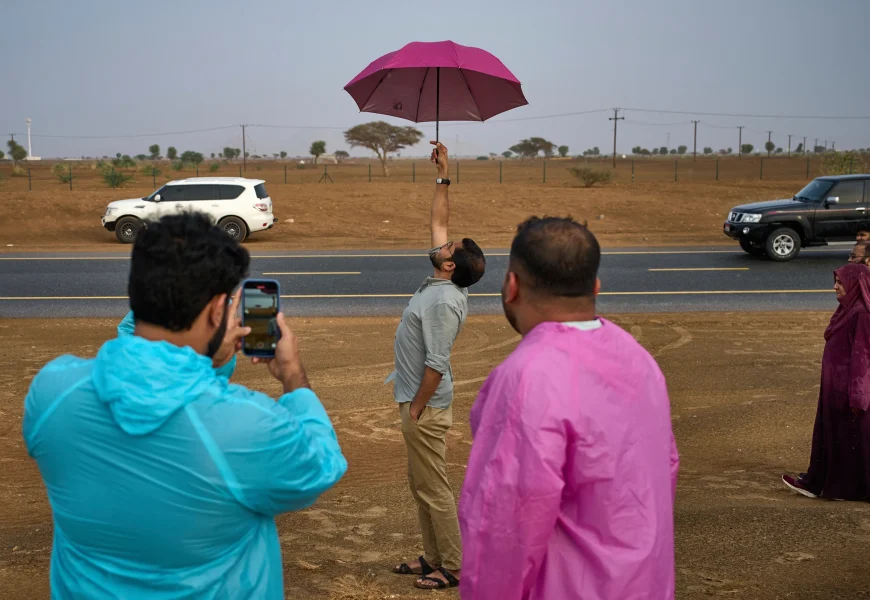
On a recent Saturday, Muhammed Sajjad Kalliyadan Poil looked to the skies in the eastern deserts of the UAE. Directly above him was a cumulonimbus cloud, looking rain heavy and ready to drop. That was the one, he said.
Leading others, Kalliyadan Poil drove to the outskirts of Masafi, a village in the Hajar Mountains nestled between Fujairah and Ras al-Khaimah, two the Emirates' seven sheikhdoms. He has grown famous over time as the "UAE Weatherman" on Instagram.
Kalliyadan Poil, like other Indians from Kerala on the trip, make up a large number of the foreign workers here in the Emirates. And their memories of home have them gather together to chase the weather on days like this.
As Kalliyadan Poil and his colleagues pulled up to an area against a mountain road under construction, the first drops fell on their windshield. He got out, standing in the sudden shower as others with him did the same.
"We come from an area where the rain is happening every day," Kalliyadan Poil said. "When the drop hits us, I return back to my childhood."
More Top Stories