°C
°C
 5
Min
5
Min
BRUSSELS (AP) – Italy on Friday gave crucial support to plans by the European Union to seal a huge free trade deal with five South American nations neighboring Venezuela that has been negotiated for over 25 years.
Italy gives key support to EU trade deal with South American nations

BRUSSELS (AP) - Italy on Friday gave crucial support to plans by the European Union to seal a huge free trade deal with five South American nations neighboring Venezuela that has been negotiated for over 25 years.
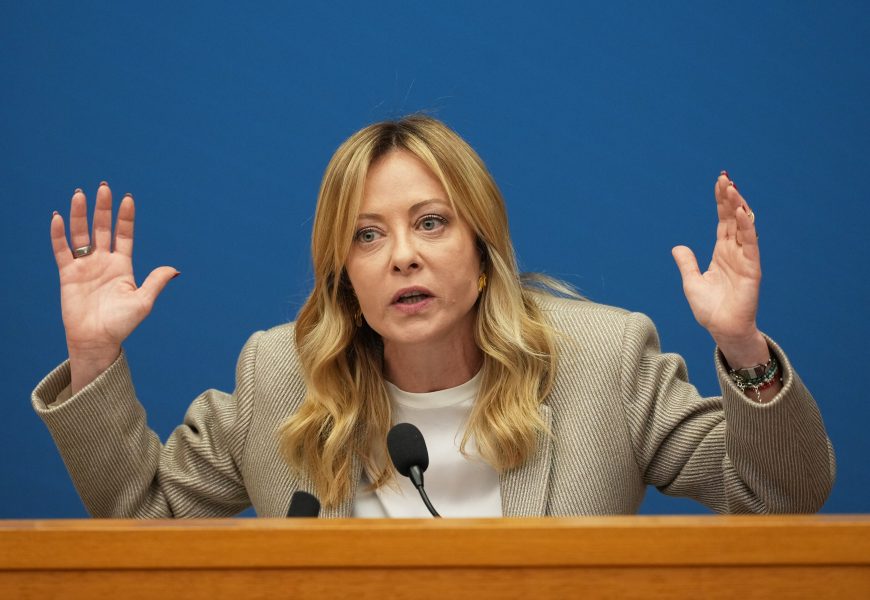
Italy's Prime Minister Giorgia Meloni was long seen as the key vote in the campaign by European Commission President Ursula von der Leyen to rally support for the trade deal with the Mercosur nations of Brazil, Argentina, Bolivia, Paraguay and Uruguay.
Von der Leyen said that the successful vote sends "a strong signal" of the EU's economic clout and stability "in the face of an increasingly hostile and transactional world." She said she would travel to Paraguay soon where Mercosur nations are meeting next week. European Parliament will vote on it before it enters into force. "At a time when trade and dependencies are being weaponised and the dangerous, transactional nature of the reality we live in becomes increasingly stark, this historic trade deal is further proof that Europe charts its own course and stands as a reliable partner," said von der Leyen.
Italy confirmed its support for the deal on Friday, with Foreign Minister Antonio Tajani hailing it as "good news for Italy."
"This agreement is destined to boost our exports, with the goal of reaching 700 billion euros ($814 billion) in exports," Tajani wrote in a post on X. He acknowledged the deal required a long negotiation, but added that Italy had secured protections for its farmers, "especially regarding production standards."
Meloni said she never had "any ideological objections" to the Mercosur agreement.
"We have always said we will be in favor of it when there are sufficient guarantees for our farmers," she told a press conference on Friday. "The agreement's potential is good, but not at the expense of the excellence of our products."
German Chancellor Friedrich Merz said the agreement "is a milestone in European trade policy and an important signal of our strategic sovereignty and ability to act."
In a statement, he stressed that "with this agreement, we are strengthening our economy and trade relations with our partners in South America - which is good for Germany and for Europe."
The deal would create one of the world's largest free trade zones, covering some 780 million people from Uruguay to Romania and a quarter of the globe's gross domestic product.
It also gives Brussels a diplomatic win at a time of economic upheaval, providing a stark counterpoint to the gunboat diplomacy of Washington and the coercive export controls of Beijing.
"Given Trump's policies of isolating the U.S. from the rest of the world, it is an imperative for the EU to lead trade integration policies at the global level and to look for partners elsewhere," said Antonio Fatas, a macroeconomist at the French business school INSEAD.
In the wake of Trumps' tariff wars, Brussels has sought to curtail its dependency on the U.S. market with trade deals forged across the world. The EU has struck deals with Japan and Indonesia, and are working on one with India.
A delay in December to the signing of the deal had infuriated Brazilian President Luiz Inácio Lula da Silva and led experts to worry a last-minute stumble would wreck the EU's credibility.
"For Europeans, the finalization of free-trade agreements with new partners stands among the best responses to US tariffs, growing protectionism and trade tensions with China," said Agathe Demarais, a senior fellow at the European Council on Foreign Relations. She said the current EU reliance on China for some critical raw materials could be broken by tapping into Mercosur's deposits.
Opposition to the deal was led by France and Poland, with riled-up farmers flooding streets and blocking roads with tractors from Brussels to Athens. Austria, Hungary and Ireland also voted against it.
Ireland's Prime Minister Micheal Martin said on Thursday in Shanghai during a state visit to China that "we don't have confidence that (Irish farmers) wouldn't be undercut by that," according to Irish public broadcaster RTE.
Both Martin and French President Emmanuel Macron said that internal negotiations sparked by the political furor surrounding the deal had led to reforms that better protect European farmers. But they acknowledged such reforms were not enough to overcome domestic political pressure.
Posting on X on Thursday, Macron said three of France's key demands were now being met: New safeguards to an "emergency brake" of imports if they are found to undercut EU prices by 5% or more; the mirroring of EU food safety regulations in the Mercosur bloc; and an increase of inspections of agrifood imports at EU ports and beyond.
Still, Macron said the potential economic gains of the Mercosur deal are limited and do not justify the risks it poses to EU agriculture. His office stated that the deal would only add 77 billion euros ($89.7 billion) by 2040 - 0.5% of the EU's GDP.
Green members of European Parliament had vowed to take the Commission to court over the deal. They said the agreement would accelerate deforestation in the Amazon and weaken the EU's climate targets.
Frances Verkamp, trade campaigner at Friends of the Earth Europe, described the deal as "toxic." She said Brussels is "playing a game of imperial dominance in global trade with China and the US that wins nothing for workers or consumers - and even less for nature and climate."
More Top Stories