°C
°C
 5
Min
5
Min
CORTINA D’AMPEZZO, Italy (AP) – When Kristin Skaslien brushed off her husband’s playful prod, it was hardly grounds for a divorce. Yet it sure revealed some tension in Norway’s curling team at the Winter Olympics.
On the ice, these curlers are scowling at each other. Off the ice, they’re happily married
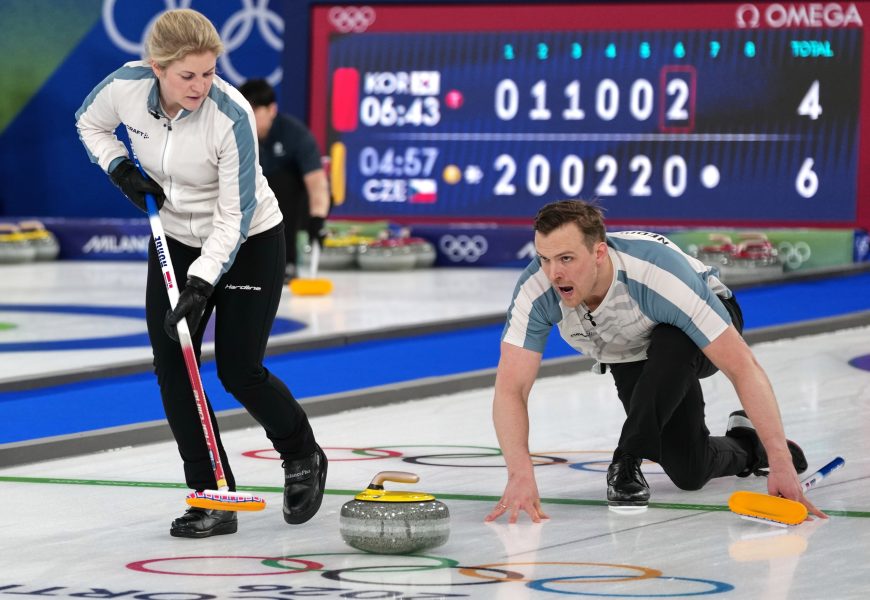

CORTINA D'AMPEZZO, Italy (AP) - When Kristin Skaslien brushed off her husband's playful prod, it was hardly grounds for a divorce. Yet it sure revealed some tension in Norway's curling team at the Winter Olympics.
Then again, giving each other the cold shoulder is hardly new for Skaslien and partner Magnus Nedregotten, one of three married couples in the mixed doubles field at the Milan Cortina Games.
They've screamed at each other, exchanged stony glances, rejected high-fives and pats of comfort. Then, after each match, they've emerged in good spirits, dismissing their discord as normal.
"A little bit of arguing and discussions isn't necessarily bad for us," Skaslien said.
Stress levels are rising at the Olympic Ice Stadium with the semifinals in sight - and the married couples told The Associated Press that good communication is the key to success.
For Jocelyn Peterman and Brett Gallant of Canada and Yannick Schwaller and Briar Schwaller-Hürlimann of Switzerland, there's an added wrinkle: both brought their young children to the Olympics.
Adding to the family feel is Sweden's brother-and-sister team Rasmus and Isabella Wranå, who are curling together after growing up as rivals. Their coach, Alison Kreviazuk, finds it easier to coach siblings than couples.
"If you quarrel with your siblings, you find a way back. They're used to that dynamic of maybe play-fighting a little bit," she said. "Bella can be on the hotter end, and Rasmus is very cool, so it's a good combination."
Skaslien and Nedregotten, bronze medalists at Pyeongchang in 2018, have a routine after coming off the ice. They call it the "hot wash."
"Just after finishing a game, we say one emotion to each other," Nedregotten told the AP. "I will say I'm angry, she will say 'I'm pissed.' Then we go for half an hour to our separate spaces and come back together to analyze what was actually the objective. We usually manage to shake it off."
"Sometimes we are our own worst enemies out there," Skaslien added. "We have to keep it down and not get over the top, because it can get really messy."
They got together in 2008, when Skaslien was competing in the European curling championship and Nedregotten was working on the ice crew. She spotted the quirky fellow as he bopped around the bleachers wearing a wig. They spoke for the first time at a honky-tonk curling party (yes, you read that correctly) in spring 2011.
When Skaslien went abroad for an internship, Nedregotten volunteered to "water her plants" - which is to say, he moved in. A year later, they teamed up for mixed doubles.
Curling isn't exactly ice hockey. Physical fights don't erupt on the ice. If you ask curling couples how competing together impacts their relationship, and they'll tell you everything is dandy.
Still, curlers' facial expressions and interactions on the ice tell a somewhat different story.
It's an intimate - at times agonizing - sport. Between each throw curlers must consult with their partners about where to place their next stone, a task that often involves barking commands - and settling disagreements - in yells across the ice, their words audible to crowds and the opposing team.
No one scrutinizes a mixed doubles curler's throws and sweeping as much as their partner. They win together, they lose together. And if they're married, they then have to go home together.
"There's only two of you. You're on an island," said Devin Heroux, a longtime curling commentator for the Canadian Broadcasting Corporation. "Information sharing. communication and being able to embrace and adapt to the changing conditions will be what allows one of these teams to win gold."
As the Norwegians bicker, the Swiss and Canadian teams keep it more low-key. Indeed, Schwaller and Schwaller-Hürlimann have been the closest thing to lovebirds in the mixed doubles field - exchanging a quick kiss prior to their match.
That doesn't mean everything's perfect, and Schwaller took the fall for being the occasional instigator.
"In the past, I was like just really nice and now sometimes I'm not nice. So I need to apologize and everything is good again," he said.
After the match, they headed straight for their one year old, River. Photos of him carrying a broom roughly double his size made him an overnight sensation in the curling community, with fans dubbing him the "Curling baby."
Schwaller-Hurlimann said it broke her heart to see him so sparingly between games.
"After today's game, when I had to give him back, he was crying and it was hard for me," she said. "That was the first time my mum heart was bleeding."
As for the Canadians, it's not obvious by their conduct they are husband and wife.
"They're both very professional in the way they handle things," said their coach, Scott Pfeifer.
Gallant says communication is "honestly, always a work in progress." When it's flowing, he said, "we seem to have success."
More Top Stories