°C
°C
 4
Min
4
Min
Belarus’ authoritarian president said Thursday that Russia had deployed its latest nuclear-capable Oreshnik missile system to the country, a move that comes as talks to end the war in Ukraine have entered a crucial phase.
Belarusian leader says Russia deployed its latest nuclear-capable Oreshnik missile to the country
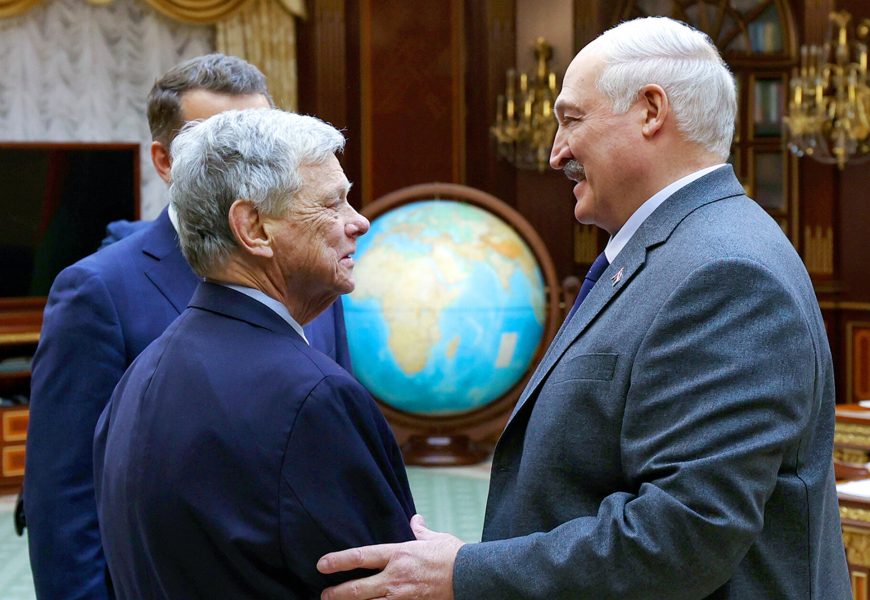

Belarus’ authoritarian president said Thursday that Russia had deployed its latest nuclear-capable Oreshnik missile system to the country, a move that comes as talks to end the war in Ukraine have entered a crucial phase.
President Alexander Lukashenko said the Oreshnik, an intermediate range ballistic missile system, arrived in the country on Wednesday and is entering combat duty. He didn’t say how many missiles have been deployed or give any other details.
Russian President Vladimir Putin said Wednesday that the Oreshnik will enter combat duty this month but didn’t give any other details. Putin made the statement at a meeting with top Russian military officers, where he warned that Moscow will seek to extend its gains in Ukraine if Kyiv and its Western allies reject the Kremlin’s demands in peace talks.
U.S. President Donald Trump has unleashed an extensive diplomatic push to end nearly four years of fighting following Russia’s full-scale invasion of Ukraine in February 2022, but Washington’s efforts have run into sharply conflicting demands by Moscow and Kyiv.
Russia previously has deployed tactical nuclear weapons to the territory of its Belarus, whose territory it used to launch a full-scale invasion of Ukraine in February 2022. Lukashenko has earlier said that his country has several dozen Russian tactical nuclear weapons.
Russia first tested a conventionally armed version of the Oreshnik – Russian for hazelnut tree – to strike a Ukrainian factory in November 2024, and Putin has boasted that it’s impossible to intercept. He has warned the West that Russia could use it next against allies of Kyiv that allowed it to strike inside Russia with their longer-range missiles.
The Russian leader has bragged that Oreshnik’s multiple warheads plunge at speeds of up to Mach 10 and can’t be intercepted, and that several of them used in a conventional strike could be as devastating as a nuclear attack. Russian state media boasted that it would take the missile only 11 minutes to reach an air base in Poland and 17 minutes to reach NATO headquarters in Brussels. There’s no way to know whether it’s carrying a nuclear or a conventional warhead before it hits the target.
Intermediate-range missiles can fly between 500 to 5,500 kilometers (310 to 3,400 miles). Such weapons were banned under a Soviet-era treaty that Washington and Moscow abandoned in 2019.
Putin and Lukashenko have previously said that the Oreshnik will be deployed to Ukraine before the year’s end.
While signing a security pact with Lukashenko in December 2024, Putin said that even with Russia controlling the Oreshniks, Moscow would allow Minsk to select the targets. He noted that if the missiles are used against targets closer to Belarus, they could carry a significantly heavier payload.
In 2024, the Kremlin released a revised nuclear doctrine, noting that any nation’s conventional attack on Russia that is supported by a nuclear power will be considered a joint attack on his country. The threat was clearly aimed at discouraging the West from allowing Ukraine to strike Russia with longer-range weapons and appears to significantly lower the threshold for the possible use of Russia’s nuclear arsenal.
The revised Russian doctrine also placed Belarus under the Russian nuclear umbrella.
Lukashenko has ruled the nation of 9.5 million with an iron fist for more than three decades. His government has been repeatedly sanctioned by the West for its crackdown on human rights and for allowing Moscow to use its territory during the 2022 invasion of Ukraine.
While maintaining strong ties with Moscow, Lukashenko also has sought a rapprochement with the U.S. On Saturday, Lukashenko freed 123 political prisoners, including Nobel Peace Prize laureate Ales Bialiatski, as part of a deal with Washington that lifted U.S. sanctions against the Belarusian potash industries, a key source of export earnings.
More Top Stories