°C
°C
 5
Min
5
Min
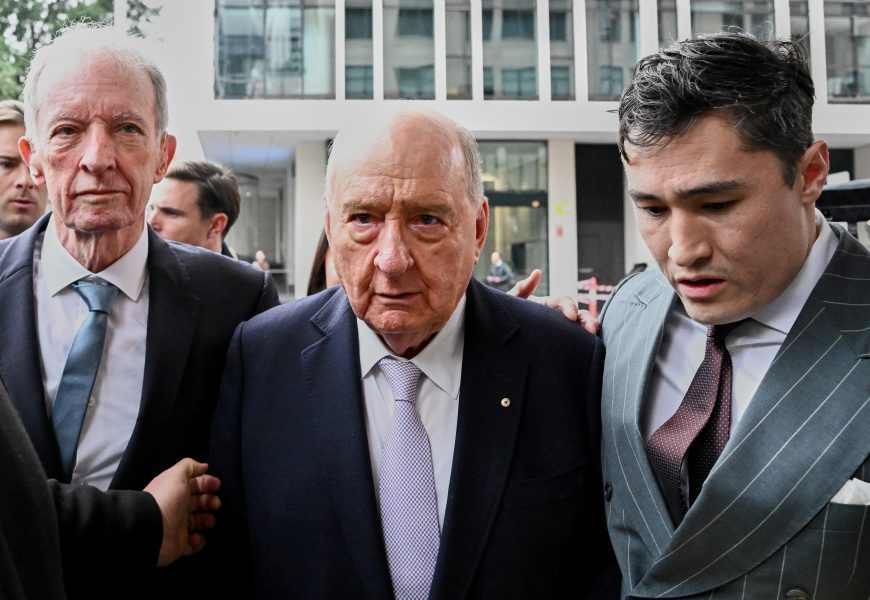
The criminal trial of former radio 2GB host and Wallabies coach Alan Jones, who turned 85 in April, has begun. Arrested at his harbourside apartment in November 2024 following a New South Wales police investigation, Jones is facing allegations that he indecently assaulted, groped or inappropriately touched a number of young men.
Closed court, no jury: a legal expert explains what's happening with Alan Jones' trial

The criminal trial of former radio 2GB host and Wallabies coach Alan Jones, who turned 85 in April, has begun.
Arrested at his harbourside apartment in November 2024 following a New South Wales police investigation, Jones is facing allegations that he indecently assaulted, groped or inappropriately touched a number of young men. He denies all wrongdoing and has pleaded not guilty to all charges.
As it now stands at the start of the trial, six male complainants are listed to give evidence of incidents that are alleged to have happened between 2003 and 2020 at Jones's apartment on Macquarie Street, Sydney, and/or at the property he formerly owned at Fitzroy Falls in the Southern Highlands.
In all, there are 22 charges arising from those alleged incidents, comprising 20 counts of indecent assault, and two further counts of sexual touching.
Why is the court closed?
The trial is being heard in a closed court. This means members of the general public cannot be in the courtroom.
The room in the Downing Centre Local Court chosen for this trial is small. It fits perhaps a couple of dozen people.
It's therefore expected that only Judge Glenn Walsh, the respective legal teams, a small group of media representatives, and officers from the child protection squad will be present during the trial.
The case is being streamed via audiovisual link, but the streaming will cut out when complainants are giving evidence to protect their identities, as is common in trials alleging sexual abuse.
All judge, no jury
Jones's defence team has elected that he be tried by a judge (formerly, until March 2026, known as a "magistrate") in the Local Court rather than to head to the District Court to be tried before a judge and jury. The prosecution has agreed with this course of action.
Election regarding which level of the judiciary will be invited to hear a matter is an option that is available when a person has been charged with less serious offences.
There are a number of reasons an accused person might opt for a Local Court trial:
- if there is a perception a jury might harbour prejudices, or be biased against the accused
- if the nature of the defence is complicated and might confuse a jury
- if there is a perception a jury may be overwhelmed by the social media coverage that will inevitably follow this trial
- there is some evidence verdicts by juries are less favourable to an accused. A study by the NSW Bureau of Crime Statistics for trials between 1993 and 2011 found judges handed down acquittals 55% of the time, compared with juries acquitting the accused only 29% of the time. However a 2014 study of NSW trial outcomes had similar rates at 33% for judges and 35% for juries
- penalties in the Local Court are more lenient. The maximum offence for assault with act of indecency is ten years imprisonment, but that drops to two years if the matter is finalised in the Local Court. (There is no such drop, however, if the victim was under 16).
Judge-alone trials in the District and Supreme Court have become commonplace nowadays. Up to 18% of NSW indictable (more serious) criminal trials are heard by judge alone.
There is no difference in the conduct of a jury trial and a judge-alone trial except that in the former, the judge acts merely as umpire and the jury makes the findings of fact and applies them to the verdicts required. In this case, Judge Walsh himself makes those factual findings and reaches his verdicts.

Who's involved?
Georgina Wright is leading the prosecution case. Her task is to present the evidence of her witnesses to prove beyond any reasonable doubt that the allegations are true.
She will argue Jones either knew he did not have the consent of the young men when he allegedly engaged in the assaults or touching (evidence of which will presumably emerge from the testimonies of the complainants) or that he was recklessly indifferent to the issue of their consent.
Barrister Gabrielle Bashir leads the defence team. She will submit to the judge that there are no direct witnesses other than the accused person and the complainants, and so will argue the alleged events did not occur and the tales regarding them emerged simply out of the opportunism of the complainants.
Moreover, in cases such as these, defence counsel may also offer consent as a defence and call evidence from the accused to that effect. This means Jones could testify he honestly believed a particular complainant consented. As the age of consent in NSW is 16, this defence could extend to the complainant who was 17 years old at the time of Jones' alleged offending.
Whether that defence emerges here (and whether the accused will indeed give evidence) is yet to be seen.
Judge Walsh has been told by counsel that he can expect to hear from more than 70 witnesses.
The trial is expected to last several weeks.
TheConversation.com
Author: Rick Sarre - Emeritus Professor in Law and Criminal Justice, Adelaide University
More Top Stories