°C
°C
 5
Min
5
Min
MOSCOW (AP) – Mourners gathered in Moscow Monday to mark two years since the death in custody of Russian opposition leader Alexei Navalny, under the shadow of a Kremlin crackdown and just two days since a new analysis reinforced suspicions that he was killed by poisoning. Navalny died in an Arctic penal colony on Feb. 16, 2024, while serving a 19-year sentence.
2 years on, Navalny’s death still casts a shadow over Russia and wider Europe
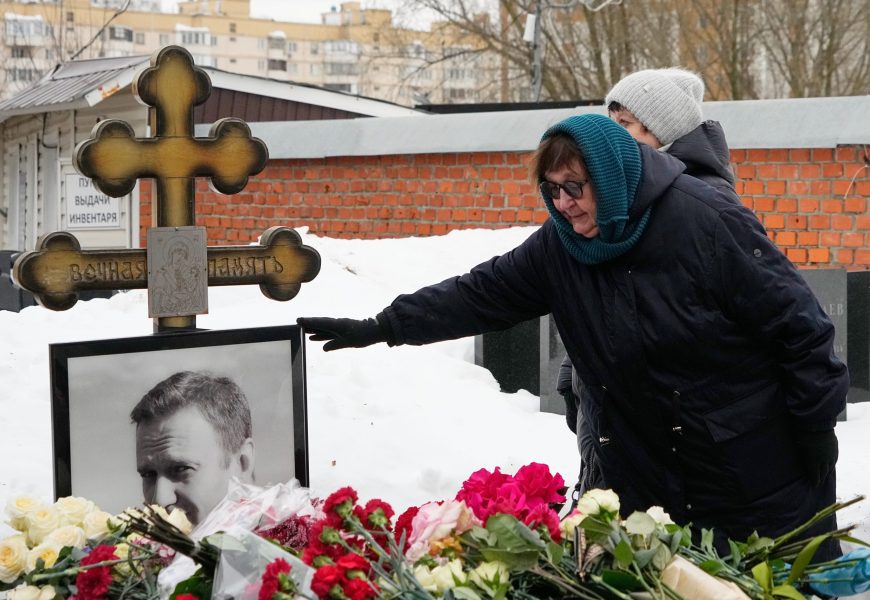
MOSCOW (AP) - Mourners gathered in Moscow Monday to mark two years since the death in custody of Russian opposition leader Alexei Navalny, under the shadow of a Kremlin crackdown and just two days since a new analysis reinforced suspicions that he was killed by poisoning.
Navalny died in an Arctic penal colony on Feb. 16, 2024, while serving a 19-year sentence that many believed to be politically motivated. His death at the age of 47 left the Russian opposition leaderless and divided, struggling to build an effective or united front without one of its most visible and charismatic figures.
On the second anniversary of Navalny's death, we look at the latest investigation into its cause and the continuing political repercussions, both within Russia and beyond.
Navalny's mother, Lyudmila Navalnaya, and his mother-in-law, Alla Abrosimova, were among the mourners laying flowers on his grave. A mound of bouquets rose above the heavy drifts of snow that blanketed Moscow's Borisovsky Cemetery.
Representatives from several European embassies also paid their respects, watched by a conspicuously high security presence. Later, a small choir gathered to sing by Navalny's graveside.
Addressing the crowd, Lyudmila Navalnaya restated her belief that her son was killed by the Russian authorities, a scenario which has also been backed by several European countries in recent days. "We knew that our son did not simply die in prison," she said. "He was murdered."
The Kremlin has denied the allegations, saying that Navalny died of natural causes.
Flowers were also laid at the memorial to the victims of political repression in St Petersburg. Access to the site was later blocked with temporary fences, local news outlets reported.
The anniversary coincides with the release of a joint statement by five European countries, which said that Navalny was poisoned by the Kremlin with a rare and lethal toxin found in the skin of poison dart frogs.
The foreign ministries of the U.K., France, Germany, Sweden and the Netherlands said on Saturday that analysis in European labs of samples taken from Navalny's body "conclusively confirmed the presence of epibatidine." The neurotoxin secreted by dart frogs in South America is not found naturally in Russia, they said.
A joint statement said: "Russia had the means, motive and opportunity to administer this poison."
In a written tribute to Navalny on Monday, French President Emmanuel Macron also linked the Kremlin with the opposition leader's death.
"Two years ago, the world learned of the death of Alexei Navalny. I pay tribute to his memory," Macron wrote on social media. "I said then that I believed his death said everything about the Kremlin's weakness and its fear of any opponent. It is now clear that this death was premeditated.
"Truth always prevails, while we await justice to do the same."
Moscow has vehemently denied its involvement in Navalny's death, saying that the politician had become unwell after going for a walk.
When asked about the allegations by journalists on Monday, presidential spokesperson said that the Kremlin does "not accept such accusations."
"We consider them biased and unfounded. In fact, we resolutely reject them," he said.
Saturday's announcement came as Navalny's widow, Yulia Navalnaya, attended the Munich Security Conference in Germany. She said she had been "certain from the first day" that her husband had been poisoned, "but now there is proof."
"Putin killed Alexei with a chemical weapon," she wrote on social media, describing the Russian leader as "a murderer" who "must be held accountable."
Navalny was the target of an earlier poisoning in 2020, with a nerve agent in an attack he blamed on the Kremlin, which always denied involvement. His family and allies fought to have him flown to Germany for treatment and recovery. Five months later, he returned to Russia, where he was immediately arrested and imprisoned for the last three years of his life.
Navalny's closest allies, as well as other key members of Russia's opposition, now continue their fight from exile.
Many have been handed lengthy prison sentences in absentia in Russia and are unable to return home. Some have been designated "terrorists and extremists" by the authorities, a designation that was also applied to Navalny in January 2022.
Yet Russia's opposition has failed to form a united front and a clear plan of action against the Kremlin. Instead, rival groups have traded accusations that some see as efforts to discredit each other and vie for influence.
In one small victory for opposition activists, Europe's leading human rights body, PACE, announced in late January the creation of a new body - the Platform for Dialogue with Russian Democratic Forces - tasked with giving opposition Russians a voice and a formal platform to engage European lawmakers.
It has been heralded as a victory for anti-war Russians, but also attracted criticism as the body was not elected democratically. Members of Navalny's anti-corruption organization are also absent from the group
In a statement to mark Navalny's death, Russian members of the Council of Europe's human rights body, PACE, said that Navalny's death was "an inevitable link in a chain of systemic crimes by the Kremlin regime against its own citizens and the citizens of foreign states."
"Alexei Navalny gave his life for a free Russia," the statement said. "We are obliged to ensure that his death was not in vain."
More Top Stories