°C
°C
 4
Min
4
Min
LOS ANGELES (AP) – Math nerds and dessert enthusiasts unite to celebrate Pi Day every March 14, the date that represents the first three digits of the mathematical constant pi. Representing the ratio of a circle’s circumference to its diameter, pi is approximately equal to 3.14159 – but its digits go on forever.
From rockets to cancer research, here’s how the number pi is embedded in our lives
LOS ANGELES (AP) - Math nerds and dessert enthusiasts unite to celebrate Pi Day every March 14, the date that represents the first three digits of the mathematical constant pi.
Representing the ratio of a circle's circumference to its diameter, pi is approximately equal to 3.14159 - but its digits go on forever. In school, you might have used it to calculate the area of a circle or the volume of a cylinder. But the applications of pi are endless and part of every corner of our world.
The holiday was created in 1988 by Larry Shaw, a physicist at the Exploratorium science museum in San Francisco.
"He had a very open and expansive view of the world and saw an opportunity with this number, mathematical concept, to invite people into the joy of mathematical learning," said Sam Sharkland, program director of public programs at the museum, who worked with Shaw before he died in 2017.
While it began as a small staff celebration featuring pie, it soon turned into a grand procession where hundreds of visitors marched around the pi shrine, each carrying a digit. Attendees often show up early to claim their favorite digit for the parade. One woman who has the symbol tattooed on her neck comes every year and marches near the front with a pi flag, Sharkland said.
The celebration begins at 1:59 p.m., signifying the next three digits of pi.
Here are a few ways pi is being used on the cutting edge of science.
In Artur Davoyan's field of mechanical and aerospace engineering, pi is so fundamental that it would be hard to pinpoint one use case for it, he said.
Pi is part of "literally every single formula that you would use to do any calculation, like for spacecraft motion, for materials and how they work, or propulsion systems," said Davoyan, a professor at the University of California, Los Angeles.
Anything that is round or has cyclical or repeating properties - such as radio waves - involves pi. Even squares or irregular blobs can be broken down into a series of progressively smaller circles and calculated using pi, Davoyan said.
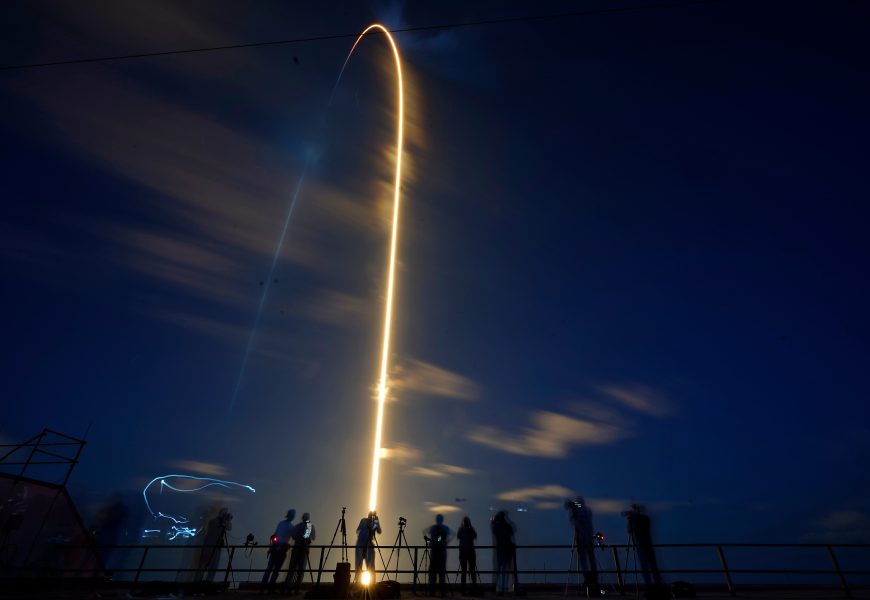
Davoyan's research looks at how to create new propulsion systems to send spacecrafts more quickly to the far reaches of the solar system to gather and send back information to Earth. He pointed to NASA's Voyager 1 and 2, which launched in 1977 but didn't reach interstellar space until 2012 and 2018.
To send a signal to those space probes, NASA must calculate Earth's exact position in orbit around the sun and design antennas for communication using pi. Then scientists use pi once more when receiving and breaking down complex signals that are being beamed back to Earth.
"Say aliens send something to us, something that we don't know how to deal with," Davoyan said. "So the very first thing that you would do, you would try to split it into simple functions... and turns out that when you do this operation, you will naturally have pis in it."
Pi also comes up frequently when studying small amounts of fluids.
Dino Di Carlo, chair of the bioengineering department at the UCLA Samueli School of Engineering, conducts research that involves creating little particles out of polymers that act as tiny test tubes for cells. This is used as an important tool to examine cells closely and learn about their functions and what's inside them.
The pi constant is used in calculating how to form those droplets, surface tension calculations that define how droplets can break up, and how researchers can control the size of those volumes, Di Carlo said.
Di Carlo is using this technique to find antibodies - small proteins that fight diseases in your body - that could block signals put out by cancer cells.
Pi is also an important part of calculations when looking at how liquids flow through tubes and barriers. One example is when the fluid sample slowly flows sideways in a take-home COVID-19 test.
Di Carlo used these properties to devise a new test for Lyme disease that can be completed in 20 minutes, rather than days or weeks like previously.
"As an engineer and scientist, (pi) is just a part of life," Di Carlo said. "Maybe I've taken it for granted."
More Top Stories