Estimated reading time 21 minutes 21 Min

The Latest: Israel hits Tehran as Trump signals willingness to talk with Iran's new leadership

U.S.-Israeli strikes on Iran continued for a second day on Sunday after the killing of Iranian Supreme Leader Ayatollah Ali Khamenei threw the future of the Islamic Republic into uncertainty and raised the risk of regional instability. There were explosions in Tehran on Sunday as Israel said it was taking its attacks to the "heart" of Iran's capital.


March 2, 2026
2 March 2026

U.S.-Israeli strikes on Iran continued for a second day on Sunday after the killing of Iranian Supreme Leader Ayatollah Ali Khamenei threw the future of the Islamic Republic into uncertainty and raised the risk of regional instability.

There were explosions in Tehran on Sunday as Israel said it was taking its attacks to the "heart" of Iran's capital.

Iran retaliated by firing missiles and drones at Israel and at U.S. military installations around the Gulf, and also at the Saudi capital and the global business hub of Dubai. Earlier Sunday, Iran's paramilitary Revolutionary Guard threatened to launch its "most intense offensive operation" ever, targeting Israel and U.S. bases.

Iran selected a 66-year-old cleric to join the three-member leadership council that will govern the country until a new supreme leader is selected.

President Donald Trump told The Atlantic in an interview on Sunday that he planned to speak with Iran's new leadership.

"They want to talk, and I have agreed to talk, so I will be talking to them," he said, declining to comment on the timing.

Here is the latest:

Trump signals willingness to talk to Iran's new leaders

A senior White House official says that "new potential leadership" in Iran has suggested they are open for talks with the United States.

The official, speaking on condition of anonymity to discuss internal administration deliberations, said President Donald Trump says he is "eventually" willing to talk, but for now the military operation "continues unabated."

The official did not say who the potential new Iranian leaders are or how they made their alleged willingness to talk known.

Trump told The Atlantic in an interview on Sunday that he planned to speak with Iran's new leadership.

"They want to talk, and I have agreed to talk, so I will be talking to them," he said, declining to comment on the timing.

9 Iranian naval vessels sunk - Trump

U.S. President Donald Trump said on social media that nine ships in the Iranian navy had been "destroyed" and sunk, "some of them relatively large and important."

Trump said the rest of Iran's fleet of military vessels "will soon be floating at the bottom of the sea, also!"

Death toll from strike on school now 165 - Iranian state media

The death toll in strike at an all girls school in southern Iran has risen to 165, according to the state-run IRNA news agency.

The local prosecutor of Minab in Iran's Hormozgan province was quoted Sunday as saying 96 other people were injured in the strike.

A local official said the casualties from the Saturday strike included students, parents and school staff.

The Israeli military said it was not aware of strikes in the area. The U.S. military said it was looking into the reports.

CIA tracked Iranian leaders' movements for months

The CIA tracked the movements of senior Iranian leaders, including Ayatollah Ali Khamenei, for months before Saturday's airstrikes, according to a person familiar with the operation who was not authorized to comment publicly and spoke on condition of anonymity.

The intelligence was shared with Israeli officials, and the timing of the strikes was adjusted in part because of that information about the Iranian leaders' location, the person said.

The New York Times earlier reported about the CIA's efforts ahead of the Israeli-U.S. strikes.

Attack on Iran is an 'illegal disastrous war' - US senator

Sen. Chris Murphy is predicting that the air campaign against Iran will backfire and result in an even more hardline government in Tehran.

"We're not going to get a democracy. We're going to get an even worse leadership," Murphy told CBS' "Face the Nation". "It's no secret that our allies in the region, with the exception of the right-wing government in Israel, they begged us not to take this action."

The Connecticut Democrat and member of the Senate Foreign Relations Committee said regime change in Iran would never succeed without troops on the ground - something that President Donald Trump has ruled out.

Barring that, Murphy said he expects the Iranian regime to hold on to power and reconstitute itself in a more hardline form.

Iran's ballistic missile sites hit - US military

B-2 stealth bombers struck Iran's ballistic missile facilities with 2,000-pound bombs, the U.S. military said Sunday in a post on X.

Ballistic missiles have been one of the concerns President Donald Trump has raised in the lead up to the attacks on Iran. Trump has claimed that Iran has been building ballistic missiles that could reach the U.S. homeland.

Iran hasn't acknowledged it is building or seeking to build intercontinental ballistic missiles.

The U.S. Defense Intelligence Agency said in an unclassified report last year that Iran could develop a militarily viable intercontinental ballistic missile by 2035 "should Tehran decide to pursue the capability."

Airstrikes to last 'probably a few weeks' - US senator

U.S. Sen. Tom Cotton, the chairman of the Senate Intelligence Committee, says he expects the massive airstrike campaign against Iran will continue for "probably a few weeks."

The Arkansas Republican told CBS' "Face the Nation" that President Donald Trump "has no plan for any kind of large-scale ground force in Iran."

Cotton would not say how the U.S. and Israeli knew the location of slain Iranian Supreme Leader Ayatollah Ali Khamenei

"We have exquisite intelligence collection methods," he said. "Israel and the United States once again proved that our nation have capabilities that no other nation on Earth has."

Crowds in Paris welcome strikes on Iran

Thousands of jubilant demonstrators marched through Paris on Sunday to celebrate the U.S. and Israeli strikes and express hope for regime change in Iran.

Waving Iranian, Israeli, American and French flags, the crowd chanted ″Freedom for Iran!″

Members of the large Iranian diaspora in France and their French supporters marched from Bastille Plaza, birthplace of the French Revolution, toward a statue of Joan of Arc. One group opened a bottle of Champagne, and the atmosphere was festive.

The night before, a crowd of Iranian demonstrators danced across from the Eiffel Tower.

Paris also saw a small counter-protest Sunday by left-wing groups denouncing ″American imperialism″ and warning of broader war.

Meanwhile, France is postponing an international conference meant to bolster Lebanon's security because of the widening conflict in the Middle East.

″Conditions are not met″ to hold the conference as scheduled in Paris on March 5, French President Emmanuel Macron's office said Sunday. It said Macron spoke Sunday with Lebanese President Joseph Aoun and they jointly decided to delay it until April.

Tehran's residents stay off streets

The streets were almost empty in Iran's capital Sunday. Merchants said shoppers were buying in bulk while supplies were arriving in Tehran at a trickle.

Ali, a 42-year-old produce vendor, said trucks of potatoes and tomatoes were arriving in fewer numbers because drivers were wary of driving into the capital while strikes were ongoing.

"People are buying as much as they can out of fear of the current mess," said Ali, who only agreed to give his first name out of fear for his own security.

Some residents expressed fear of the strikes, but also of the future.

Reza Mehrabi, 67, said celebrations of the deaths of Iranian senior leaders seem premature. He recalled similar celebrations after the 1979 revolution when the Shah was deposed, and the Islamic Republic reign began.

"I saw some people were happy about the losses, but when I remember 1979 revolution and its aftermath, I need more consideration to understand if the nation and the country is on the right path."

'I am leading this transition,' says former Shah's exiled son

Reza Pahlavi, the exiled son of Iran's last shah overthrown during the 1979 Islamic Revolution, claims he is taking charge of the transition to a new government.

Speaking to Fox News Channel's "Sunday Morning Futures," he said: "This is time now for a very strong, stable transition. I am leading this transition. I have the support of millions of Iranian people. I have the people inside the country that are joining ... the military will side with us. We have a plan of action and a transition plan."

He says that process would lead ultimately "to a democratic outcome so the Iranian people get to choose their future government and system."

Asked how long his transitional leadership would be, he said that "to be realistic from the time that we start until the day we can have the final referendum, I anticipate a period that should be longer than a couple of years at the most. But what's critical is the first 100 days."

Iran's military remains in place - FM

Iran's Foreign Minister Abbas Araghchi says that despite the attacks on his country, "nothing has changed in our ... military capability."

He tells ABC's "This Week" that in only a few hours after Iran was struck, Tehran retaliated against Israeli targets and American bases "and we have continued to do so. So, our military is in place. They are capable enough to defend our country."

Asked whether a diplomatic deal with the Trump administration was still possible, he said, "We negotiated with the United States twice in the past 12 months. And in both cases, they attacked us in the middle of negotiation. And that has become a very bitter experience for us."

He said "a deal was at our reach, and we left Geneva happily with the understanding that we can reach a deal next time we meet."

Rescuers dig through rubble of Israeli synagogue

First responders dug through rubble in a search for survivors hours after a missile struck a synagogue in a central Israeli town.

At least nine people were killed in the Beit Shemesh region, according to Israeli police. It's the deadliest attack on Israel since it launched attacks on Iran jointly with the U.S. on Saturday.

The victims were sheltering in a safe room in the synagogue when a missile struck it, according to emergency responders, who said the number of dead could rise.

Crowds of people from the community gathered Sunday overlooking the gaping hole in the ground where the missile struck. The area was surrounded by bombed-out cars, slabs of concrete and houses with their roofs blown off.

"It's really sad that people came to hide and actually died in a synagogue," said Chaim Stenge, 13.

Residents said they want the war to continue. "Bibi and Trump well done," said Hagit Ben Ezra, referring to the Israeli and American leaders. "Bibi Netanyahu has to kill Hamas and Iran so there's quiet in the Middle East."

Istanbul protests denounce strikes on Iran

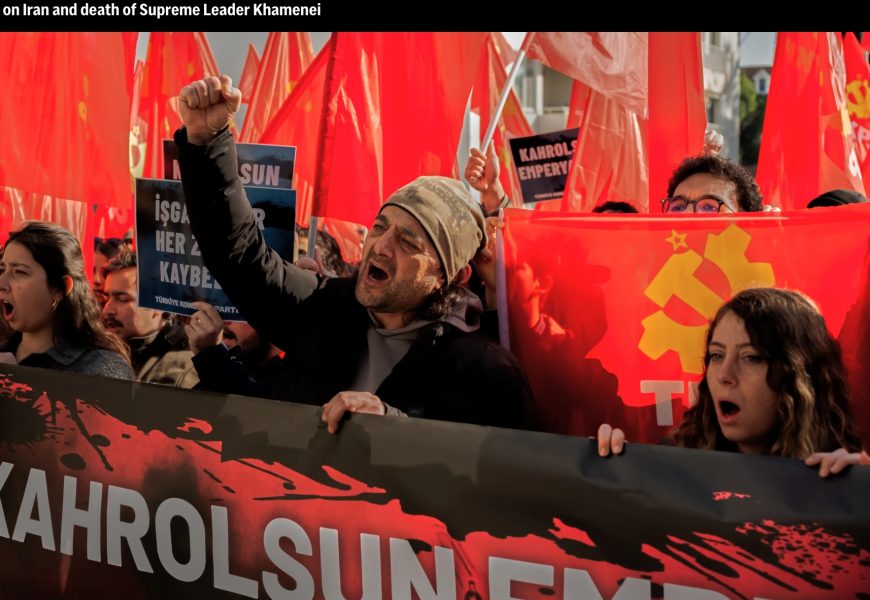
Hundreds of protesters gathered at multiple locations in Istanbul to denounce the Israeli-U.S. attacks on Iran. A demonstration in front of Israel's Consulate ended with protesters burning the U.S. and Israeli flags as well as posters of President Donald Trump and Israeli Prime Minister Benjamin Netanyahu.

A protest was also held near city hall, where people chanted and held up signs against Israel and the United States.

"We reject and denounce American oppression and America's actions," one of the protesters, Ahmet Agirakca, told The Associated Press. "We have gathered here not only to condemn but also to show that we will fight against them for the rest of our lives."

Another protester, Ali Emre, said he was there to show solidarity with Muslims "and to protest Trump, the USA, and global imperialism."

Doctor describes celebrating Khamenei's death

A doctor in northern Iran said he and colleagues spent the early hours of Sunday celebrating indoors news of the death of Supreme Leader Ayatollah Ali Khamenei, because armed security forces were heavily deployed in his city.

Security forces were stopping and interrogating people celebrating in their cars, he said, but there was no gunfire.

"It was one of the best nights, if not the best night of our lives," the doctor said in a voice message from the city of Rasht in northern Iran. He spoke on condition of anonymity for fear of reprisal. "It was actually my first time ever smoking a cigarette. ... We didn't sleep at all. And we don't even feel tired."

Iranian missiles did not hit carrier - US military

The U.S. military is pushing back against claims by Iran's leadership that the USS Abraham Lincoln aircraft carrier was struck in an attack, stating that the "missiles launched didn't even come close."

U.S. Central Command said in a post on X that the American warship continues to launch aircraft. The Lincoln is one of two aircraft carriers that the U.S. military has deployed to the region.

Central Command posted its statement shortly after releasing another statement that three U.S. service members have been killed in the U.S. military operation against Iran.

Iranians in Berlin and Vienna celebrate Khamenei's death

Iranians in Berlin and Vienna took to the streets to celebrate the death of Supreme Leader Ali Khamenei.

Hundreds gathered in front of the U.S. Embassy in Berlin. They held pre-1979 Iranian flags as well as Israeli and American flags, as they danced and sang near the Brandenburg Gate.

Demonstrators included supporters of Reza Pahlavi, the exiled son of Iran's last shah overthrown during the 1979 Islamic Revolution.

More than 1,000 people also celebrated in Vienna, according to the city police quoted by the Austrian press agency.

Hezbollah supporters in Lebanon pay tribute to Khamenei

Hundreds of supporters of the Iranian-backed Hezbollah militant group gathered south of Beirut to mourn the death of Iranian Supreme Leader Ali Khamenei

They chanted anthems and slogans paying tribute to Khamenei and Iran. They waved the flags of Iran and Hezbollah, some beating their chests.

Hezbollah is Iran's most powerful proxy in the region, but it suffered heavy losses in a monthslong war with Israel in 2024. It has not taken military action in solidarity with Tehran, as Lebanon's political leadership tries to keep the nation out of the conflict for fears of a spillover.

3 US service members killed, 5 wounded

The U.S. military says three service members have been killed and five seriously wounded in the Iran operation.

Central Command made the announcement on social media Sunday without providing additional information.

Italy says Iran's hard-line stance provoked attacks

Italy blamed Iran for provoking the U.S. and Israeli attack, saying its hardening position about its nuclear and long-range missile aspirations had "posed a threat to everyone."

"The obvious issue was the atomic bomb and the increase in the production of long-range missiles that posed a threat to everyone," Foreign Minister Antonio Tajani said Sunday.

Tajani also strongly condemned Iran's retaliatory strikes as "senseless" and said they had only served to further isolate Tehran. He said countries hit by Iran had the right to respond.

"I hope the situation doesn't worsen but I sensed a strong irritation of all the ministers and leaders of countries hit by Iran about the Tehran regime," Tajani said.

Who takes shelter in Jerusalem?

Sirens ring out periodically in Jerusalem to signal incoming missiles from Iran, but the warnings are received differently in different parts of the city.

In the west of the city, where most Israelis live, the streets are relatively empty, though some kids could be seen running around in neighborhood playgrounds. It seemed Israelis are mainly staying close to home so they can get to shelters quickly if necessary.

In the east of the city, however, Palestinian residents go about their normal lives, shopping for meals during the holy month of Ramadan. There are some public shelters in east Jerusalem but they are far less common than in the west.

US senator warns US doesn't know what follows Khamenei's death

Sen. Mark Warner, D-Va., said that the death of Iran's Supreme Leader Ali Khamenei is creating uncertainty about the trajectory of the conflict.

"We have had very little visibility into what happens next after the supreme leader is eliminated," Warner told CNN on Sunday. "I think we still don't know what is happening next."

Warner said he hoped the Iranian people would rise up, but he didn't believe that would be the outcome. He said the fear is that the U.S. is seeing the "opening salvos" of "what could be a sustained war in the region."

Maersk rerouting ships from Suez to Cape of Good Hope

Maersk, the world's biggest shipping company, said it has paused vessels' traffic through the Ban el-Mandab Strait and the Suez Canal.

The company said in a statement Sunday it has decided to reroute the ships from the Suez Canal to the Cape of Good Hope.
Iranian-backed Houthi rebels in Yemen had targeted vessels in the Bab el-Mandeb and the Red Sea in 2024 and 2025.

Turkey's Erdogan calls for diplomacy

Turkish President Recep Tayyip Erdogan emphasized that diplomacy remains "the most rational path forward" during a telephone call with Saudi Crown Prince Mohammed bin Salman.

According to a statement from the Turkish presidency, Erdogan also extended his well‑wishes to Saudi Arabia following recent attacks on the country and warned that, without decisive action, the conflict could escalate with "serious consequences for both regional and global security."

Iraqis mourn the Iranian leader's death

Hundreds of Iraqis have decried the killing of Iran Supreme Leader Ali Khamenei and expressed solidarity with the Islamic Republic.

The mourners wore black and waved flags belonging to Iran-backed Iraqi militias and red flags that symbolize vengeance in the Shiite Muslim faith as they marched across Sadr City. Some held Iran flags and portraits of Khamenei, who was killed in U.S. and Israeli strikes across the Islamic Republic.

Iraq has for years tried to balance a delicate relationship with both the U.S. and Iran, and has called for an end to the conflict and a return to dialogue.

Iran's retaliatory strikes on U.S. bases have struck a handful of cities across the Mideast, several in the northern Iraqi city of Irbil.

US senator disagrees with Trump's 'gamble' on Iran

A leading U.S. senator says he fears that President Donald Trump will cause "a more repressive, more aggressive Iranian regime" by "choosing the path of war when diplomacy was still within reach."

Sen. Chris Coons, a Delaware Democrat and a member of the Senate Foreign Relations Committee, also says he hopes "our national security apparatus is as prepared as it can be for attacks anywhere in the world against the United States and our interests."

Coons says he understands Trump "taking a bold gamble" given how "weak" the Iranian leadership was, "but I disagree with this gamble at this point."

OPEC Plus will increase oil production

OPEC Plus, a group of eight oil-producing countries, says it will increase oil production by 206,000 barrels a day in April in an effort to mitigate the impact on oil prices during the latest conflict in the Middle East.

The group, which includes Arab Gulf countries and Russia, has said in a statement that its members will "closely monitor and assess market conditions, and in their continuous efforts to support market stability."

New leadership council begins its work in Iran

Iran's President Masoud Pezeshkian said Sunday that a new leadership council "has begun its work" after the death of Supreme Leader Ayatollah Ali Khamenei.

Pezeshkian made the comment in a prerecorded message aired on Iranian state television.

Pezeshkian is one of three officials on the council. The other two are head of judiciary cleric Gholam Hossein Mohseni Ejehei and Ayatollah Ali Reza Arafi.

Vessel attacked in Strait of Hormuz

A second vessel has come under attack in the Strait of Hormuz, according to an agency of the British military.

The U.K. Maritime Trade Operations center said that the attack happened off Mina Saqr, United Arab Emirates.

It said that the vessel had been hit by a projectile that caused a fire. The blaze was extinguished and the vessel will continue on its way.

Another vessel earlier in the Strait of Hormuz off Iran also came under attack. The attacks come as Iranian officials reportedly have been threatening vessels transiting the strait over the radio.

The Strait of Hormuz sees a fifth of the world's traded oil pass through it.

1 killed, 20 wounded in Kuwait in latest barrage from Iran

Kuwait's Ministry of Health says one person has been killed and 20 people have been wounded in new retaliatory attacks by Iran.

The country's news agency reported the latest toll. None of the casualties are Kuwaiti citizens, the ministry said.

A dozen people were injured in Kuwait in previous attacks on Saturday.

The Kuwaiti army said Sunday that it has destroyed a number of ballistic missiles and drones launched against the Gulf country "since the start of the Iranian aggression."

The spokesperson for the Kuwaiti defense ministry, Saud Abdulaziz al-Otwan, said in a statement 97 Iranian ballistic missiles launched toward the State of Kuwait were detected, along with 283. He said debris falling on facilities led to "minor material damage."

North Korea condemns strikes on Iran

North Korea has condemned the joint U.S.-Israel strikes on Iran as an "illegal act of aggression" and "the most despicable form of violation of sovereignty."

The North's foreign ministry in a statement on Sunday said the attack shows how they continue to destabilize the region by pursuing hegemonic interests under the pretext of "fake peace."

North Korea has suspended meaningful dialogue with Washington since 2019, when a summit between leader Kim Jong Un and President Donald Trump during his first term collapsed over disagreements on exchanging the release of U.S.-led sanctions and the North's denuclearization steps.

Pyongyang and Tehran were among the few governments in the world that supported Russian President Vladimir Putin's invasion of Ukraine, and both have been accused of providing Russia with military equipment.

US priority is Iran's 'vast missile arsenal'

The chairman of the U.S. Senate Intelligence Committee says a priority for its joint military campaign is Iran's "vast missile arsenal."

Republican Tom Cotton of Arkansas told CBS' "Face the Nation" that those missiles threatened American troops "from bases as far flung as the Indian Ocean to Western Europe."

"We're stopping a lot of them from being fired before Iran can fire them. It's much easier to kill the archer on the ground than it is to shoot his arrows out of the sky," he said in the television interview.

3 people killed in the UAE

The United Arab Emirates' Defense Ministry said Sunday that three people have been killed so far in Iranian attacks on the country.

The ministry said Iran had launched 165 ballistic missiles targeting the country, of which 152 were destroyed. Thirteen fell into the sea, it added.

Iran launched 541 bomb-carrying drones at the UAE, of which 506 were destroyed. Another 35 struck the country, killing three people from Pakistan, Nepal and Bangladesh, while 58 others were wounded.

Iran has launched 97 ballistic missiles at Kuwait

Iran fired 97 ballistic missiles and 283 drones at Kuwait since the start of the war between the U.S., Israel and Iran, the Gulf nation's military said.

The military said in a statement interception operations led to shrapnel falling in parts of the county, causing "limited damage."

On Saturday, the military said three Kuwaiti troops were wounded when shrapnel landed in the Ali Al Salem air base.

At least 6 killed in Israel

Israel's police said at least five people were killed and 23 others wounded in a strike that hit central Israel on Sunday.

A spokesperson for the rescue services said searches were ongoing for additional victims.

Iran has so far launched dozens of rockets at Israel.

Saudi Arabia summons Iranian ambassador

This follows repeated Iranian attacks on the kingdom.

The state-run Saudi Press Agency said the country expressed "dismay, condemnation and denunciation of the Iranian attacks on the kingdom and the Gulf states."

It added that the kingdom "will take all necessary measures to defend its security and protect its territory."

South Korea prepares plans to ensure safety of nationals in Mideast

South Korea says it's preparing emergency evacuation plans and considering the deployment of response teams to the Middle East to guarantee the safety of South Korean nationals.

The Foreign Ministry said Second Vice Foreign Minister Kim Jina chaired back-to-back meetings over the weekend with officials from the country's embassies in Iran and Israel, as well as other Middle East missions, to assess the conflict's impact on the safety of Korean nationals.

There are about 60 South Koreans in Iran and about 600 in Israel, including about 100 short-term visitors, according to the ministry. No casualties among South Koreans had been reported as of Sunday, but Kim warned that uncertainty in the region could intensify.

More Top Stories