°C
°C
 5
Min
5
Min
ASSISI, Italy (AP) – The bones of St. Francis of Assisi went on public display for the first time Sunday, capping an 800-year saga over his bodily remains and confirming the enduring appeal to Christians of venerating a saint’s relics.
Display of St. Francis of Assisi’s bones confirms enduring appeal of relics for Christians
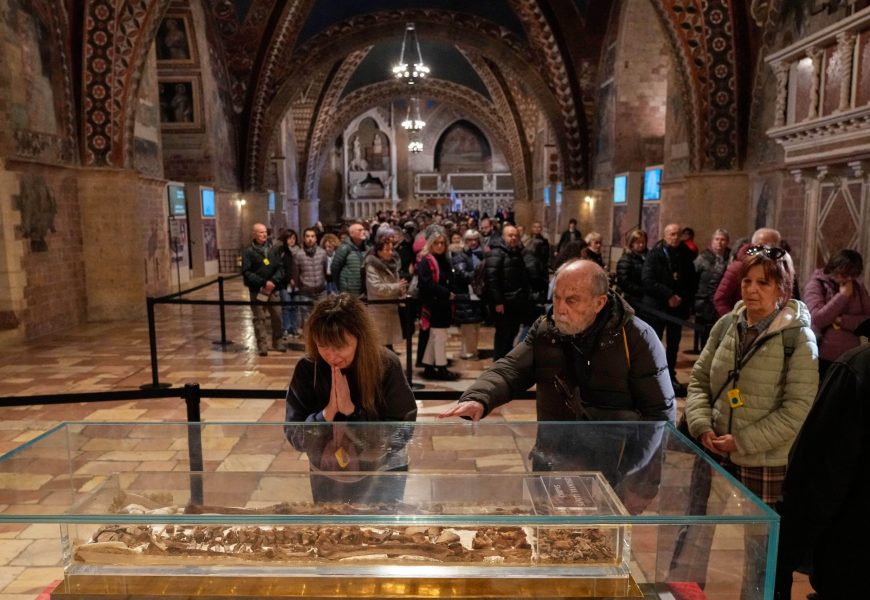

ASSISI, Italy (AP) - The bones of St. Francis of Assisi went on public display for the first time Sunday, capping an 800-year saga over his bodily remains and confirming the enduring appeal to Christians of venerating a saint's relics.
Nearly 400,000 people registered in advance to see the bone fragments, which are contained in a slim, bulletproof Plexiglas case in the lower Basilica of St. Francis in the hilltop Umbrian town the medieval friar made famous.
The Franciscans decided to exhibit the bones for one month, through March 22, to honor the 800th anniversary of St. Francis ' death in 1226. The aim is to revive his message of peace and fraternity that made him one of the most beloved Christian saints and inspired Pope Francis to take his name, the first pope to do so.
The exposition of his bodily remains is particularly remarkable given the somewhat tortured history of the body of St. Francis, a wealthy merchant's son born in 1182 who gave up all his possessions to live as a mendicant friar.
At the end of his life, St. Francis' body was said to have acquired the stigmata, the first documented case of a saint acquiring the marks of Christ on the cross.
In death, his body was lost for hundreds of years, after it was secretly buried by one of his followers who feared it would be stolen during the fight over relics that was common in Christianity in the Middle Ages.
That history is recounted in an exhibition mounted in the Franciscan convent, adjacent to the basilica, which pilgrims can visit as part of their appointment to pass by the bones.
Brother Giulio Cesareo, spokesman for the Franciscans in Assisi, said the exposition wasn't a macabre celebration of the dead. Rather, he said, it was part of the long tradition of Christians venerating the physical remains of saints to experience the spirit that lived in them.
"It is not so much about venerating Francis, but rather encountering Francis by venerating the Holy Spirit who filled that humanity and made it capable of giving itself," he said. "And it is, at least for a believer, a way to renew oneself in this one life."
Over centuries, the fascination with relics has of course led to abuses, with thefts, forgeries and now online sales all part of their history. But that doesn't diminish their hold on the faithful, said Sean Pilcher, who runs Sacra: Relics of the Saints, which provides consulting and authentication services to the Catholic Church.
If the saints are our brothers and sisters in heaven, "then it makes sense that we're going to have things that we hold on to," he said. "And what the church does is just take this natural desire that we all have for connection and belonging and direct it in a way that leads us toward Christ."
What is remarkable to a viewer today is how tiny St. Francis seems: He was known to suffer poor health and nutrition, and the delicate, slight skeletal bones seem to confirm his diminutive stature.
For Fiorella Farina, a resident of northern Reggio Emilia who is so devoted to St. Francis that she bought a country house in Assisi and named her children Francesco and Francesca, the exposition is a once-in-a-lifetime opportunity.
"Just talking about it gives me goosebumps," she said outside the basilica. "It's an event I couldn't miss."
St. Francis, she said, went against all societal norms to live out the Gospel message of peace, care for the poor and the environment.
"In this historic moment, we need him," she said.
Security was tight but discreet on Sunday morning as the first pilgrims passed through metal detectors before filing into the basilica. Police declined to provide details, but said extra officers, sniffer dogs, plain-clothed police, television cameras and other measures were being used to protect the relics.
Given the history of St. Francis' body, such measures seem only appropriate.
Even before he died, St. Francis had gained such a reputation for sanctity that he traveled with an armed escort when he made his final return to Assisi, said Brother William Short, professor of Christian spirituality at the Franciscan School of Theology at the University of San Diego.
There are also references in contemporary accounts of people reaching up to try to grab parts of his tunic as he went by on horseback, believing that his relics could help heal the sick or prevent calamity, Short said in an interview at the Franciscan residence in Rome, where he directs an international Franciscan study center.
When St. Francis died Oct. 3, 1226, he was initially buried in a small Assisi church, San Giorgio. Within two years, Pope Gregory IX had canonized him and laid the cornerstone for a basilica to house his tomb.
But on the eve of the transfer, St. Francis' trusted aide, Brother Elias, took the body and secretly buried it in the basilica, fearing it could be stolen, said Short. The body remained there, hidden in a column but unmarked, until 1818. That's when excavations discovered the remains and Pope Pius VII confirmed the bones belonged to St. Francis.
"It was a matter of safety and economics," Short explained. "If you have a big saint, a new saint - and this guy had the potential to be a really big saint - whoever gets the body gets the pilgrims."
And Assisi now has them, in spades.
Some people signed up to visit the relics when the exposition was first announced in October, and they were slotted into 10-minute increments starting Sunday morning.
Silvanella Tamos traveled to Assisi from Pordenone, north of Venice, with a group of 54 people from her diocese. They had had one of the earliest slots Sunday, at 9:30 a.m.
"It's a body that's alive," she said. "It's not a dead body. He still has a lot to tell us today," she said.
More Top Stories