°C
°C
 4
Min
4
Min
MILAN (AP) – A 15th-century statue that once stood outside Milan’s iconic Duomo has found a new home. The Bearded Saint with Book was recently restored under the “Adopt a Statue” program, launched in 2020 by the centuries-old institution that oversees the cathedral’s conservation.
‘Adopt a Statue’ program for Milan’s iconic Duomo restores centuries-old marbles
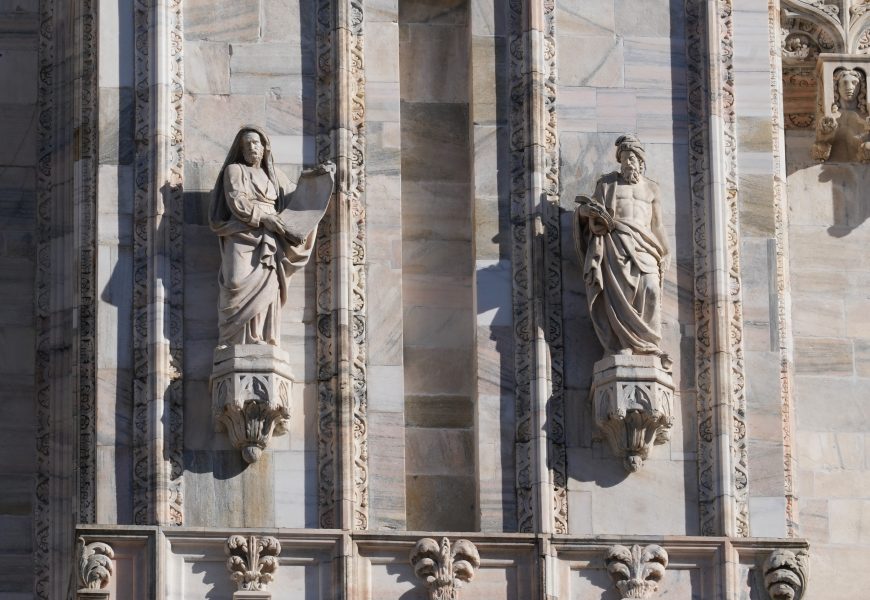
MILAN (AP) - A 15th-century statue that once stood outside Milan's iconic Duomo has found a new home.
The Bearded Saint with Book was recently restored under the "Adopt a Statue" program, launched in 2020 by the centuries-old institution that oversees the cathedral's conservation. As of Feb. 13, it is on display at Piazzale Cadorna, behind a glass window at the headquarters of FNM, a Lombardy-based transport company.
The program recruits donors - either companies or individuals - to fund restoration of a statue under a loan agreement that allows it to occasionally be displayed outside the Duomo.
"The uniqueness of this project is that statues that would otherwise remain in our deposits are restored and brought back to their original beauty," the program's project manager, Elisa Mantia, said in an interview with The Associated Press. "In that way, they can continue to tell the story of the Duomo even in places that are far from the monument."
These agreements are in some cases granted for an initial one-year term and may be renewed. The initiative follows previous fundraising campaigns in which donors could adopt gargoyles or spires in exchange for inclusion in the Duomo's donor register, where contributors' names are recorded as part of the cathedral's long history of support.
The construction of the Duomo began in 1386, under the rule of Gian Galeazzo Visconti, then lord of Milan, in collaboration with the city's archbishop. The cathedral was built on the site of two preexisting basilicas and its completion took more than five centuries. One of its bronze doors was not installed until 1965.
Because construction spanned centuries, the Duomo's statues were carved by artists from different regions and periods, resulting in a monument that reads as a timeline of evolving artistic styles.
The Veneranda Fabbrica del Duomo, which oversees the cathedral's conservation, has sought funding to restore statues removed over the centuries for maintenance or safety reasons.
"Culture can save the world," Andrea Gibelli, president of FNM, said during a press conference on Feb. 13 to mark the unveiling of Bearded Saint with Book. "We want to spread the cultural riches we are fortunate to have, which are often overlooked or not fully appreciated."
Other sculptures adopted under the program by different sponsors have included a 16th-century David, a depiction of Samson and the Lion, and a statue of Saint Matthew the Apostle.
While the number of adopted statues isn't disclosed and not all are displayed in public spaces, Mantia said that her institution has preselected around 30 sculptures as eligible for restoration. Each case must be authorized by Italy's cultural heritage authorities, as the process involves a formal loan agreement subject to conservation, insurance and transport regulations.
"We usually select them because they are very beautiful and not so damaged that they would be unsafe to loan," Mantia said.
Once a donor reaches out, experts like Mantia accompany them to the Duomo's storage facilities to choose a sculpture. After it is selected, restoration typically takes between one and three months.
Bearded Saint with a Book was originally displayed outdoors. Aside from a black crust from air pollution on its surface, it had no structural damages preventing its loan.
"This often involves only surface finishing or an intervention with compresses or mechanical cleaning," Mantia said.
The marble used for both the statues and the Duomo itself comes from the quarries of Candoglia in Italy's Piedmont region. The same stone has been used since the late 14th century, under the supervision of the Veneranda Fabbrica del Duomo.
"Beyond being the symbol of Milan, the Duomo is also a symbol of its history," Mantia said. "It is a monument that grew together with the city, that tells within itself, in its statues and in the style with which it is decorated, the entire history of the city."
More Top Stories