°C
°C
 4
Min
4
Min
NEW YORK (AP) – There will be a new leader at billionaire eBay founder Pierre Omidyar’s philanthropic group that aims to expand access to the digital revolution’s economic opportunities.
A civil rights lawyer will lead the billionaire eBay founder’s philanthropy for more inclusive AI
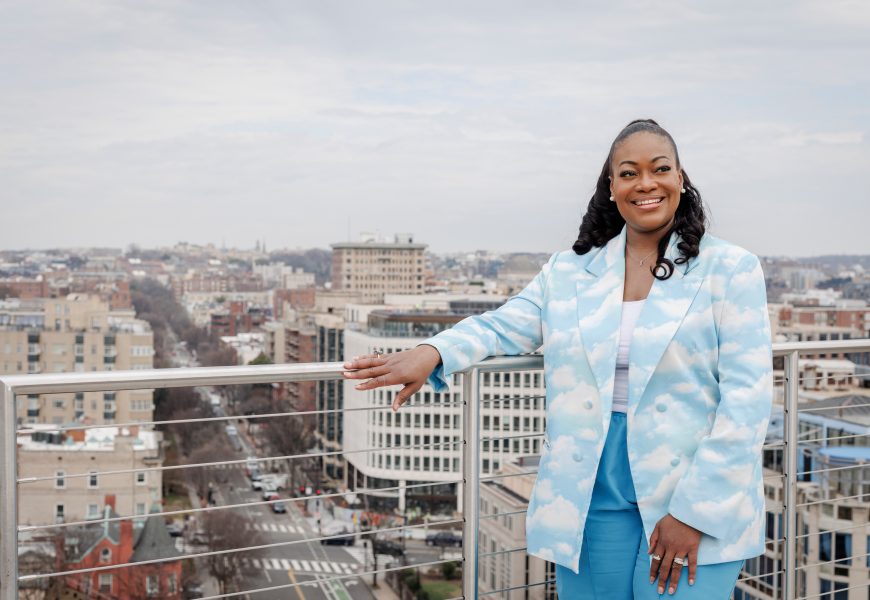
NEW YORK (AP) - There will be a new leader at billionaire eBay founder Pierre Omidyar's philanthropic group that aims to expand access to the digital revolution's economic opportunities.
Omidyar Network President Michele Jawando takes over as CEO next month, according to a Wednesday announcement from the left-leaning organization that blends charitable grantmaking with for-profit impact investments. A civil rights lawyer and former Google executive who managed the company's public policy partnerships, Jawando will helm one of the best-financed technology organizations looking to loosen Silicon Valley's grip on artificial intelligence's development, deployment and regulation.
"Our focus will be making sure that there is a much more diverse set of views and people and coalitions and voices shaping the moments, the opportunities and the rules for the AI era," Jawando said.
"I just want people to feel agency and power in this moment," she added. "I hate the fact that most people feel like this technology is happening to them."
Philanthropy often lacks the financial heft and political clout of AI companies that are valuated at hundreds of billions of dollars and have secured favorable policies under U.S. President Donald Trump. This week, the social sector has watched with concern as the Trump administration retaliated against Anthropic over the artificial intelligence company's refusal to allow the government unrestricted military use of its technology.
The Anthropic episode underscores Jawando's insistence that a handful of companies shouldn't determine the guardrails for what she called "really powerful super tools." Omidyar Network recently refined its focus to fill what leaders saw as gaps in philanthropy's engagement with the rapidly evolving landscape of artificial intelligence, putting together a $30 million generative AI portfolio in recent years.
Acknowledging the "David and Goliath kind of asymmetry" in resources, Jawando said her role is to build bridges across philanthropy that can elevate working people's perspectives.
"The responsible and safe use of AI shouldn't be just one company's mantra," Jawando said. "It's not that some companies are too responsible and others aren't. It's just that we don't have a public governance framework."
Outgoing Omidyar Network CEO Mike Kubzansky said philanthropy will always be outspent by big tech companies and acknowledged that the sector isn't known for strong coordination.
But he highlighted Jawando's role as co-chair of a philanthropic coalition putting $500 million behind AI that prioritizes the public's interests. Kubzansky said his successor is the one who involved several funders that hadn't been as active in the AI space, such as the Doris Duke Foundation and the Lumina Foundation.
"She rarely jumps to the oppositional card first," he said. "She finds new partners for us and she brings people along."
A self-described bridge builder, Jawando said Omidyar Network will double down on consulting underrepresented communities, influencing state legislatures and supporting research that applies this "marvelous technology" for everyday people's benefit.
That means partnering with advocacy nonprofits such as the Model Alliance, which championed a recently implemented New York State law that requires fashion workers' consent to create digital replicas of their likenesses. The firm aims to empower overlooked populations by supporting leaders such as #BlackTechFutures Research Institute co-founder Fallon Wilson, who is working with HBCUs and African American churches on AI literacy.
Omidyar Network will keep supporting tech regulation advocates despite Trump's executive order curtailing state AI guardrails. As public outcry grows against energy-hungry data centers that are expanding in size and number, Jawando said the network wants to identify models for responsible data centers that consider factors such as carbon neutrality and community engagement. And it funds AI researchers who want to advance health care, for example, not business-to-business services.
"I think we have the people. I think we have the will. I think we have the creativity," she said. "In a way that, if you only are forced to think about shareholders every three months, you start to lower and really narrow the window of your ambition."
One nonprofit tech proponent hoped other funders would take inspiration from Omidyar Network's commitment to AI, reinforced by the announcement of Jawando's promotion. Fast Forward executive director Shannon Farley, whose accelerator helps nonprofits that apply technological solutions to social problems, said philanthropy stands at an "inflection point" where AI is rapidly accelerating but those most impacted have the fewest protections.
She welcomed Jawando's collaborative approach. Farley said she hopes the new CEO can galvanize her peers, considering Omidyar Network's status as one of the earliest "tech for good" investors.
"We're asking nonprofits to solve 21st-century problems with 20th-century tech," Farley said. "They can't do that if funders aren't understanding AI and backing people with lived experience to solve the problems in front of them."
More Top Stories