°C
°C
 6
Min
6
Min
SACRAMENTO, Calif. (AP) – Billionaire climate activist Tom Steyer is selling himself as a class traitor in his bid for California governor. The Democrat with a personal fortune estimated at $2.4 billion wants wealthy people and corporations to pay higher taxes.
Billionaire Tom Steyer wants to take on the rich in run for California governor
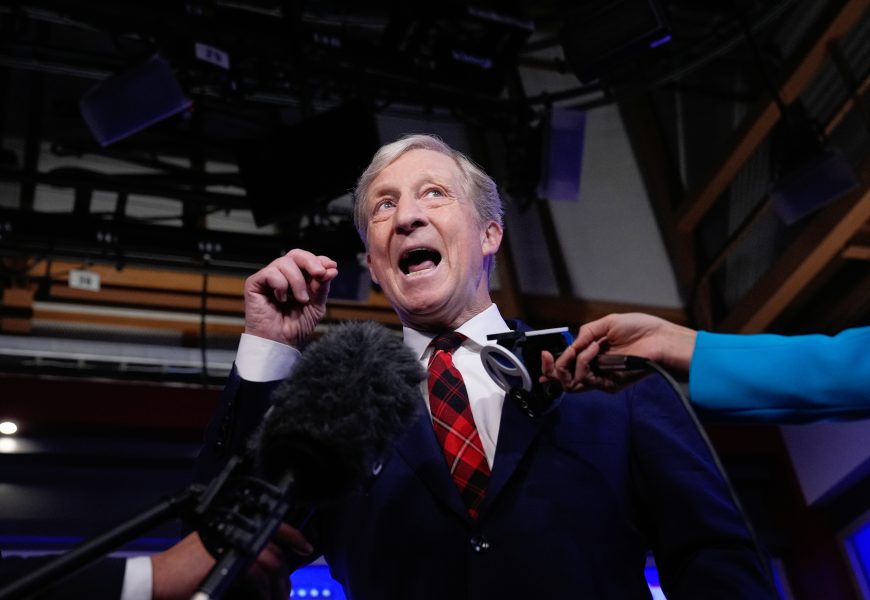

SACRAMENTO, Calif. (AP) - Billionaire climate activist Tom Steyer is selling himself as a class traitor in his bid for California governor.
The Democrat with a personal fortune estimated at $2.4 billion wants wealthy people and corporations to pay higher taxes. He's endorsed by a progressive advocacy group that believes billionaires shouldn't exist. He founded one of the world's largest hedge funds yet he's the candidate taking the heaviest hits from business groups.
"I'm the billionaire who wants to tax other billionaires," he's fond of saying, though he's given only tenuous backing to a billionaires' tax proposal likely to appear before California voters in November.
Steyer has long leaned into the contradictions between his business success and political views. While his hedge fund invested in fossil fuels, Steyer spent millions to protect a California law aimed at curbing planet-warming emissions. As a presidential candidate in 2019 vying to succeed President Donald Trump, another rich man, Steyer championed eliminating corporate money from politics.
"I'm not one of the people who begrudges people's success," Steyer told The Associated Press, referring to businesspeople who become wealthy in California. "If you're going to come here and build a company and make a ton of money, great."
"But you're part of a system - you're depending on a system built by, basically, poor people," he continued. "If you aren't willing to pay your fair share, I feel like you're spitting on those people."
His stances, often unpopular with other billionaires, have earned him staunch support from some and persistent skepticism from others. Despite his vast wealth, progressive supporters perceive him as "one of the good ones" who will stand up to monied interests. But critics in both parties view him as disingenuous and making unrealistic promises to appeal to voters. Democratic rivals accuse him of trying to buy the election, noting he's spending nearly 30 times the amount of his nearest party opponent on ads.
After decades of using his pocketbook to influence politics and policy, Steyer is now a leading contender in the race to govern the nation's most populous state and one of the world's largest economies ahead of the June 2 primary. His former hedge fund's investments have been a persistent topic of criticism from his Democratic rivals.
"You made the billions that you're using to fund your campaign off fossil fuels," former U.S. Rep. Katie Porter charged during Tuesday night's debate. Steyer responded by noting business groups are spending to oppose him: "That's how you know I'm for real."
Steyer, 68, founded Farallon Capital Management in 1986 in San Francisco. He earned the respect of business peers for the firm's rapid success and learned to weather criticism from environmentalists for the company's stakes in oil and coal. In 2012, he left and founded NextGen America, a group encouraging young people to vote.
Much of his political giving has focused on climate change, including a $5 million donation in 2010 to oppose a California ballot proposition that would have suspended a law requiring the state to reduce its greenhouse gas emissions. The climate law prevailed. Starting in 2013, he used the political arm of NextGen to back governor and U.S. Senate candidates seen as strong on climate with mixed success.
Steyer has spent more than $62 million on California ballot measures, including an unsuccessful effort in 2020 to keep a law that eliminated cash bail. He was one of the largest donors to a successful 2016 measure to tax tobacco products to raise money for healthcare for low-income Californians.
His contributions have been met with some cynicism. Longtime Sacramento strategist Rob Stutzman, a Republican, pointed to an ad Steyer paid for last year that prominently features him urging voters to support a redistricting ballot measure. It was an initiative championed by Gov. Gavin Newsom, and Steyer had no involvement other than simply spending on advertising.
Steyer "has always been a self-promoter with his dollars," Stutzman said.
Steyer says he wants to tackle three main crises: climate change, California's high cost of living and threats from the Trump administration.
Hundreds of people gathered at a ping-pong club and bar in San Francisco recently to drink cocktails and nibble on hors d'oeuvres - on the campaign dime - as Steyer touted his commitment to fighting climate change. His plan is light on specifics but includes defending the state's cap-and-trade program.
Some major environmental groups have endorsed him. Progressive organizations have also backed him, including Our Revolution, which was founded by Vermont Sen. Bernie Sanders and advocates for ridding politics of corporate and billionaire influence. State Assemblyman Alex Lee, chair of the progressive caucus, said he's backing Steyer in part due to his support for a government-run healthcare system, an idea that's failed repeatedly in Sacramento.
Lee was hesitant to back a billionaire but said Steyer is different.
"He is someone who became wealthy in his lifetime," Lee said, "but didn't go off and become (Mark) Zuckerberg level."
Meanwhile, Pacific Gas & Electric, one of the nation's largest utilities, spent $10 million to oppose him. Steyer has vowed to "break up utility monopolies" to bring down Californians' notoriously high electricity rates. One ad funded in part by PG&E says Steyer isn't a "different type of billionaire" as he claims. The California Chamber of Commerce says Steyer will raise costs, not lower them.
"His policy promises will cost billions, driving investment out of California and worsening the state's affordability crisis," chamber spokesperson John Myers said in a statement.
It remains to be seen whether money and endorsements will translate into votes. Some political observers say it would be evident by now if Steyer was poised to break away from the pack, given his spending blitz.
Money wasn't enough in the 2020 Democratic presidential contest. Steyer staked his campaign largely on appealing to voters of color, highlighting inequalities in healthcare access, the environment and criminal justice system. In South Carolina, he spent $24 million on ads - more than all the other candidates combined - but dropped out after finishing third.
He often garnered attention for his quirks over his policies - the red tartan tie and colorful belt he made part of his campaign trail uniform, his dance moves to a performance by rapper Juvenile.
Steyer had planned to spend $100 million, and his wealth proved a liability in a race where rivals including Sanders decried the existence of billionaires.
He's spent more in the California governor's primary alone, including on an ad attacking a rival. This time, he's being received differently.
"Tom Steyer is running on taxing the wealthy, supporting single-payer healthcare, and taking on corporate power - positions that are central to our movement," Our Revolution Executive Director Joseph Geevarghese said in a statement. "That alignment with a pro-worker, anti-corporate agenda - and the urgency of this race - is why we are backing him."
More Top Stories