°C
°C
 4
Min
4
Min
BOGOTA, Colombia (AP) – The Colombian city of Cartagena began replacing its iconic horse buggies with electric carriages Tuesday, following years of protests by animal rights activists, who argued that horses pulling 19th-century-like coaches for tourists suffered from exploitation and poor health.
A Colombian city swaps iconic horse buggies for electric carriages amid animal welfare concerns
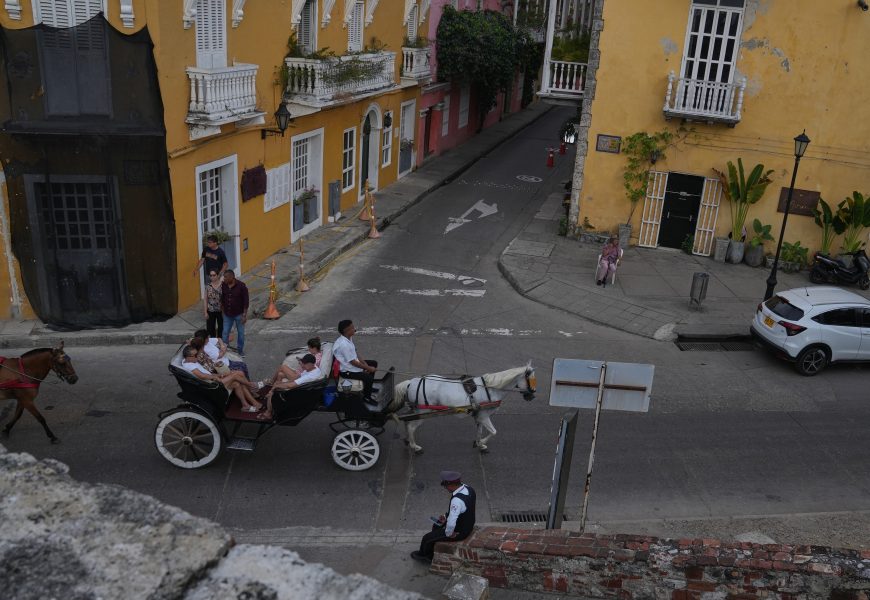

BOGOTA, Colombia (AP) – The Colombian city of Cartagena began replacing its iconic horse buggies with electric carriages Tuesday, following years of protests by animal rights activists, who argued that horses pulling 19th-century-like coaches for tourists suffered from exploitation and poor health.
In a sunny plaza lined with elegant colonial era mansions, Mayor Domek Turbay introduced a new fleet of 30 vehicles with large wheels and open tops that resemble the city’s traditional horse carriages. The new vehicles are powered by batteries and have steering wheels for their drivers, instead of reins and yokes.
“Times are changing,” Turbay said. “For many years locals and visitors alike had rejected the mistreatment that comes with using horses to pull buggies for tourists.”
Cartagena is one of Colombia’s most popular destinations, thanks to its location on the Caribbean Sea, and its well preserved historical center, where visitors can still walk along stone walls built in the 17th century to defend the city from attacks by pirates and buccaneers.
Since the 1940s, tourists have also been able to get around the city’s lantern lit streets on small buggies pulled by horses, whose clip-clopping sound became a quintessential part of the city’s life.
But over the past decade, animal rights activists have been lobbying the municipal government to axe the tradition.
Fanny Pachon, a local activist, said that while horses are pack animals, they are not meant to work in a city with cement roads, cars and motorbikes. She pointed out that on several occasions horses have collapsed on the city’s streets due to Cartagena’s heat.
“Their joints suffer from the pavement,” she said. “And the honking of cars can stress them out.”
The Colombian city, whose historic center is a UNESCO World Heritage site, is now billing itself as the first major tourist destination to replace horse buggies with electric vehicles.
The city government said that over the next few weeks, 62 electric carriages, which were custom built in China, will be introduced in the city center. The city is also building a warehouse with a small solar plant and a charging station for the new sight-seeing vehicles.
The move has been fiercely opposed by the city’s traditional horse buggy owners, who argue that their industry has already been regulated to improve animal welfare.
Coach rides were restricted mostly to night-time hours by regulations published in 2015, that also said that horses had to undergo inspection by the local animal welfare agency.
“We are one of the most regulated industries in this city,” said Jacqueline Gonzalez, the owner of two traditional coaches in Cartagena.
Coach owners have threatened to go on a hunger strike if the city does not compensate them for their losses. They argue that the city government is pushing them out of a business that working class families built up with decades of hard labor.
“This has not been a transition,” said Yesid Soto, the president of an association that represents horse coach owners and their employees. “It has been more of an imposition.”
A decree issued last week by Turbay prohibited the use of horse carriages starting Monday. It states that the electric buggies that will now take tourists around the city center, will be the property of the city.
Soto said there are 26 horse coach owners in the city who will be displaced by the new decree.
He said that coach owners are asking the city to compensate them for the horse carriages that will be taken off the city’s streets, but that so far, an agreement with officials has not been reached. Soto said that during the city’s high season for tourism, in December and January, a horse buggy can earn around $150 each day.
Cartagena’s municipal government says it wants to hire coach owners and coach drivers to operate the new vehicles. It has offered jobs to horse carriage drivers, but has still not spelled out how it could integrate coach owners into the management of the new fleet of electric vehicles.
Turbay has accused the coach owners of “sabotaging” negotiations.
More Top Stories