27% of Australian students now have an adjustment for disability at school. Why are we seeing this growth?
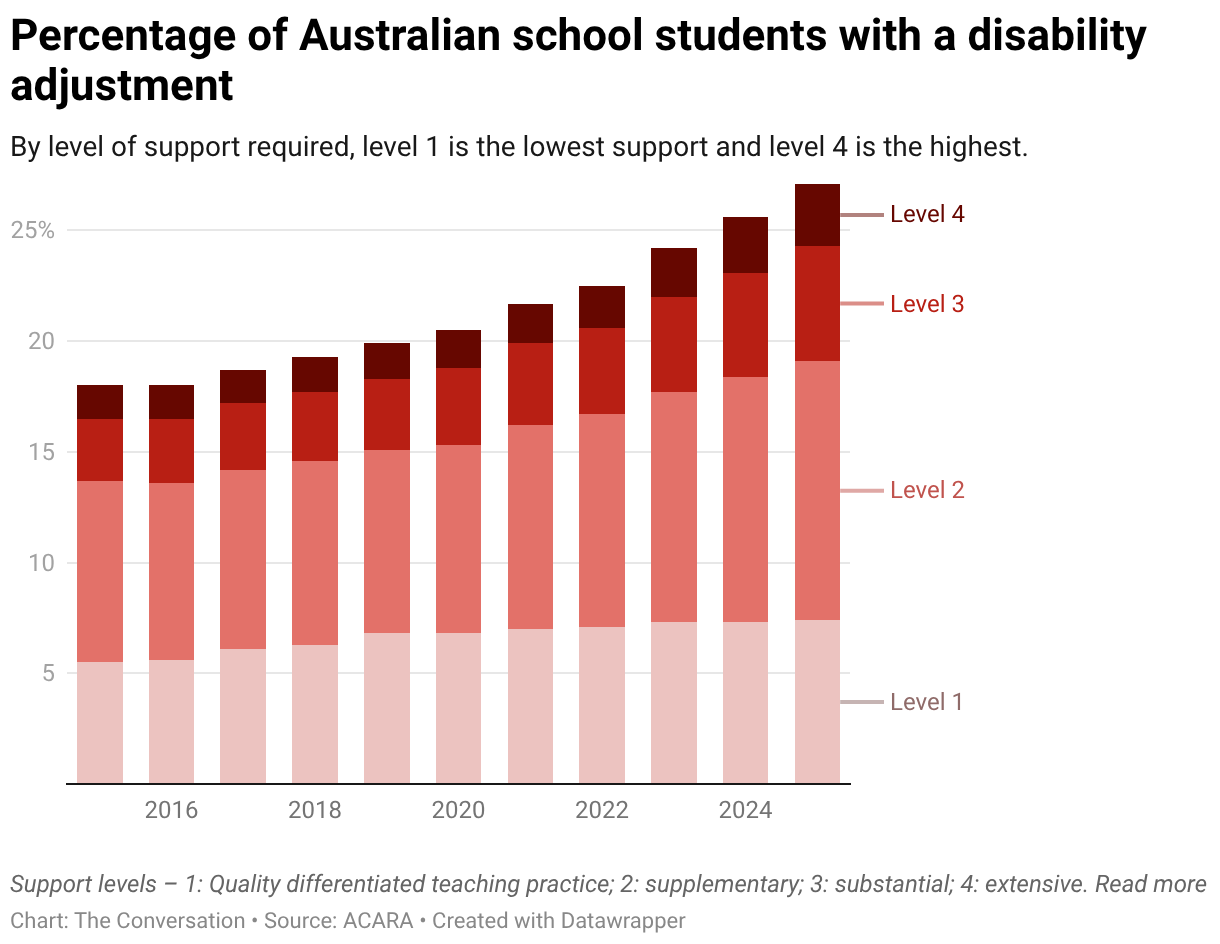
New data shows 27.2% of Australian students are receiving an adjustment for disability at school. This is up from 25.7% in 2024 and 18% in 2015. An educational adjustment helps students participate on the same basis as their peers without a disability.
24 May 2026
24 May 2026
New data shows 27.2% of Australian students are receiving an adjustment for disability at school. This is up from 25.7% in 2024 and 18% in 2015.
An educational adjustment helps students participate on the same basis as their peers without a disability.
Adjustments can include a wide range of measures, such as allowing rest breaks or noise-cancelling headphones. It could also include extra support staff or tools such as voice-to-text software.
This comes as the federal budget included a A$463 million compliance "crackdown" on how disability funding is allocated to schools to ensure support is targeted based on need.
But this is unlikely to work because the real problem lies in the design of the model itself.
How does disability funding work in schools?
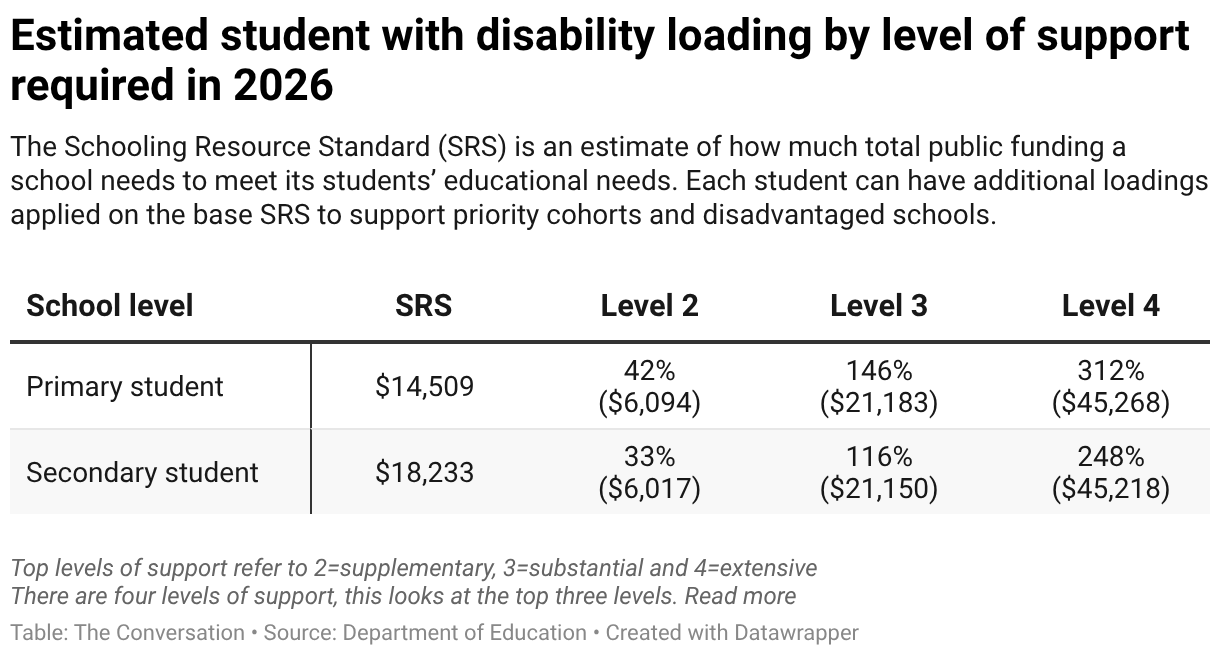
All schools receive a base amount of funding for each student. There are extra loadings based on school size and location, and whether students are Indigenous, come from disadvantaged backgrounds, have low levels of English or disability. The disability funding then has different levels, depending on the types and frequency of adjustments needed.
In 2018, Australia introduced a new disability funding allocation method based on a national reporting system. Schools report the number of students who need adjustments to participate in education and the types of adjustments being providing.
1. quality differentiated teaching practice: teachers use everyday strategies to help everyone learn in different ways. Examples include visual schedules or breaking tasks into steps.
2. supplementary adjustments: extra support is added when a student needs more help than usual to join in or learn. Examples include changed test conditions or short‑term, small‑group programs.
3. substantial adjustments: regular, personalised support is provided because a student often faces learning barriers. Examples include major curriculum changes across several subjects.
4. extensive adjustments: intensive, ongoing support is needed throughout most of the school day. Examples include continuous one‑to‑one help or specialised health or personal‑care support.
Why do we have the current model?
Previous models for disability funding in schools required a medical diagnosis within a narrow range of disability categories. There were also differences between states. For example, some did not include autism or speech language impairment. None included Attention Deficit Hyperactivity Disorder (ADHD).
This created a perverse incentive for existing diagnoses to be changed or supplemented by additional diagnoses (for example, swapping ADHD to autism), so a student who needed support would qualify for funding.
This approach was also inequitable as highly educated, wealthier parents have more capacity to secure a diagnosis for their child through private assessments.
What is the current approach?
The current model seeks to address these issues by adopting the same broad, inclusive definition of disability as used in the Disability Discrimination Act. It allocates funding on the basis of observed need, irrespective of disability type.
Students' educational needs are determined by educational professionals, not doctors, and substantiated with evidence of the adjustments provided over a ten-week period.
Students or their families do not personally receive funds. The disability loading gets added to overall government funding to "approved authorities", which include independent schools, Catholic dioceses and state education departments.
But this new model has flaws of its own. This has become more evident over time and is reflected in uneven patterns of growth.
Which numbers are growing?
We have seen a large increase in students receiving adjustments over the past eleven years. But as shown in the graph below, this increase differs by the level of adjustment.
The percentage of students with disability whose needs are being met through basic classroom teaching (level 1) has gone from 5.5% to 7.4%, an increase of 35%.
Students receiving supplementary adjustments (level 2) went from 8.2% to 11.7%, an increase of 43%.
The greatest increases have been in substantial and extensive adjustments (levels 3 and 4), which have risen by factors of 86% and 87%, respectively.
Why are we seeing this growth?
Further research is needed to unpick exactly why these increases are occurring. But there is likely to be a range of factors.
Various state education departments have also aligned their disability funding models to the national model at different points in time. For example, Queensland only changed to the national model in 2023, potentially contributing to the later uptick.
Another potential explanation for the overall pattern of increase is the disability loadings themselves.
The first level attracts no additional funding and is not evaluated for quality or accessibility. Schools are then allocated about $6,000 additional funding for each student receiving "supplementary" adjustments, $21,000 for "substantial", and $45,000 for "extensive" adjustments.
Why does this matter?
The new needs-based model was inspired by a tiered prevention and intervention framework first developed in public health. This framework relies on the idea that basic healthcare should be high quality and accessible to all.
This thinking is important when it comes to students with disability. If basic classroom teaching is not accessible to these students, then they will need more adjustments.
There is no incentive for schools to meet children's needs through accessible quality universal teaching - in fact, there's a perverse incentive not to.
Meeting children's needs at level 1 currently means forgoing the additional funds that could be gained by providing adjustments later.
The government's bid to increase compliance in disability funding does not adequately address this flaw.
What needs to change?
In the health system, we reserve hospital places for those who really need them. If too many people are arriving at emergency departments, it is a sign other levels of the system are not working as they should.
Increases in the proportions of students receiving supplementary, substantial and extensive adjustments should likewise prompt scrutiny of the first level of support we are providing.
The current system turns basic practices, like providing extra time and accessible materials, into "adjustments" children must wait to receive. Even though these can benefit all learners.
The emphasis on making adjustments, rather than designing for accessibility from the outset, is what needs to change. This will require critical evaluation and redesign of the model itself. And funding will be needed to evaluate and improve the quality and accessibility of everyday classroom teaching.
TheConversation.com
Author:
Linda J. Graham - Professor and Director of the Centre for Inclusive Education, Queensland University of Technology
Callula Killingly - Postdoctoral Research Fellow, Centre for Inclusive Education, Queensland University of Technology


 °C
°C
 6
Min
6
Min