°C
 4
Min
Armenia is seeking greater involvement from Central Asian countries as it moves forward with plans for a major regional trade and transport corridor backed by the United States and named the Trump Route for International Peace and Prosperity, or TRIPP.
Armenia Looks to Central Asia as TRIPP Corridor Advances
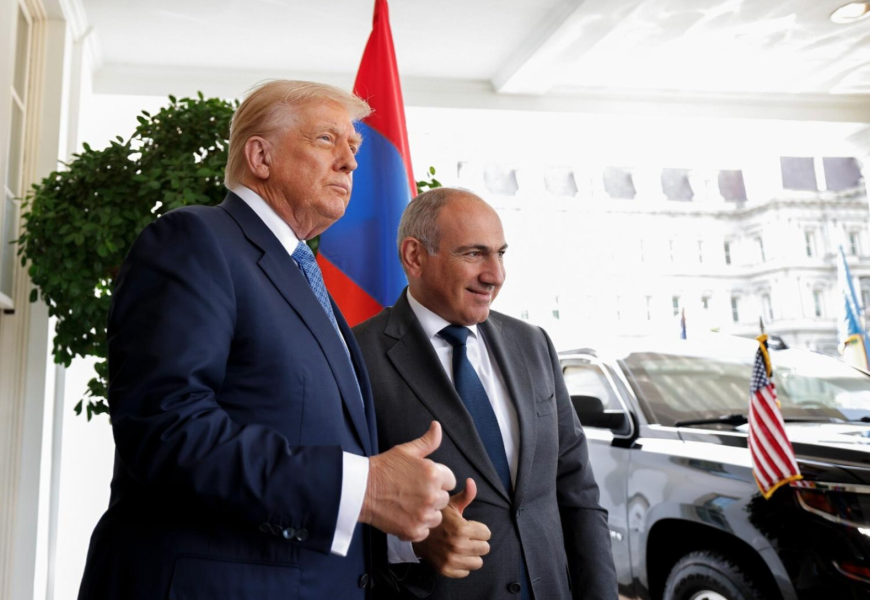
Armenia is seeking greater involvement from Central Asian countries as it moves forward with plans for a major regional trade and transport corridor backed by the United States and named the Trump Route for International Peace and Prosperity, or TRIPP.
The proposed corridor forms part of a broader peace agreement between Armenia and Azerbaijan. It would cross Armenian territory, connecting Azerbaijan with its Nakhchivan exclave while creating a new east-west trade route that would bypass both Russia and Iran.
The project has received strong support from Washington but has raised concerns in Moscow and Tehran, whose regional influence could be challenged by the emergence of a major transport link outside their traditional spheres of influence.
Armenian Prime Minister Nikol Pashinian has recently sought to bring Kazakhstan and Kyrgyzstan into the initiative. However, analysts say both countries are likely to weigh the potential economic benefits against the risks of upsetting Russia, which remains an important political, economic and security partner in Central Asia.
Pashinian discussed the TRIPP project with Azerbaijani and Indian leaders, as well as US representatives, during the Shanghai Cooperation Organization summit in Bishkek on September 1.
He had also raised Kazakhstan's possible involvement during a recent telephone conversation with Kazakh President Qasym-Zhomart Tokayev.
"We discussed this issue in relation to Kazakhstan and the TRIPP project. Various countries are now showing interest," Pashinian said on August 27, without providing further details.
Kyrgyzstan, meanwhile, has indicated that it has not yet received a formal proposal. Kyrgyz government official Daniyar Amangeldiev said authorities were still awaiting an official approach.
Project Moves Into Public Phase
Despite uncertainty over regional participation, Armenia and the United States are pressing ahead with the public rollout of TRIPP.
On September 1, the two countries launched an official TRIPP Armenia Facebook page, jointly managed by Armenia's Foreign Ministry and the US Embassy in Yerevan.
US and Armenian officials also met in Armenia's Syunik province, where the planned 43-kilometre corridor would be located, to discuss the project's development and its potential economic impact.
Under the current arrangement, the United States would hold a 74 percent stake in the project, while Armenia would retain 26 percent. Washington has committed an initial $145 million, although Pashinian has described the overall initiative as a multibillion-dollar project.
The Armenian government approved TRIPP in July. The country's Constitutional Court is expected to consider the project on September 15, after which it would proceed to parliament for a final vote.
The United States has also pledged to assist Armenia in attracting additional public and private investment, although no further investors or funding commitments have yet been announced.
For landlocked Armenia, TRIPP represents a potential opportunity to overcome longstanding economic isolation and establish itself as an important regional transport and logistics centre.
The corridor was developed as part of a US-backed peace process following decades of conflict between Armenia and Azerbaijan over Nagorno-Karabakh. Plans include road and railway infrastructure, with potential projects involving oil and gas pipelines, electricity and fibre-optic networks.
The initiative comes as Armenia has increasingly distanced itself from Russia and strengthened relations with Western countries following Azerbaijan's military takeover of Nagorno-Karabakh in September 2023.
Central Asian Interest Remains Cautious
Kazakhstan has publicly indicated an interest in becoming involved in TRIPP, which could complement the so-called Middle Corridor - a developing 6,500-kilometre trade route connecting China and Europe through Central Asia and the Caucasus while avoiding Russian territory.
TRIPP could provide an additional link from Azerbaijan through Armenia and Nakhchivan towards Turkey and European markets.
Kyrgyzstan has likewise viewed the project as a possible opportunity to expand its own transport connections westward.
Kyrgyzstan's ambassador to the United States, Edil Baisalov, said the country's railway network could eventually connect with Baku, providing a route towards Turkey and creating new economic opportunities.
However, neither Kazakhstan nor Kyrgyzstan has formally committed to joining the project.
Kyrgyz political analyst Emilbek Dzhuraev described the positions of Bishkek and Astana as "curiously muted", suggesting geopolitical considerations were influencing their approach.
Both countries have sought stronger relations with Washington, he said, but their membership of the Shanghai Cooperation Organization places them alongside countries such as Russia and Iran, which oppose or remain deeply concerned about TRIPP.
Dzhuraev said Russia could be the most significant factor shaping the two countries' decisions.
Moscow has traditionally exercised considerable influence across both Armenia and Central Asia, but its relationship with Pashinian's government has deteriorated as Yerevan has moved closer to the West.
Russia's weakening influence in Armenia, Dzhuraev argued, means Moscow has a significant strategic interest in the outcome of the TRIPP project and is unlikely to encourage Kazakhstan or Kyrgyzstan to participate.
If successfully implemented, TRIPP could reshape trade routes across the South Caucasus and Central Asia, while further altering the region's geopolitical balance between Russia, Iran, Turkey, Europe and the United States.
More Top Stories