°C
 3
Min
US economists Robert Hall and Michael Woodford have been awarded the 2026 Nobel Prize in Economic Sciences for developing models that help governments and central banks manage economic fluctuations and respond to financial shocks.
Robert Hall and Michael Woodford Win 2026 Nobel Economics Prize
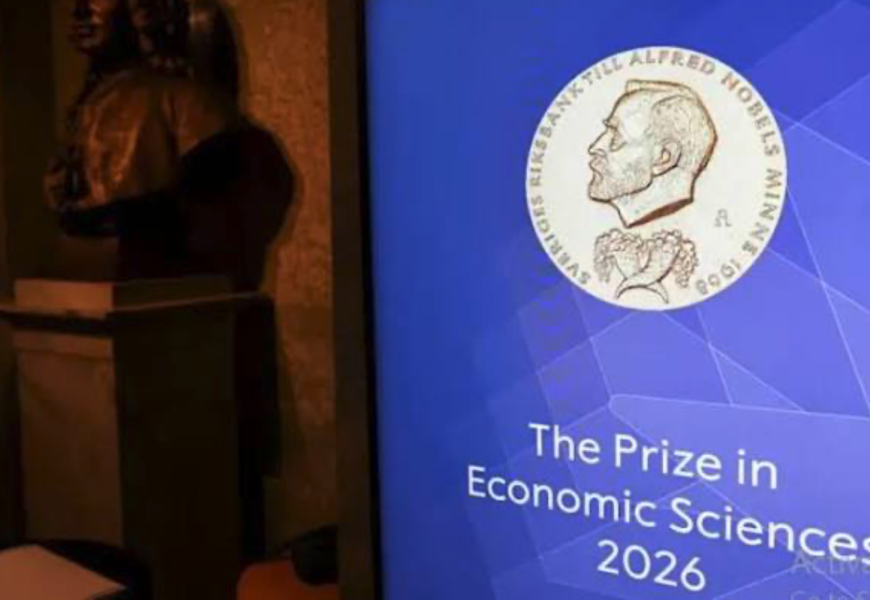
US economists Robert Hall and Michael Woodford have been awarded the 2026 Nobel Prize in Economic Sciences for developing models that help governments and central banks manage economic fluctuations and respond to financial shocks.
The Royal Swedish Academy of Sciences announced the winners on Monday, recognising their work on how monetary and fiscal policies can be used to stabilise economies and reduce the impact of disruptive events.
The award, formally known as the Sveriges Riksbank Prize in Economic Sciences in Memory of Alfred Nobel, is the final Nobel prize to be announced this year.
Hall and Woodford developed macroeconomic models designed to improve the effectiveness of government policy responses to recessions, inflationary pressures and other economic disturbances. Their research has helped establish a theoretical framework for measures aimed at maintaining economic stability.
John Hassler, chair of the Committee for the Prize in Economic Sciences, said the laureates' work had established a foundation for models now used by central banks and governments around the world.
The research has also strengthened policymakers' ability to respond to unexpected economic shocks, including energy crises and sudden changes in household spending.
The development of their models followed difficulties experienced with existing economic forecasting methods during the oil crises of the 1970s. At the time, established Keynesian models used to guide responses to recessions and economic fluctuations became less effective.
Hall and Woodford pursued a different approach, building their models on microeconomic foundations rather than relying primarily on statistical relationships between broad economic indicators.
Their framework considers how the individual decisions of households and businesses collectively influence the wider economy. By examining these underlying behaviours, policymakers can better assess how changes in interest rates, government spending and other economic measures may affect production, consumption and inflation.
The approach has become an important part of modern macroeconomic analysis, helping governments and central banks evaluate policy options when faced with uncertainty and changing economic conditions.
The economics prize was first awarded in 1969. Unlike the original Nobel prizes established under Alfred Nobel's will in 1895, the economics award was created by Sweden's central bank, Sveriges Riksbank.
Recipients receive a diploma, a gold medal and prize money of approximately US$1.2 million.
Most previous economics laureates have been from the United States, while women remain underrepresented among the winners. Claudia Goldin became the most recent female recipient before this year's award when she won in 2023 for research examining the historical influence of gender on employment and wages in the United States.
The 2025 economics prize was shared by Joel Mokyr, Philippe Aghion and Peter Howitt for their work on innovation, technological progress and the concept of creative destruction - the process through which new technologies and production methods replace older ones and contribute to economic growth.
The other 2026 Nobel prizes, covering medicine, physics, chemistry, literature and peace, were announced the previous week. Among this year's recipients were South African jurist Navi Pillay, who received the Peace Prize, and Canadian writer Anne Carson, who was awarded the Literature Prize.
The economics award concludes this year's announcements, recognising research that continues to influence how governments and financial institutions understand and respond to economic change.
More Top Stories