°C
 5
Min
US President Donald Trump has promised a $5,000 payment to every adult American citizen if Republicans retain control of both chambers of Congress at November's midterm elections. Trump made the pledge while addressing a major Republican gathering in Dallas, Texas, as his party faces difficult polling.
Trump promises Americans $5,000 if Republicans win midterms
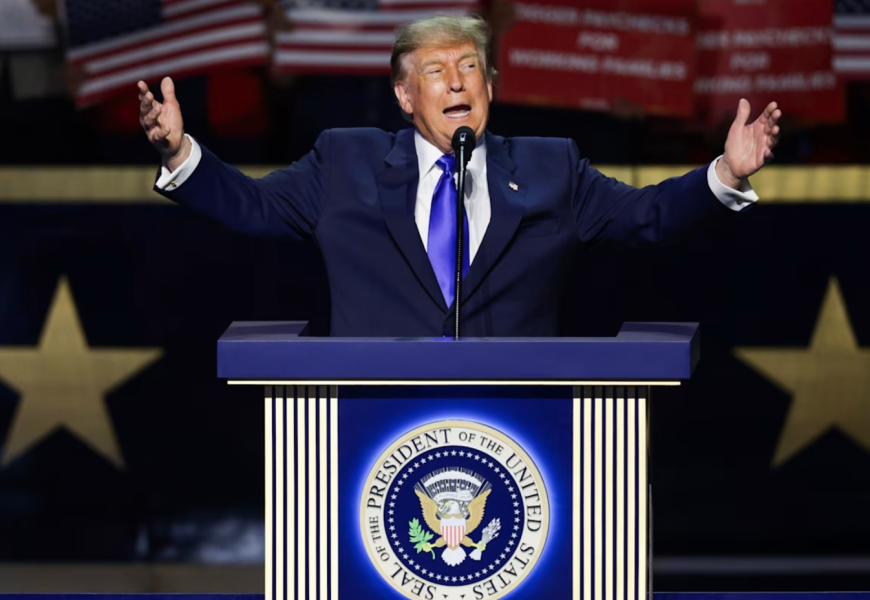
US President Donald Trump has promised a $5,000 payment to every adult American citizen if Republicans retain control of both chambers of Congress at November's midterm elections.
Trump made the pledge while addressing a major Republican gathering in Dallas, Texas, as his party faces difficult polling and the prospect of Democrats making significant gains in the House of Representatives and Senate.
The proposed payment, which has been described as a potential "Trump dividend", would come as the United States faces high government debt, elevated living costs and increased energy prices, while continuing to deal with the economic consequences of its conflict with Iran.
The scale and funding of the proposal have immediately raised questions about whether the federal government could afford such a payment and whether Congress would approve it.
What has Trump promised?
Addressing Republican supporters, Trump said the United States was generating enough money to provide a direct payment to its adult citizens.
He promised a $5,000 dividend for every adult US citizen, provided Republicans maintain their majorities in both the House and Senate.
Trump did not specify when the payments would be distributed or establish a detailed mechanism for delivering them.
He also said recipients would be expected to spend the money within the United States rather than taking the funds overseas.
The proposal would represent one of the largest direct cash distributions ever contemplated by the federal government.
A potential $1.3 trillion bill
With approximately 270 million adult US citizens, a $5,000 payment to every eligible person would cost roughly $1.35 trillion.
That figure does not include the administrative expenses associated with determining eligibility, processing payments and administering the program.
Vice President JD Vance has suggested tariff revenue generated by the Trump administration could provide the funding.
The argument is that tariffs imposed on imported goods are producing substantial additional revenue that could ultimately be returned to American workers.
However, available forecasts indicate that tariff revenue would be insufficient to comfortably cover the proposed payment from a single year of collections.
The Tax Policy Center has estimated that US tariffs could generate about $1.7 trillion between fiscal years 2026 and 2036, including approximately $177 billion during 2026.
A $1.35 trillion dividend would therefore consume a very large proportion of the projected tariff revenue expected over more than a decade.
Those projections are also estimates rather than money already sitting in a government account. They could change depending on trade volumes, economic conditions, court decisions and the response of US trading partners.
Retaliatory tariffs imposed against American exports could also reduce economic activity and affect the ultimate revenue generated.
Would more borrowing be required?
The central financial issue is whether tariff revenue could realistically finance the entire program.
Analysts have warned that if the government could not raise enough money through tariffs or other sources, the difference would effectively have to be financed through additional federal borrowing.
That would add to an already enormous national debt.
The US government currently spends about $1.1 trillion a year servicing its existing debt, a figure that has grown substantially as borrowing and interest rates have increased.
US national debt passed $40 trillion in August, reaching its highest recorded level.
The country's debt burden has expanded rapidly over the past decade, with the COVID-19 pandemic contributing to a sharp increase in government spending and borrowing. More recently, additional spending associated with the conflict involving Iran has added to pressure on federal finances.
Around 80 percent of US gross debt is publicly held, meaning it is owed to investors and institutions both inside and outside the United States.
Domestic holders include the Federal Reserve, mutual funds, pension funds, banks, state and local governments, corporations and individual investors.
Any additional borrowing required to finance a large cash dividend would increase the government's future interest obligations unless the new expenditure were offset by additional revenue or spending reductions.
Could the payment be legal?
The proposal also raises questions about US election law.
Federal law prohibits payments intended to influence how an individual votes. However, legal experts have pointed to an important distinction between offering money in exchange for a person's vote and announcing a government benefit that would be available to eligible citizens regardless of how they voted.
Because Trump's proposal would reportedly apply to all qualifying adult citizens rather than being conditional on supporting a particular candidate, the legal situation could be different from a direct vote-buying scheme.
There is, however, another major hurdle.
The president cannot simply create a $1.3 trillion spending program without congressional authorisation.
Congress would need to approve the necessary legislation and funding before the federal government could distribute the payments.
That means the proposal's fate would ultimately depend on whether enough lawmakers were prepared to support it.
Trump has made dividend promises before
This is not the first time Trump has suggested that Americans could receive direct payments from savings or additional government revenue.
During the creation of the Department of Government Efficiency, known as DOGE, Elon Musk argued that major reductions in government spending could potentially generate substantial savings that could eventually benefit taxpayers.
Musk initially discussed the possibility of cutting as much as $2 trillion from federal spending, although that target was later reduced.
DOGE subsequently claimed significant savings, but the size of those savings became the subject of political and financial disputes.
No broad taxpayer dividend resulting from those claimed savings was ultimately distributed.
Trump also suggested in late 2025 that Americans could receive at least $2,000 each from tariff revenue, excluding high-income earners.
That proposed payment was not subsequently distributed.
The latest $5,000 pledge therefore represents a much larger potential commitment.
For the proposal to become reality, Republicans would first need to retain control of Congress, lawmakers would need to approve the necessary legislation and the government would need to identify a sustainable source of funding.
With the US already carrying a record debt burden, the question of whether the promised dividend could be funded without adding significantly to government borrowing is likely to remain at the centre of the debate.
More Top Stories