°C
 3
Min
US President Donald Trump has said he would welcome a united Ireland, describing the prospect as "fantastic" during a visit to Dublin. Trump made the comments on Saturday while sitting alongside Irish Prime Minister Micheál Martin, saying he would like to see Northern Ireland eventually leave the United Kingdom and become part of a united Ireland.
Trump backs idea of unified Ireland during Dublin visit
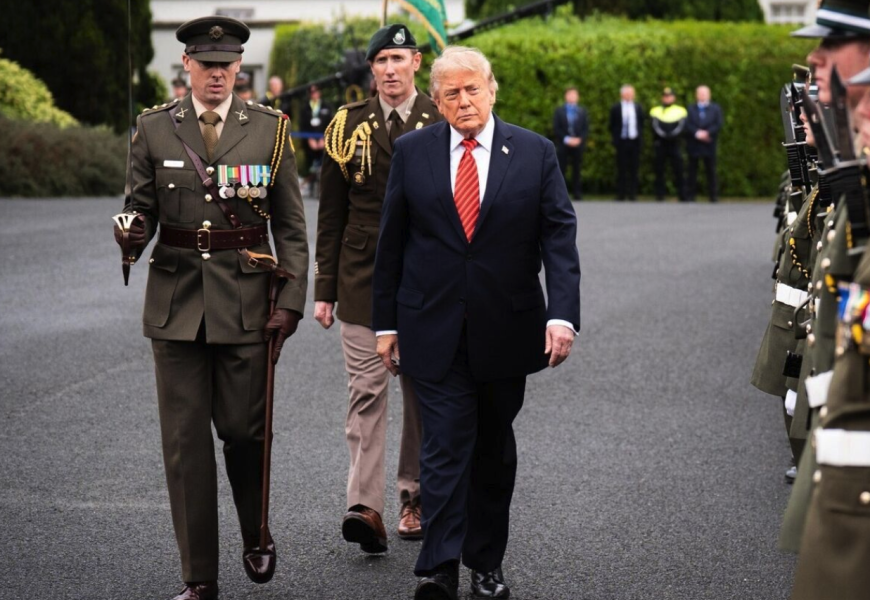
US President Donald Trump has said he would welcome a united Ireland, describing the prospect as "fantastic" during a visit to Dublin.
Trump made the comments on Saturday while sitting alongside Irish Prime Minister Micheál Martin, saying he would like to see Northern Ireland eventually leave the United Kingdom and become part of a united Ireland.
"I don't want to cause any problems, but I will tell you, I'd love to see it unified," Trump said.
"It's going to happen eventually ... I think it would be a fantastic thing."
Trump acknowledged that the British government would have a say in any move towards Irish unity, but said he believed unification would ultimately be a positive development.
Martin did not respond when reporters asked him to comment on Trump's remarks.
The comments come after British Prime Minister Andy Burnham said a referendum on Northern Ireland's constitutional future was not currently being considered.
A spokesperson for Burnham said his position had not changed following Trump's comments.
Questioned in Parliament earlier in the week about the possibility of a referendum, Burnham said he was not aware of majority public support for another vote and that there would be no referendum unless that changed.
Under the 1998 Good Friday Agreement, a referendum on Northern Ireland leaving the United Kingdom can be called at the discretion of the British government.
The agreement brought an end to three decades of conflict known as the Troubles, a period of violence involving mainly Catholic nationalist groups seeking a united Ireland, Protestant unionists supporting continued membership of the UK, and British security forces.
Gavin Robinson, leader of the Democratic Unionist Party, said Northern Ireland's constitutional future should be determined by its people.
"President Trump knows better than most that elections matter," Robinson said. "Northern Ireland's constitutional future will be decided by the people of Northern Ireland, not by commentary in London, Dublin or Washington."
Opinion polling continues to show a majority in Northern Ireland favouring remaining part of the United Kingdom, although the margin has narrowed in recent years. Britain's departure from the European Union has also increased political attention on the question of Irish unity.
Trump also met Irish President Catherine Connolly during his visit. Connolly was elected president last year and previously attracted attention for her opposition to aspects of US foreign policy.
During Trump's previous visit to Ireland in 2019, Connolly protested against his presence at Shannon Airport.
The latest visit has also been accompanied by demonstrations, with protesters calling for opposition to US military actions overseas and for Ireland to maintain its policy of military neutrality.
Anti-Trump protests
Anti-war and anti-Trump demonstrations have taken place in Dublin, with further protests planned in western Ireland near Trump's golf resort in Doonbeg.
Some protesters have also criticised the cost of the security operation surrounding the US president's visit.
They have argued that money being spent on security could instead be directed towards healthcare and other social priorities.
Trump's comments on Irish unity are likely to add a new international dimension to an already sensitive debate over Northern Ireland's constitutional future.
More Top Stories