°C
 4
Min
Russian President Vladimir Putin and Iranian President Masoud Pezeshkian have arrived in New Delhi ahead of a major BRICS summit expected to be dominated by conflicts in the Middle East and Ukraine, as well as growing economic pressures.
Putin, Pezeshkian Arrive in India as BRICS Summit Faces War Challenges
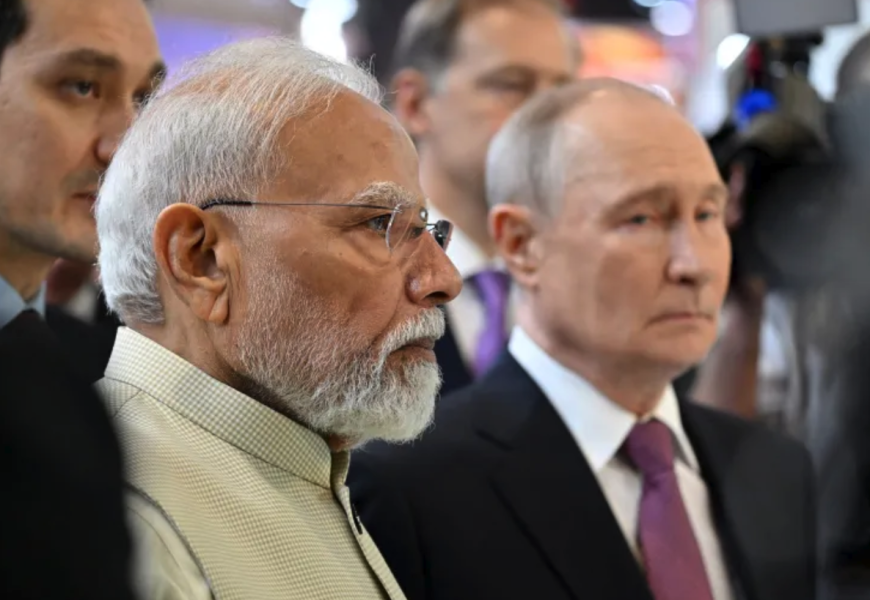
Russian President Vladimir Putin and Iranian President Masoud Pezeshkian have arrived in New Delhi ahead of a major BRICS summit expected to be dominated by conflicts in the Middle East and Ukraine, as well as growing economic pressures.
Putin held talks with Indian Prime Minister Narendra Modi on Friday, with the two leaders agreeing to further strengthen the longstanding strategic relationship between Russia and India.
India said the leaders discussed the conflicts in West Asia and the Black Sea region, both of which have disrupted maritime trade and raised concerns about the safety of Indian seafarers.
Modi reiterated India's position that conflicts should be addressed through dialogue and diplomacy and said New Delhi was prepared to support efforts aimed at achieving peace.
The Indian leader also met Pezeshkian, with discussions focusing on regional security, freedom of navigation and the continued movement of commercial shipping.
Modi stressed the importance of protecting the safety and welfare of crews operating in waters affected by regional tensions, while also calling for continued efforts to achieve lasting peace and stability.
Chinese President Xi Jinping is expected to arrive in India on Saturday and is likely to hold talks with Modi on the sidelines of the two-day summit.
BRICS was established in 2009 by Brazil, Russia, India, China and South Africa as a forum for major emerging economies seeking greater influence in international institutions traditionally dominated by Western powers.
The group has since expanded to include Iran, Saudi Arabia and the United Arab Emirates, bringing together countries with significantly different positions on the conflict involving Iran, Israel and the United States.
The expanded membership is expected to face a significant test during the summit as leaders attempt to manage their competing political and economic interests.
Indian security forces have been deployed across New Delhi, with extensive traffic restrictions introduced in central parts of the capital. Images of Modi have appeared throughout the city as India prepares to host leaders from across the expanded BRICS grouping.
The conflict in the Gulf is expected to be one of the most difficult issues confronting the summit, with disagreements among members potentially making it harder for the group to reach common positions.
Pezeshkian's visit is his first to India since becoming Iranian president and is expected to ensure the Middle East conflict remains high on the summit agenda.
The war involving Iran is also likely to test the cohesion of the expanded BRICS membership. Earlier attempts by the group's foreign ministers to agree on a joint statement reportedly highlighted differences between members.
India has maintained relations with both Iran and Israel while also seeking to preserve its important relationship with the United States.
The conflict has created additional energy and shipping challenges for India, prompting New Delhi to deepen its reliance on Russia, which remains one of India's most important strategic partners and a major source of energy supplies.
Putin last made an official visit to India in December 2025, although he met Modi earlier this month in Bishkek, Kyrgyzstan.
India has also continued diplomatic engagement over the war in Ukraine. Foreign Minister Subrahmanyam Jaishankar visited Kyiv this month, where Ukrainian President Volodymyr Zelenskyy welcomed India's stated commitment to efforts aimed at ending the conflict.
Xi's visit will be his first to India since 2019 and represents another significant step in the gradual improvement of relations between the two Asian powers.
Relations between India and China have slowly improved following years of heightened tensions after a deadly military confrontation along their disputed Himalayan border.
Flights, visa arrangements and high-level diplomatic contacts have gradually resumed, although substantial differences remain.
The two countries continue to face disputes over their shared frontier, a widening trade imbalance and broader strategic competition, making Xi's meetings with Modi a closely watched part of the BRICS summit.
More Top Stories