Home Top Politics Business Sports Technology Entertainment Life/Style Health/Science Photos Videos Travel

Estimated reading time 7 minutes 7 Min

Hamas official says the group ready to discuss ‘freezing or storing’ its weapons
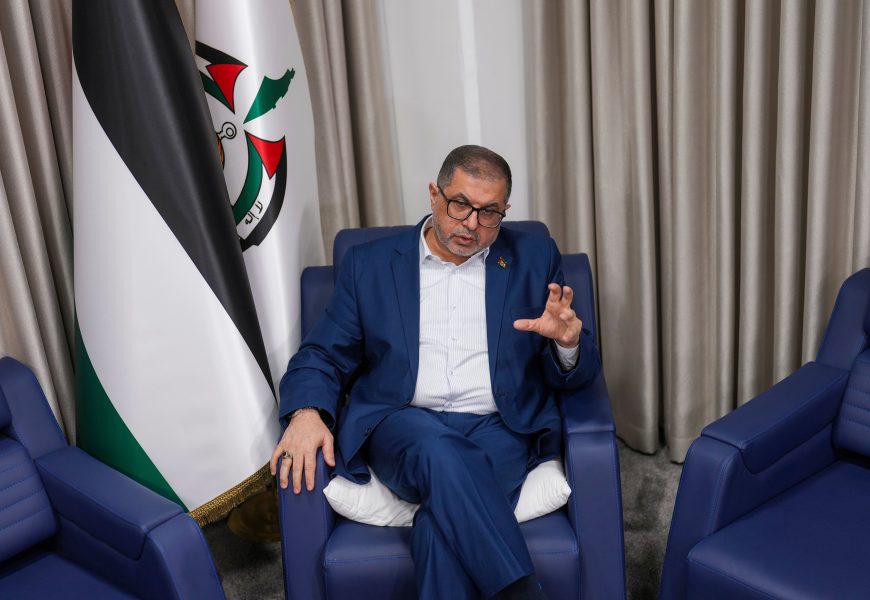
DOHA, Qatar (AP) – Hamas is ready to discuss “freezing or storing” its arsenal of weapons as part of its ceasefire with Israel, a senior official said Sunday, offering a possible formula to resolve one of the thorniest issues in the U.S.-brokered agreement.

December 8, 2025
8 December 2025

DOHA, Qatar (AP) – Hamas is ready to discuss “freezing or storing” its arsenal of weapons as part of its ceasefire with Israel, a senior official said Sunday, offering a possible formula to resolve one of the thorniest issues in the U.S.-brokered agreement.

Bassem Naim, a member of Hamas’ decision-making political bureau, spoke as the sides prepare to move into the second and more complicated phase of the agreement.

“We are open to have a comprehensive approach in order to avoid further escalations or in order to avoid any further clashes or explosions,” Naim told The Associated Press in Qatar’s capital, Doha, where much of the group’s leadership is located.

The deal halted a two-year Israeli offensive in Gaza, launched in response to Hamas’ Oct. 7, 2023, attack. Asked whether the attack was a mistake, Naim defended it as an “act of defense.”

Since the truce took effect in October, Hamas and Israel have carried out a series of exchanges of Israeli hostages for Palestinian prisoners. With only the remains of one hostage still held in Gaza — an Israeli policeman killed in the Oct. 7 attack — the sides are preparing to enter the second phase.

The new phase aims to lay out a future for war-battered Gaza and promises to be even more difficult — addressing such issues as the deployment of an international security force, formation of a technocratic Palestinian committee in Gaza, the withdrawal of Israeli troops from the territory and the disarmament of Hamas. An international board, led by President Donald Trump, is to oversee implementation of the deal and reconstruction of Gaza.

The Israeli demand for Hamas to lay down its weapons promises to be especially tricky — with Israeli officials saying this is a key demand that could hold up progress in other areas. Hamas’ ideology is deeply rooted in what it calls armed resistance against Israel, and its leaders have rejected calls to surrender despite over two years of war that left large parts of Gaza destroyed and killed tens of thousands of Palestinians.

Naim said Hamas retains its “right to resist,” but said the group is ready to lay down its arms as part of a process aimed at leading to the establishment of a Palestinian state. He gave few details on how this might work but suggested a long-term truce of five or 10 years for discussions to take place.

“This time has to be used seriously and in a comprehensive way,” he said, adding that Hamas is “very open minded” about what to do with its weapons.

“We can talk about freezing or storing or laying down, with the Palestinian guarantees, not to use it at all during this ceasefire time or truce,” he said.

It is not clear whether the offer would meet Israel’s demands for full disarmament.

The ceasefire is based on a 20-point plan presented by Trump, with international “guarantor” nations, in October.

The plan, adopted by the U.N. Security Council, offered a general way forward. But it was vague on details or timelines and will require painstaking negotiations involving the U.S. and the guarantors, which include Qatar, Egypt and Turkey.

“The plan is in need of a lot of clarifications,” Naim said.

One of the most immediate concerns is deployment of the international stabilization force.

Several countries, including Indonesia, have expressed a willingness to contribute troops to the force, but its exact makeup, command structure and responsibilities have not been defined. U.S. officials say they expect “boots on the ground” early next year.

One key question is whether the force will take on the issue of disarmament.

Naim said this would be unacceptable to Hamas, and the group expects the force to monitor the agreement.

“We are welcoming a U.N. force to be near the borders, supervising the ceasefire agreement, reporting about violations, preventing any kind of escalations,” he said. “But we don’t accept that these forces have any kind of mandates authorizing them to do or to be implemented inside the Palestinian territories.”

In one sign of progress, Naim said Hamas and the rival Palestinian Authority have made progress on the formation of the new technocratic committee set to run Gaza’s daily affairs. He said they have agreed upon a Palestinian Cabinet minister who lives in the West Bank, but is originally from Gaza, to head the committee. He did not give the name, but Hamas officials, speaking on condition of anonymity to discuss the negotiations, have identified him as Health Minister Majed Abu Ramadan.

Both Israel and Hamas have accused each other of repeated violations of the deal during the first phase.

Israel has accused Hamas of dragging out the hostage returns, while Palestinian health officials say over 370 Palestinians have been killed in continued Israeli strikes since the ceasefire took effect.

Israel says its strikes have been in response to Palestinian violations, including the movement of Palestinians into the Israeli-held half of Gaza. Three soldiers have been killed in clashes with about 200 Hamas militants that Israeli and Egyptian officials say remain holed up underground in Israeli-held territory.

Naim said Hamas was “not aware” of these gunmen when the ceasefire was signed, and that communications with them were “totally cut.”

“Therefore, they are not aware about what’s going on now on the ground,” he said.

He claimed that Israel has rejected Hamas offers to resolve the standoff and added numerous “conditions” to their surrender. Israel has not acknowledged the negotiations and says it has killed several dozens of them.

Naim said Hamas is committed to “fulfilling its obligations” and claimed that Israel has fallen short of key pledges, including not flooding Gaza with humanitarian supplies and failing to reopen the Rafah border crossing with Egypt.

Most of the supplies entering Gaza, he said, are goods for private merchants to sell to the few people in Gaza with money, leaving masses of poor people struggling without food or shelter.

Last week, Israel said it was ready to reopen Rafah — Gaza’s main gateway to the outside world — but only for people to leave the strip. Egypt and the Palestinians fear this is a plot to expel Gaza’s Palestinians and say Israel is obligated to open the crossing in both directions.

The Oct. 7 attack killed over 1,200 people and took over 250 others hostage. It is the deadliest attack in Israel’s history and remains a source of great national trauma.

Israel’s retaliatory offensive has killed over 70,000 Palestinians, according to local health officials, displaced nearly all of Gaza’s 2 million people and caused widespread damage that will take years to rebuild. It remains unclear who will pay for the reconstruction or when it will begin.

The Palestinian Health Ministry, part of Gaza’s Hamas government, does not distinguish between civilians and militants, but says that roughly half of the dead were women and children.

Naim acknowledged the Palestinians have paid a heavy price for Oct. 7 but when asked if the group regrets carrying out the attack, he insisted it came in response to years of Israeli policies going back to the war surrounding Israel’s establishment in 1948.

“History didn’t start on Oct. 7,” he said. “Oct. 7 for us, it was an act of defense. We have done our duty to raise … the voice of our people.”
More Top Stories