°C
 4
Min
A US appeals court has rejected the Trump administration's attempt to put new rules governing mail-in voting into effect, leaving the measures blocked less than eight weeks before the November 3 midterm elections. The First Circuit Court of Appeals in Boston ruled on Thursday against lifting an injunction imposed by a lower court last week.
US appeals court blocks Trump bid for new mail voting rules
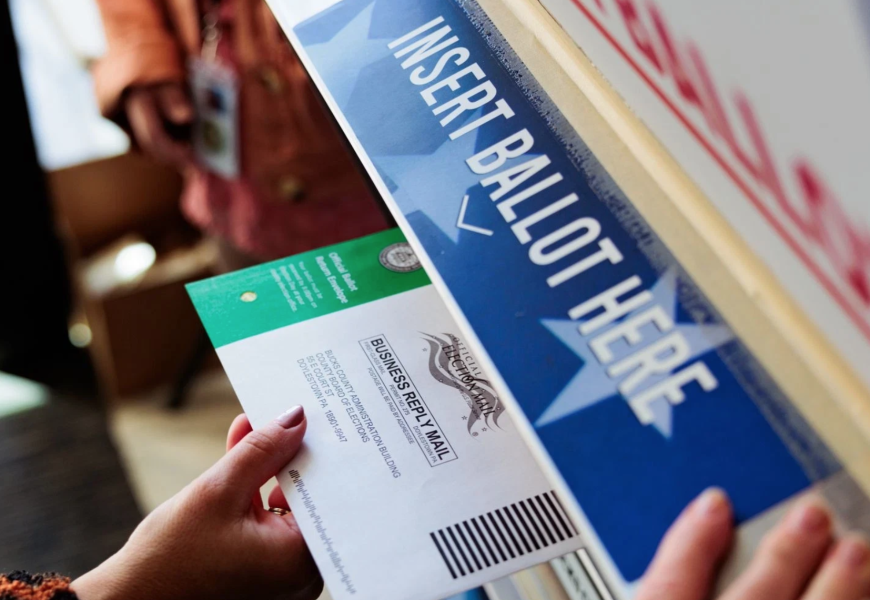
A US appeals court has rejected the Trump administration's attempt to put new rules governing mail-in voting into effect, leaving the measures blocked less than eight weeks before the November 3 midterm elections.
The First Circuit Court of Appeals in Boston ruled on Thursday against lifting an injunction imposed by a lower court last week. The US Supreme Court is separately considering a similar request from the administration.
The dispute centres on rules finalised by the US Postal Service in late August that would introduce new requirements for mail-in ballots.
Under the proposed system, states would have to redesign mail-in ballots to include unique barcodes that could be scanned, allowing the federal government to track the ballots. States would also be required to provide lists of voters who are expected to receive ballots by mail.
The Postal Service would have the authority not to transmit mail-in or absentee ballots if envelopes failed to meet the new standards or if the intended voters were not included on the submitted lists.
Voting rights organisations, including the League of Women Voters, are challenging the rules in court. They argue the changes could disenfranchise voters who depend on mail-in ballots, particularly because of the limited time available for states and election officials to adjust their systems before the election.
The Trump administration has defended the measures as necessary to strengthen election security.
In seeking to overturn the injunction, the US Department of Justice argued that the legal challenge was based on an unfounded assumption that the Postal Service intended to take control of election administration.
The department said state election officials would continue to determine who was eligible to vote by mail, while the Postal Service would be responsible only for ensuring ballot envelopes met the new design requirements.
The appeals court nevertheless declined to suspend the injunction, warning of significant confusion and disruption if the rules were implemented immediately.
The court also upheld parts of the lower court's decision, which was issued by US District Judge Indira Talwani.
The appeals court said the lower court had made detailed findings about the potential for widespread disruption and disenfranchisement before November 3.
Among the concerns was the possibility that some states would not have enough time to reprint compliant ballot envelopes. The court also pointed to the Postal Service potentially having to scan tens of millions of ballot envelopes through a digital system that was not yet operational.
The appeals court said there was no evidence before it that contradicted those findings.
Election administration is largely controlled by individual states under the US Constitution. Trump, however, has pushed for tighter voting rules, arguing they are needed to address election security and alleged fraud.
His efforts have faced strong opposition from Democrats and voting rights organisations, which argue that the changes could restrict access to the ballot and potentially influence the outcome of the midterm elections.
Republicans currently control both chambers of Congress, while Democrats are seeking to win control of the House and Senate in November.
All 50 states permit some form of mail-in voting. In 29 states, voters can request a mail ballot without providing a reason, while eight states conduct elections entirely by mail.
The legal dispute has continued for weeks, creating uncertainty for election officials and voters ahead of the midterms.
A separate lawsuit has also been brought by a coalition of 24 states and the District of Columbia.
The Supreme Court last month lifted an earlier injunction issued by Judge Talwani that had prevented the rules from taking effect. The Trump administration subsequently filed another emergency request with the high court seeking intervention.
The new Postal Service rules followed an executive order issued by Trump in March calling for tighter controls on voting by mail.
Trump has also continued to promote the unsubstantiated claim that widespread voter fraud was responsible for his defeat in the 2020 presidential election.
A whistleblower statement released on September 1 alleged that the Postal Service had rushed to implement the new requirements, resulting in a flawed system that could interfere with the delivery of mail-in ballots.
More Top Stories