

 °C
 5
Min
Questions have emerged over the role of two senior political operatives closely associated with US President Donald Trump after reports that they advised pro-Russian Bosnian Serb leader Milorad Dodik ahead of elections in Bosnia and Herzegovina.
Trump Operatives' Work for Dodik Raises Questions
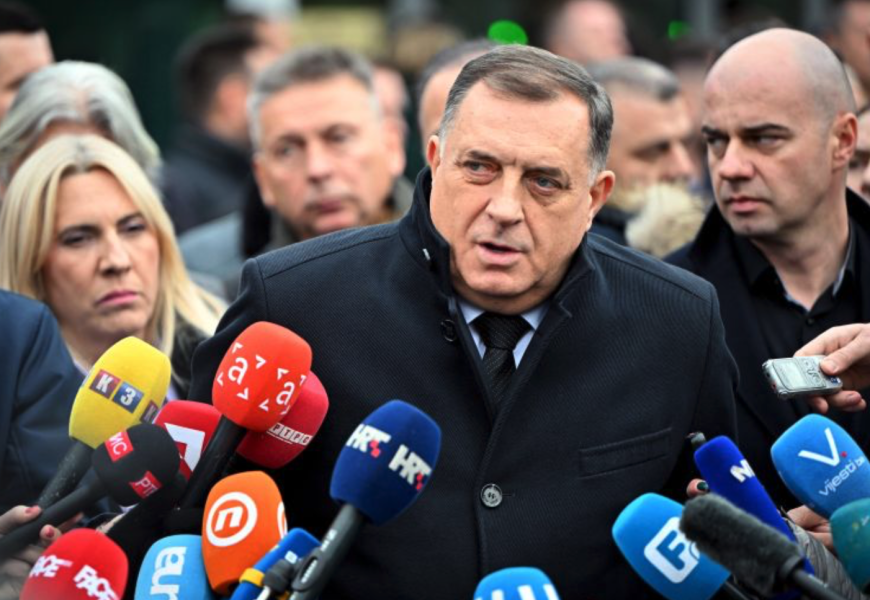
Questions have emerged over the role of two senior political operatives closely associated with US President Donald Trump after reports that they advised pro-Russian Bosnian Serb leader Milorad Dodik ahead of elections in Bosnia and Herzegovina.
James Blair and Chris LaCivita reportedly travelled to Bosnia and Herzegovina to advise Dodik and were paid hundreds of thousands of dollars for their work, according to a report by The New York Times.
The revelation has prompted criticism from some Republicans, particularly because Blair oversees Trump's principal fundraising organisation, MAGA Inc, while LaCivita remains a senior adviser to the president.
Neither Blair nor LaCivita has publicly commented on their reported work for Dodik.
Who is Milorad Dodik?
Dodik is a prominent Bosnian Serb nationalist and a longstanding political figure in Republika Srpska, the Serb-majority entity within Bosnia and Herzegovina.
He has maintained close relations with Russia and met Russian President Vladimir Putin in Moscow on September 29, only days before the Bosnian election.
Dodik was barred from formally contesting this year's election after Bosnia's highest court upheld a ban against him. The decision followed his conviction for refusing to comply with decisions made by the international official overseeing implementation of the Dayton Peace Agreement.
He was sentenced to one year in prison and banned from holding political office for six years. He was subsequently removed as president of Republika Srpska.
Despite the restrictions, Dodik remained a powerful political force. His Alliance of Independent Social Democrats (SNSD) recorded more than 55 percent of the vote in regional elections, reinforcing its control over Republika Srpska.
Dodik has been a dominant figure in the entity for decades and has repeatedly advocated greater autonomy and eventual secession from Bosnia and Herzegovina, with the stated goal of closer integration with neighbouring Serbia.
Such ambitions have raised concerns over the stability of a country still recovering from the 1992-95 war, which ended with the Dayton Peace Agreement negotiated with strong US involvement during Bill Clinton's presidency.
Dodik's relationship with Washington has changed significantly over the years. He initially gained US support as a moderate alternative to hardline Serbian nationalists, but later moved increasingly closer to Moscow.
Following Trump's return to the White House, Dodik sought to rebuild relations with Washington. He was photographed wearing a MAGA hat during the 2024 US presidential campaign.
The Trump administration subsequently lifted US sanctions against Dodik and several people associated with him, describing the decision as a pragmatic step intended to reduce tensions. Dodik, in turn, withdrew several laws deemed unconstitutional.
Why were Trump operatives advising Dodik?
The reported arrangement involved Blair and LaCivita working through a Washington law firm retained by the Republika Srpska government.
US Justice Department filings indicate that Republika Srpska has paid more than $4 million since the beginning of 2025 to lobbyists and political operatives with links to Trump.
The use of public money for international lobbying has also attracted scrutiny in Bosnia and Herzegovina. On September 25, the country's Constitutional Court ruled that lobbying activities conducted by Republika Srpska were unconstitutional because their objectives conflicted with the country's constitution, court decisions or state institutions.
Transparency International Bosnia and Herzegovina official Ivana Korajlic said the lobbying was unlikely to stop and could instead be presented under a different form.
LaCivita has previously worked overseas, including as a campaign strategist for Albanian opposition leader Sali Berisha.
Republican criticism
The involvement of Blair and LaCivita has generated criticism within Republican circles, particularly because their reported work for Dodik coincided with the final stages of campaigning for US congressional midterm elections.
Former Trump chief strategist Steve Bannon described the two operatives as "grifters" and called for scrutiny of the payments they received, according to Politico.
Trump initially said he was unaware of their other activities and said he would ask them who else they were working for. He indicated that he would dismiss them if he determined there was a conflict of interest.
Trump later said there was no conflict because Blair and LaCivita were not White House employees and were working as consultants who could have multiple clients.
What did Dodik gain?
The precise purpose and outcome of the advice provided by the Trump operatives remains unclear.
Aleksandar Trifunovic, an editor and political commentator in Banja Luka, said there was little evidence that their advice had produced a measurable change in Dodik's political strategy.
Instead, he suggested the relationship may have provided Dodik with access to Trump's political network and the ability to demonstrate that people close to the US president were working with him.
Dodik's longstanding nationalist rhetoric has also been compared with elements of Trump's political messaging.
The relationship is particularly significant because of Dodik's close ties to Putin and Moscow.
Political commentator Miljan Kovac said Trump's return to power had given Dodik greater political room after years of US sanctions.
Dodik himself highlighted the importance of Trump's political comeback following his party's election performance.
He argued that without Trump's return, his political movement might have been in a much weaker position.
The reported involvement of Trump's political operatives therefore places a renewed spotlight on the increasingly complex relationship between Washington, Dodik and Moscow - and on the role of private political consultants in international lobbying.
More Top Stories
















