°C
 5
Min
Former Bosnian Serb Army commander Ratko Mladic, convicted of genocide and other war crimes by a United Nations tribunal, has been buried in Belgrade with state and military honors, drawing condemnation from Bosnia and Herzegovina, the United States and European Union.
Mladic Buried With State Honors in Belgrade Amid International Condemnation
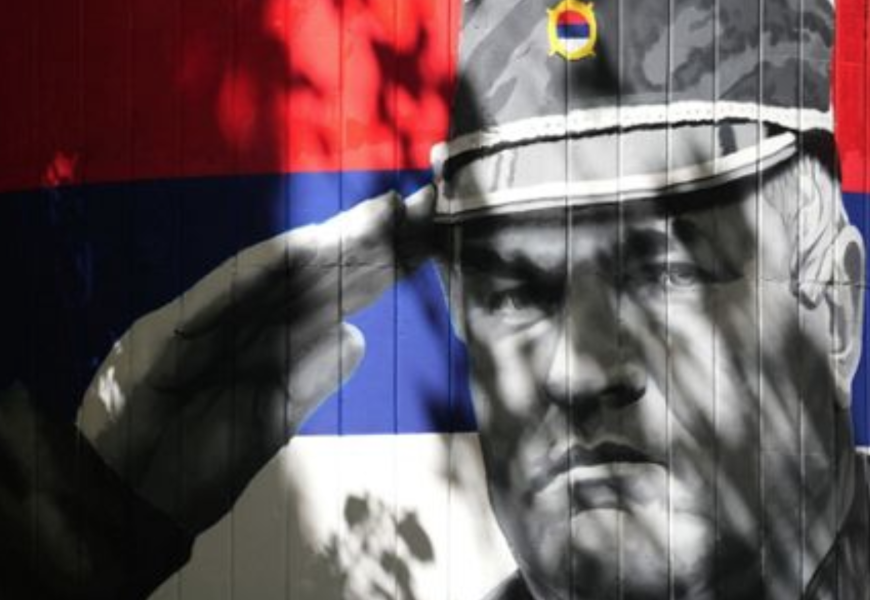
Former Bosnian Serb Army commander Ratko Mladic, convicted of genocide and other war crimes by a United Nations tribunal, has been buried in Belgrade with state and military honors, drawing condemnation from Bosnia and Herzegovina, the United States and European Union.
Mladic's coffin was carried into a Belgrade cemetery on September 7 in the presence of members of the Serbian armed forces, Serbian government officials and political leaders from Bosnia's Serb-majority Republika Srpska entity.
Some of those attending applauded the arrival of the coffin and chanted Mladic's name, while others wore clothing bearing his image or symbols associated with the 1992-95 Bosnian War.
Mladic died aged 84 on August 27 in The Hague, where he had been serving a life sentence after being convicted of genocide, crimes against humanity and violations of the laws or customs of war. His body had previously been lying in state at the Church of St Luke in Belgrade.
During the funeral service, Serbian Orthodox Church Patriarch Porfirije said Mladic's name would remain part of the memory and prayers of many Serbian Orthodox people.
A prayer was also offered asking that "General Ratko" be forgiven for his sins, while members of the Serbian armed forces stood as an honor guard. Veterans of the former Bosnian Serb Army took turns standing beside the coffin.
Thousands of mourners gathered outside the church, with four buses carrying former Bosnian Serb Army members traveling to Belgrade from Banja Luka. The trip was organised by the Republika Srpska Veterans Organization.
Several senior Serbian officials attended the funeral, including Culture Minister Nikola Selakovic, Public Investment Minister Darko Glisic, Defense Minister Bratislav Gasic and Justice Minister Nenad Vujic.
Serbian President Aleksandar Vucic did not attend, saying he was hosting Uzbekistan's President Shavkat Mirziyoev in Belgrade.
Also present were Zeljka Cvijanovic, the Serb member of Bosnia and Herzegovina's tripartite presidency, and former Republika Srpska leader Milorad Dodik. Russian Ambassador to Serbia Aleksandr Botsan-Kharchenko also attended with a delegation.
Security was tight around the ceremony, with nearby roads closed and police deployed. Journalists and television crews gathered outside the church but were prevented from entering the restricted area.
A Controversial Legacy
Mladic became commander of the Bosnian Serb Army in 1992 and oversaw military operations during the Bosnian War. His forces besieged Sarajevo and were responsible for the 1995 Srebrenica massacre, in which more than 8,000 Bosniak men and boys were killed.
The International Criminal Tribunal for the former Yugoslavia convicted Mladic in 2017 of genocide, crimes against humanity and war crimes. His convictions were upheld on appeal.
For relatives of those killed at Srebrenica, the decision to give Mladic state and military honors was deeply painful.
Fazila Efendic, president of the Mothers of Srebrenica association, said Mladic had been buried as though he were a statesman. Efendic lost her son, husband and 22 other relatives during the massacre.
She described the funeral as a reflection of Serbia's attitude towards Mladic and his legacy.
Bosnia and Herzegovina's Foreign Minister Elmedin Konakovic announced that the country would downgrade diplomatic relations with Serbia and recall most of its diplomatic personnel from its embassy in Belgrade.
Konakovic cited the funeral, commemorations following Mladic's death and public statements made in his honour.
"If I could, I would sever diplomatic relations with Serbia today," Konakovic said, adding that he would work to reduce relations to the lowest possible level.
Mladic's death has prompted further public displays of support across Serbia and Republika Srpska. A banner describing him as a "hero" appeared near the Church of St Luke, while supporters of Belgrade football club Red Star displayed a large image of Mladic alongside the words "Direction Potocari".
Potocari, near Srebrenica, was the location of a United Nations base where thousands of civilians sought refuge during the 1995 massacre. Bosnian Serb forces subsequently separated men and boys from women and children. The site is now home to the Srebrenica Genocide Memorial.
Western Condemnation
The decision to honor Mladic has triggered strong criticism from Western governments and officials.
Bosnia's Presidency Chairman Denis Becirovic said the tribunal's judgment placed Mladic among the most brutal killers of the 20th century. He condemned the Serbian government's decision to provide state and military honors, describing it as institutional glorification of a convicted war criminal and an insult to the victims of Srebrenica.
US Senators Jeanne Shaheen, Chuck Grassley and Keith Self also urged Serbia and Republika Srpska authorities to distance themselves from the funeral.
They said the decision to provide state and military honors would test whether Serbia and Republika Srpska were prepared to confront their past and continue moving towards European integration.
EU Enlargement Commissioner Marta Kos canceled a planned visit to Serbia after Mladic's body was transported to Belgrade on a government aircraft and received by soldiers carrying his Serbian flag-draped coffin.
The European Union's diplomatic service said the glorification of convicted war criminals, denial of genocide and historical revisionism were incompatible with European values and had no place in EU member states or candidate countries.
The United States also highlighted the victims of the Srebrenica genocide, with US lawmakers visiting the memorial site to pay tribute to those killed in 1995.
Serbia remains an official candidate for European Union membership, making its handling of Mladic's legacy an increasingly sensitive issue in its relationship with Brussels and neighbouring Bosnia and Herzegovina.
More Top Stories