

 °C
 5
Min
A television scene showing a father preparing a family meal has sparked speculation about Kim Jong Un's daughter becoming his successor, but analysts warn against reading too much into the footage.
Could 'Apron Dad' TV Scene Help Prepare North Korea for Female Leader?
A television scene showing a father preparing a family meal has sparked speculation about Kim Jong Un's daughter becoming his successor, but analysts warn against reading too much into the footage.
A scene from a North Korean television drama showing a man wearing a floral apron and serving food to his family has prompted debate over whether state media is helping prepare the public for the possibility of the country's first female leader.
The footage, which circulated widely on social media, shows a father bringing a tray of food from the kitchen while his wife thanks him for his efforts and helps untie his apron.
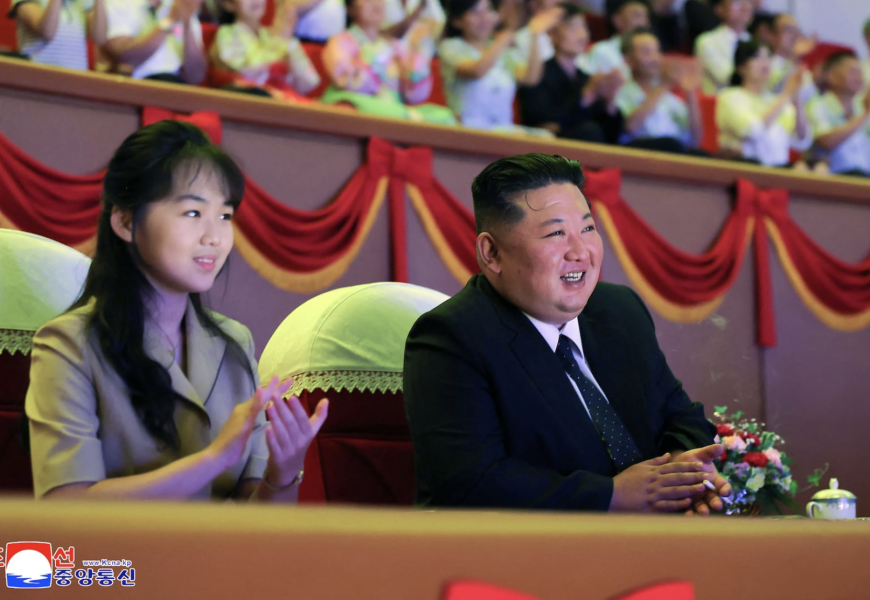
Some observers believe the portrayal could form part of a broader propaganda strategy designed to make North Koreans more accepting of women in positions of authority, potentially paving the way for leader Kim Jong Un's daughter, Ju Ae, to succeed him.
However, experts caution that the scene does not necessarily signal a shift in official policy on gender roles or indicate that authorities are deliberately preparing the population for female leadership.
The discussion gained momentum on X, where Korean-speaking users shared clips and commentary suggesting North Korean television was increasingly depicting working mothers and fathers participating in household duties. One post discussing the broader theory attracted 4.3 million views, while the video of the scene from the drama A New Spring in the Plains of Baekhak received 2.4 million views.
North Korea has made no official announcement naming a successor to Kim Jong Un. However, South Korea's National Intelligence Service reportedly told lawmakers on September 1 that Ju Ae appeared to have reached the stage of being designated as her father's successor.
Yoshihiro Makino, a foreign affairs specialist with Japan's Asahi Shimbun newspaper and visiting professor at Hiroshima University, said state television could potentially be used to support preparations for a succession.
In North Korea, television serves as an important instrument of political propaganda rather than simply a source of entertainment, he said.
However, Makino suggested any effort to influence public perceptions of women's leadership would be aimed specifically at facilitating Ju Ae's succession, rather than improving the position of ordinary women.
Rachel Minyoung Lee, a senior researcher at the Washington-based Stimson Center who studies North Korean state media, said linking the television scene directly to succession planning could be premature.
She noted that North Korean dramas had included scenes of men preparing or serving family meals since at least the mid-2010s, well before speculation about Ju Ae's future role intensified.
Whether the latest portrayal reflects a deliberate government effort to normalise men taking on domestic responsibilities remains unclear.
Kim Su Kyong, a North Korean escapee from the northeastern port city of Chongjin who now lives in Virginia, said such scenes were unlikely to change deeply entrenched attitudes.
She argued that watching a male character set the table or prepare food would not necessarily persuade North Koreans to reconsider traditional expectations about household responsibilities.
Deep-rooted patriarchy remains
The prospect of a woman leading North Korea could encounter significant resistance because male-dominated attitudes remain deeply embedded in the country's society, Kim Su Kyong said.
She suggested that some North Koreans might privately resent Ju Ae becoming leader, although fear of punishment or denunciation could prevent them from expressing their views openly.
Women have held prominent positions within the North Korean leadership, but analysts say their advancement does not necessarily reflect broader improvements in women's status.
Kim Jong Un's sister, Kim Yo Jong, holds a senior position in the ruling Workers' Party and has previously been widely discussed as a possible successor. Foreign Minister Choe Son Hui is another prominent woman in the country's political establishment.
Lee said such figures had benefited from privileged backgrounds and access to the leadership.
Their presence in senior positions, she argued, should not be interpreted as evidence that women generally enjoy greater political influence or social standing. Men continue to dominate the country's senior leadership.
Makino similarly noted that, although women work in sectors such as healthcare and education, men generally retain positions of greater responsibility.
The Korea Institute for National Unification, based in Seoul, reported in its 2025 North Korean Human Rights White Paper that women had gained some economic influence through the growth of the country's emerging market economy.
Nevertheless, the report found that women continued to face inequality in politics and public life.
Conflicting messages on equality
North Korea's official messaging on women's rights has also reflected a tension between its socialist ideology and its conservative social traditions.
To mark the 80th anniversary of founder Kim Il Sung's July 30, 1946, decree on gender equality, the state-run newspaper Rodong Sinmun published an article claiming that North Korean women had participated in the country's revolutionary development on equal terms with men for eight decades.
Yet only two weeks earlier, Kim Jong Un had addressed newly elected leaders of the Socialist Women's Union, emphasising women's responsibilities as mothers and educators.
He called on women to contribute to the country's prosperity by raising children and fostering communist values.
Lee said the apparent contradiction reflected the combination of conservative cultural expectations and the government's ideological commitment to socialism, which formally promotes gender equality.
The debate surrounding the television scene therefore highlights a wider question about North Korea's future: whether the possible elevation of Ju Ae would represent a genuine shift in attitudes towards women or simply another example of political privilege within the country's ruling family.
For now, analysts say the footage provides insufficient evidence to establish a direct connection between domestic scenes on television and plans for the country's next leader.
More Top Stories
















