

 °C
 4
Min
An attack on King Khalid International Airport in Saudi Arabia's capital, Riyadh, has killed 12 people and injured 309 others, according to the country's Civil Aviation Authority, raising fears of further escalation across the Gulf region.
12 Killed, 309 Injured in Riyadh Airport Attack
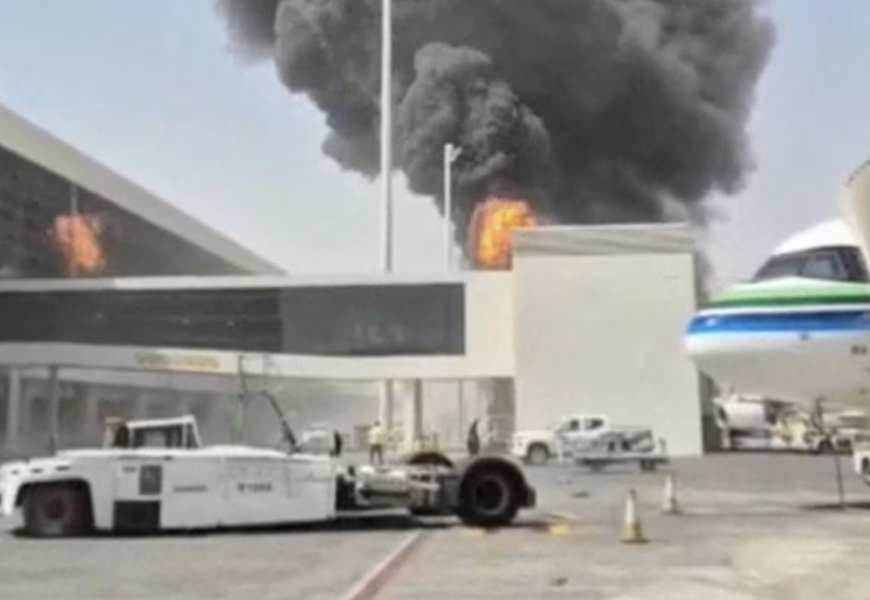
An attack on King Khalid International Airport in Saudi Arabia's capital, Riyadh, has killed 12 people and injured 309 others, according to the country's Civil Aviation Authority, raising fears of further escalation across the Gulf region.
The authority said on Saturday that the victims included four Saudi nationals, two Bangladeshi nationals, and one citizen each from the United States, Egypt, Jordan, Syria, Palestine and Sudan.
The attack has prompted condemnation from regional governments and renewed concerns about the widening conflict involving Yemen's Houthi movement and Saudi Arabia.
Airport operations were temporarily suspended following reports of an explosion, with flights diverted to other airports, including Jeddah. The incident marks the third reported attack on King Khalid International Airport in the space of a week.
US President Donald Trump said he would "take a look" at the possibility of joining Saudi Arabia in military action against the Houthis, while also raising the prospect of renewed strikes on Iran.
The latest developments have heightened concerns that the conflict could spread further across the Gulf Cooperation Council (GCC), a regional bloc that includes Saudi Arabia, Qatar and four other Gulf states.
Regional governments condemn attack
Qatar strongly condemned the reported Houthi attack, describing it as a serious violation of Saudi sovereignty and a direct threat to regional security.
In a statement published on social media, Qatar's Ministry of Foreign Affairs said the attacks endangered civilians, civilian infrastructure and air navigation.
The ministry also stressed that Saudi Arabia's security was an integral part of Qatar's own security and the collective security of the GCC.
Egypt also condemned the attack, describing it as a flagrant violation of international law and expressing concern about the disregard for civilian safety.
Egypt said it stood alongside Saudi Arabia in confronting the attacks and supported measures taken by Riyadh to protect its sovereignty, national security and citizens.
Concerns over further airport attacks
The latest incident follows warnings that Saudi airports could remain targets amid the escalating conflict.
Analysts following the Houthi movement, also known as Ansar Allah, have identified King Khalid International Airport and other Saudi airports, including facilities in Abha, Jazan and Najran, as potential targets.
Houthi military spokesman Yahya Saree has previously indicated that certain airports associated with Islam's holiest sites would be excluded from planned attacks.
The movement's stated objective, according to previous remarks cited by analysts, is to disrupt air traffic into Saudi Arabia and retaliate against military operations targeting Houthi positions and missile-launch sites.
Saudi Arabia and its allies have continued strikes against Houthi targets as the conflict intensifies.
Calls for Gulf unity
Former Qatari prime minister Hamad bin Jassim bin Jaber Al Thani said the attack demonstrated the growing urgency of regional cooperation with Saudi Arabia.
In a post on social media, Al Thani called for Gulf states to put aside their differences and respond collectively to what he described as mounting threats to regional security.
He argued that the GCC needed greater unity and strategic coordination in confronting threats linked to the conflict in Yemen.
Al Thani served as Qatar's prime minister from 2007 to 2013 and also held the foreign affairs portfolio for much of that period.
Airline suspends Saudi services
India's Akasa Air has extended the suspension of all flights to Saudi Arabia until October 13, citing the continuing security situation.
The airline had already halted services following missile attacks on Saudi airports earlier in the week.
The suspension highlights the potential impact of the conflict on commercial aviation, passenger travel and regional transport links.
International conference faces uncertainty
The attack also comes as Saudi Arabia prepares to host the World Petroleum Congress, an international gathering expected to attract ministers and senior executives from dozens of companies.
The latest security developments have raised questions about the potential disruption to travel and major events as authorities assess the situation.
With further attacks feared and military operations continuing, governments across the Gulf face mounting pressure to prevent the conflict from spreading.
The latest violence has intensified calls for regional coordination, while uncertainty over possible additional US military involvement adds another dimension to an increasingly volatile security situation.
More Top Stories
















