°C
 4
Min
Residents of the Russian-occupied Ukrainian city of Oleshky are reportedly facing severe shortages of food, water, medicine and electricity, with Ukrainian officials and humanitarian workers warning that those remaining may be running out of ways to survive or escape.
Oleshky residents face starvation under blockade
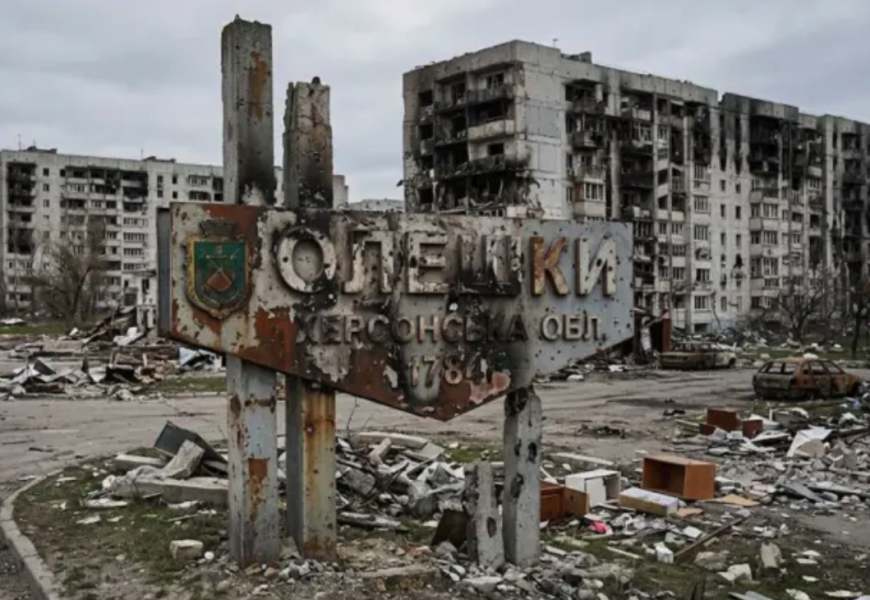
Residents of the Russian-occupied Ukrainian city of Oleshky are reportedly facing severe shortages of food, water, medicine and electricity, with Ukrainian officials and humanitarian workers warning that those remaining may be running out of ways to survive or escape.
Messages from residents sent to the relocated Ukrainian administration describe people eating only once a day and rationing whatever food remains.
One resident reportedly listed a beetroot, five potatoes, an onion, a zucchini, a tomato and a small amount of barley before writing: "We're preparing our last borshch."
Another message said: "We eat once a day. We'll die this autumn for sure. I'm dying already, weakening with each day."
Oleshky, in the southern Kherson region, has been under Russian occupation since the early stages of Moscow's full-scale invasion in February 2022. The city is less than 10 kilometres from Kherson, across the Dnieper River, after Ukrainian forces retook the regional capital in late 2022.
The city, once home to about 24,000 people, has suffered extensive damage during the war and the population has fallen sharply. Ukrainian volunteer Iryna-Ester Vratareva said fewer than 2,000 people remained by the end of September, including about 50 children.
The humanitarian crisis was compounded by the destruction of the Kakhovka Dam in June 2023, which caused catastrophic flooding across parts of the Kherson region. Ukrainian authorities blamed Russian forces, who controlled the dam at the time, while Russia has rejected Ukrainian responsibility for the disaster.
Oleshky was almost completely submerged by the resulting floodwaters. Ukrainian estimates have put the number of people who died in the city at about 500, with thousands more reported missing.
Food and medical shortages deepen
Ukrainian officials say supplies have become increasingly scarce, with the last deliveries from the Russian-controlled side reportedly arriving about four months ago.
Vratareva said residents were surviving on extremely limited amounts of food, sometimes consuming little more than clear soup and a few spoonfuls of porridge in a day.
Local officials have also reported residents collecting rainwater and melting snow for household use, while some people have reportedly hunted pheasants and caught pigeons for food.
Tetyana Hasanenko, head of the Oleshky military administration, has alleged that there have been cases of people eating dogs. She has also described reports of dogs feeding on the bodies of people who died.
The city's hospital reportedly remains open despite shortages of electricity and fuel. Hasanenko said the basement was being used to store bodies.
The approaching winter has raised further concerns. Volunteer Ksenia Archypova said elderly residents endured freezing conditions last winter, with temperatures inside some homes falling to about 3 degrees Celsius.
Calls for evacuation
Ukraine's human rights ombudsman, Dmytro Lubinets, said Kyiv had sought to establish a humanitarian corridor from Oleshky to Ukrainian-controlled territory but that Russia had not agreed to the proposal.
Lubinets said in September that at least 358 people required immediate evacuation.
Ukrainian Foreign Minister Andriy Sybiha also appealed for humanitarian corridors during a speech at the United Nations General Assembly, urging international attention to the situation.
The Kremlin has acknowledged problems with food and medicine deliveries but has blamed Ukraine for the deteriorating conditions, arguing that Ukrainian military activity threatens supply routes. Kremlin spokesman Dmitry Peskov said Russian forces were working to address the situation.
Ukrainian officials and aid workers have disputed that explanation. Kherson regional military administration chief Oleksandr Prokudin alleged that some residents who received food had been detained and beaten by Russian forces. He also alleged cases of sexual violence involving aid recipients.
Those allegations could not be independently verified.
Ukraine has attempted to use drones to deliver food and other supplies to Oleshky. Ukrainian forces said one recent operation reached about 100 households. Yuriy Boyechko, chief executive of the US-based humanitarian organisation Hope for Ukraine, said Russian forces had deliberately targeted drones being used for deliveries.
Military analysts have also described Oleshky as strategically important because of its proximity to Ukrainian-held territory around Kherson.
For Ukrainian humanitarian workers, however, the immediate concern is the survival of civilians trapped in the city.
Vratareva said residents were facing severe restrictions on movement and that some had risked crossing minefields in attempts to escape.
With food stocks reportedly running low and another winter approaching, Ukrainian officials and volunteers are calling for an evacuation mechanism that would allow vulnerable residents to leave the occupied city.
More Top Stories